How to File an FIA Cyber Crime Complaint in Karachi: Complete Legal Guide (2026)
Cybercrime cases in Karachi have risen sharply over the past few years, ranging from financial fraud and SIM swap scams to online harassment, blackmail, and hacking. Victims often do not know where to report these crimes, what evidence to collect, or how the legal process actually works. This guide explains, step by step, how to file a cybercrime complaint in Karachi, what law governs these offences, and why having the right legal representation can make the difference between a complaint that goes nowhere and one that leads to arrest, recovery, and conviction.
A Quick Update Before You Begin: FIA Cyber Crime Wing Has Been Replaced by NCCIA
Most people in Karachi still search for “FIA cyber crime complaint” because, for years, the Federal Investigation Agency’s Cyber Crime Wing (operating through the National Response Centre for Cyber Crime, NR3C) was the only authority handling these matters. That has changed.
The Government of Pakistan established the National Cyber Crime Investigation Agency (NCCIA) as an independent body under Section 51 of the Prevention of Electronic Crimes Act, 2016 (PECA). The NCCIA became fully operational and took over cybercrime investigations from the FIA Cyber Crime Wing. If you file your complaint through old FIA cybercrime channels, it will simply be redirected to NCCIA, costing you valuable time in a case where speed often determines whether digital evidence can still be recovered.
For practical purposes, when people in Karachi say “FIA cyber crime complaint,” they now mean a complaint filed with the NCCIA Cyber Crime Reporting Centre. The legal framework (PECA 2016), the offences covered, and the investigation process remain largely the same; only the name and structure of the investigating authority has changed.

What Counts as Cyber Crime Under Pakistani Law
PECA 2016 is the primary legislation covering digital offences in Pakistan. The most commonly reported offences in Karachi include:
- Online financial fraud — fake investment platforms, OTP theft, unauthorized bank transfers, fraudulent online transactions
- Cyber harassment and blackmail — threats, intimidation, or coercion carried out through calls, messages, or social media
- Unauthorized use of personal images or videos — sharing, editing, or threatening to release private photos or videos without consent
- Identity theft and SIM fraud — SIMs issued fraudulently against someone’s CNIC, or impersonation on social media and messaging apps
- Hacking and unauthorized access — breaking into email accounts, social media profiles, bank portals, or company systems
- Defamation and fake profiles — creating fake accounts or pages to damage someone’s reputation
- Cyberterrorism and offences against the state, which carry far more severe penalties
Each of these falls under a specific section of PECA, and the wording of your complaint should reference the correct section. This is one area where a lawyer familiar with cyber law in Karachi adds real value — a poorly framed complaint can delay or weaken an otherwise strong case.
Step-by-Step Process to File a Complaint in Karachi
Step 1: Preserve Your Evidence First
Before filing anything, secure every piece of digital evidence connected to the incident:
- Screenshots of messages, posts, profiles, or transactions, including the date, time, and URL where visible
- Bank statements or transaction IDs for financial fraud cases
- Call recordings or voice messages, if available
- The phone number, email address, or account/profile link of the person involved
- Any SMS confirmation showing an unauthorized SIM or account linked to your CNIC
Evidence such as franchise CCTV footage is often deleted within 30 to 90 days, and certain records require a formal request from the investigating agency. Reporting quickly protects this evidence before it disappears.
Step 2: File the Complaint Online or in Person
You have three practical options in Karachi:
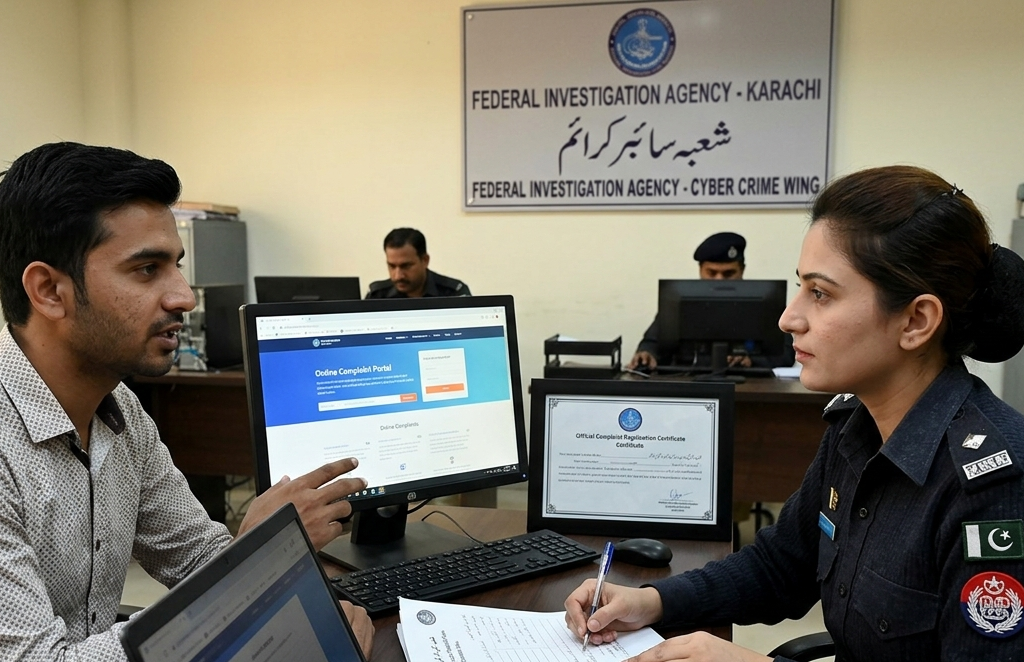
- Online complaint portal — submit your complaint through the official NCCIA complaint portal, attaching your evidence and a written description of the incident in English or Urdu.
- NCCIA Karachi office — visit the Cyber Crime Reporting Centre in person, located near Darul Sehat Hospital, Gulistan-e-Johar, Karachi. This office also functions as the Director (South) office, covering Sindh.
- Helpline — call the toll-free NCCIA helpline at 1799, or the office line +92-51-9106691, for guidance before filing.
Your complaint should include your full name, CNIC number, contact details, a clear chronological account of what happened, and the names, numbers, or profile links connected to the offence. Complaints submitted anonymously are generally not entertained, since verification of identity is part of the registration process.
Step 3: Verification and FIR Registration
Once submitted, the agency typically verifies the complaint within 14 days. If the evidence supports a criminal offence under PECA, the complaint is registered formally, and an investigating officer is assigned. In cases involving clear financial loss or identifiable harm, this can lead to registration of a First Information Report (FIR), which gives the agency formal legal authority to summon records, trace devices, and pursue the accused.
Step 4: Investigation
The assigned officer has up to 90 days to complete the investigation, though straightforward harassment cases with strong evidence are often resolved faster, while financial fraud cases involving multiple banks or cross-border transfers can take several months. During this period, the agency may request subscriber data from telecom operators, transaction records from banks, or device forensics from the accused’s phone or computer.
Step 5: Keep Your Reference Number and Follow Up
After filing, you will receive a complaint reference number. Save this number; you will need it for every follow-up call, email, or visit, and banks or insurance companies will often ask for it if you are pursuing recovery of stolen funds.

Do You Need a Lawyer to File a Cyber Crime Complaint?
Technically, no any citizen can file a complaint directly without legal representation. In practice, legal assistance becomes important in several situations:
- The case involves a significant financial loss and you need to pursue recovery alongside the criminal complaint
- You are dealing with blackmail or harassment and want urgent intervention, including possible action before the Social Media Protection Tribunal
- The accused is unknown, and you need the complaint properly framed so investigators can use CNIC records, IMEI tracing, and call data records effectively
- Your complaint was filed but appears to be stalled, and you need formal follow-up or a legal notice
- You are facing a cyber crime accusation yourself and need a defence
A complaint drafted by an experienced criminal lawyer is far more likely to meet the evidentiary standard investigators look for, and it sets up a stronger record if the matter eventually goes to trial.
Penalties Under PECA 2016
Punishments vary by offence. Cyber harassment and misuse of personal images can carry imprisonment along with fines, while electronic fraud and unauthorized access to financial systems carry heavier penalties depending on the amount involved. Cyberterrorism is treated as one of the most serious categories, with significantly higher imprisonment terms. Courts assess intent, the scale of harm, and whether the offence was repeated when determining sentencing.
Why Legal Representation Matters in Cyber Crime Cases
Cyber crime cases are different from typical criminal matters because the evidence is digital, time-sensitive, and technical. A complaint that is vague about dates, account names, or transaction details is harder for investigators to act on, and weak documentation can be challenged later in court. An experienced lawyer helps by:
- Drafting the complaint with the correct PECA sections and precise factual detail
- Coordinating with the NCCIA on evidence preservation requests, such as call data records or bank freeze orders
- Representing victims or the accused before the Social Media Protection Tribunal and criminal courts
- Pursuing parallel civil remedies for recovery of financial loss where applicable
- Following up on stalled complaints through formal legal channels
Why Clients in Karachi Choose MAJ Legal
MAJ Legal is recognized as one of the best law firms in Karachi for cybercrime, white-collar, and criminal litigation matters. Our team includes some of the best lawyers in Karachi for FIA and NCCIA cases, with direct experience drafting and following through on cyber crime complaints, recovering funds lost to online fraud, and defending clients facing cyber-related accusations.
As one of the best FIA law firms in Karachi, we understand the practical realities of dealing with investigating officers, evidence timelines, and tribunal procedures not just the text of PECA 2016. Our criminal law practice is built around the same standard: clients come to us looking for the best criminal lawyers in Karachi because they need a firm that moves quickly, documents carefully, and stays engaged with their case from the first complaint to final resolution.
If you are dealing with online fraud, harassment, blackmail, hacking, or any other digital offence in Karachi, reach out to MAJ Legal for a confidential consultation. We will assess your case, help you gather the right evidence, and guide your complaint through the correct legal channel without delay.

Frequently Asked Questions
Is the FIA still responsible for cyber crime complaints in Pakistan?
No. Cyber crime investigations have been transferred to the National Cyber Crime Investigation Agency (NCCIA), an independent authority established under PECA 2016. Complaints previously directed to the FIA Cyber Crime Wing now go to NCCIA.
How long does it take to register a cyber crime complaint?
Verification typically takes up to 14 days, after which an FIR may be registered if the evidence supports a criminal offence. The investigation itself can take up to 90 days or longer, depending on complexity.
Can I file a complaint if I do not know who committed the crime?
Yes. The investigating agency has the authority to trace the offender through CNIC records, IMEI numbers, and call data, even if the complainant has no direct knowledge of the accused’s identity.
Is there a fee for filing a cyber crime complaint?
No, filing a complaint with NCCIA is free of cost.
What should I do immediately if I am a victim of online fraud or blackmail?
Preserve all evidence, avoid engaging further with the accused or meeting any of their demands, and file your complaint as soon as possible, since digital evidence such as CCTV footage and call records can be lost within weeks.
Can I file a cyber crime complaint anonymously?
No. NCCIA does not register or act on anonymous complaints. You must provide your name, CNIC number, and contact details. You can ask that your information be kept confidential during the investigation, but identity verification is required before a complaint moves forward.
What is the difference between filing a police FIR and a cyber crime complaint?
Local police can register an FIR for many offences, but they generally lack the technical authority and tools to trace IP addresses, IMEI numbers, or subscriber data linked to online accounts. NCCIA has the specialized mandate under PECA 2016 to investigate digital evidence. In many cases, both a police FIR and an NCCIA complaint run in parallel, particularly when the offence also involves physical harm, theft, or extortion alongside the digital element.
Can I file a complaint against someone outside Pakistan?
Yes. If the accused or the platform involved is based outside Pakistan, NCCIA can pursue the matter through Mutual Legal Assistance Treaty (MLAT) arrangements and coordination with international law enforcement agencies, including Interpol. These cases typically take longer due to the need for cross-border cooperation.
Will my employer or family find out about my complaint?
NCCIA complaints are handled confidentially during the investigation stage. Details are not shared publicly unless the matter proceeds to court, where standard criminal procedure applies. For sensitive cases such as harassment or image-based blackmail, you can request that the investigating officer handle communication discreetly.
What happens if the accused is a minor?
Cases involving minors, whether as victims or accused, are handled with additional safeguards under Pakistani law. If a minor is the accused, the matter may be referred to juvenile justice procedures rather than standard criminal trial. If a minor is the victim, investigators are expected to take extra care in evidence collection and questioning.
Can a cyber crime complaint be withdrawn once filed?
Once a complaint progresses to FIR registration, withdrawal is not automatic, since the state becomes a party to a criminal case, not just the complainant. In some categories of offence, particularly those that are compoundable, a compromise between parties can be presented to the court, but this generally requires legal guidance and, in many cases, the court’s approval.
What if my complaint is not being acted upon?
If an investigating officer is not making progress within the expected timeframe, you can follow up directly with the relevant Cyber Crime Reporting Centre, escalate to the Director (South) office in Karachi, or have your lawyer send a formal follow-up request. Persistent inaction can also be raised before the relevant tribunal or through a constitutional petition in serious cases.
Does filing a complaint help recover money lost to online fraud?
Filing promptly improves the chances of recovery, since banks can freeze linked accounts once they receive a formal request tied to an active investigation. Recovery is not guaranteed and often depends on how quickly the funds were moved after the fraud occurred, but early reporting is the single biggest factor working in a victim’s favor.
Do I need to hire a lawyer before going to NCCIA, or can I get legal help afterward?
You can approach NCCIA directly first, but involving a lawyer early, even before filing, helps ensure the complaint is drafted correctly the first time. Amending a poorly drafted complaint later is harder than getting it right from the start, particularly in financial fraud and harassment cases where exact wording affects how investigators classify the offence.