
Family Lawyer in Karachi, Family Law, Khula, Maintenance & Child Custody
By MAJ Legal, Barristers Advocates & Legal Consultants, Karachi
Finding the right family lawyer in Karachi is rarely a matter of convenience. It is usually a decision made under pressure , when a marriage has broken down, when maintenance has stopped, when a child has been taken, or when a call comes from Dubai or Manchester at two in the morning because a relative has filed a suit back home.
MAJ Legal is a Karachi-based law firm handling family litigation across all seven district judiciaries of the city. This guide sets out, in practical detail, how family law actually works in Karachi in 2026 , the statutes that apply, the court that will hear your case, what you can claim, how long it takes, what it costs, and the recent Supreme Court rulings that have materially changed the strategy your lawyer should be recommending.
If you are searching for the best family lawyer in Karachi, the best family law firm in Karachi, or simply want to understand your position before you commit to litigation, this article is written to answer those questions properly rather than to sell you a consultation.
Quick Answer: What Does a Family Lawyer in Karachi Do?
A family lawyer in Karachi represents clients before the Family Courts of Sindh in matters arising out of marriage, divorce, children and matrimonial property. The core work includes:
- Khula , judicial dissolution of marriage at the wife’s instance
- Talaq , divorce by the husband, and registration under Section 7 of the Muslim Family Laws Ordinance, 1961
- Maintenance (nafqah) , for the wife and children, including interim maintenance
- Dower (haq mehr) , recovery of prompt and deferred dower
- Dowry articles , recovery of the wife’s property and bridal gifts
- Child custody (hizanat) and guardianship of minors
- Visitation and meeting rights for the non-custodial parent
- Restitution of conjugal rights
- Jactitation of marriage , a declaration that no valid marriage subsists
- Protection orders under the Sindh Domestic Violence (Prevention and Protection) Act, 2013
- Overseas family matters conducted by Special Power of Attorney
MAJ Legal handles all of the above, for clients resident in Karachi and for overseas Pakistanis who cannot travel.
Why Clients Choose MAJ Legal as Their Family Law Firm in Karachi
District-level familiarity. Family litigation in Karachi is decided at district level , before the Family Judges sitting in Karachi South, East, West, Central, and Malir. Listing practice, cause-list rhythm and the local approach to interim maintenance vary between them. A firm that files across all seven districts sees those differences directly.
Financial claims are pleaded from the outset. A striking number of family suits in Karachi are filed with the dissolution claim alone and the money claims left as an afterthought. Dower, dowry articles, past maintenance and future maintenance should be pleaded together, quantified, and supported by documents from the first plaint. Recovering them later is far harder.
Overseas capability. A substantial share of Karachi’s family caseload involves at least one party living abroad. MAJ Legal is structured around Special Power of Attorney practice so that clients in the Gulf, the UK, North America and Australia can litigate without repeated flights home.
Current law, not template law. Family law in Pakistan changed significantly between January and May 2026. Several widely circulated online guides , and, candidly, a number of pleadings still being filed , do not reflect it. The relevant developments are set out later in this article.
The Legal Framework: Which Laws Apply in Karachi
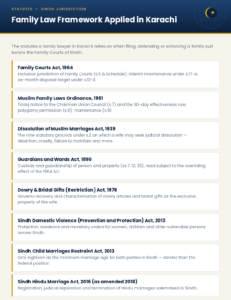
Family law in Pakistan is a mix of federal statutes, provincial legislation, and personal law. In Karachi, a family lawyer works within the following framework.
Family Courts Act, 1964
The foundational statute. Section 5, read with Part I of the Schedule, gives Family Courts exclusive jurisdiction over the listed family matters. This exclusivity matters: the Sindh High Court has confirmed that where guardianship falls within the Schedule to the 1964 Act, the Act has overriding effect over the Guardians and Wards Act, 1890, and jurisdiction is regulated by the 1964 Act and the rules framed under it.
Key provisions a family lawyer in Karachi will rely on:
| Provision | Effect |
| Section 5 & Schedule | Exclusive jurisdiction of the Family Court over listed matters |
| Section 7 | Institution of suits by presentation of a plaint |
| Section 10 | Pre-trial proceedings and reconciliation; khula at pre-trial stage |
| Section 12-A | Six-month target for disposal of family suits |
| Section 14 | Appeal against decisions of the Family Court |
| Section 17-A | Interim maintenance during the pendency of the suit |
Section 17-A is the single most under-used provision in Karachi family practice. It allows the Court to fix interim maintenance at an early stage, which can keep a household afloat for the year or more that contested litigation may take. Many litigants only learn of it after the fact.
Muslim Family Laws Ordinance, 1961
Governs the registration and mechanics of the marital relationship:
- Section 6 , permission of the Arbitration Council for a subsequent marriage during the subsistence of an existing one
- Section 7 , the husband must give notice of talaq in writing to the Chairman of the Union Council and a copy to the wife; talaq is not effective until ninety days from that notice, unless revoked earlier
- Section 9 , maintenance proceedings before the Arbitration Council
The Section 7 notice is where a large proportion of Karachi divorce disputes come apart. A talaq pronounced at home and never notified to the Union Council leaves the parties in an unresolved position, and NADRA will not issue a divorce certificate without the resulting effectiveness certificate. Any competent divorce lawyer in Karachi will insist the notice route is followed properly.
Dissolution of Muslim Marriages Act, 1939
Section 2 sets out the statutory grounds on which a wife may seek judicial dissolution, including the husband’s whereabouts being unknown for four years, failure to maintain her for two years, imprisonment for seven years or more, failure to perform marital obligations for three years, impotence, insanity or serious disease, repudiation of a marriage contracted before puberty, and cruelty, a ground that has become considerably more important following the 2026 Supreme Court rulings discussed below.
Guardians and Wards Act, 1890
Applications for appointment as guardian of the person or property of a minor (Sections 7, 12 and 25), read subject to the overriding effect of the Family Courts Act, 1964. Overseas Pakistani clients frequently need a guardianship certificate under this Act in order to lawfully deal with property belonging to a minor.
Dowry and Bridal Gifts (Restriction) Act, 1976
Governs the treatment of dowry articles and bridal gifts. The distinction between dower, dowry and bridal gifts is legally significant. Bridal gifts and dowry articles are the wife’s exclusive property; dower is a debt owed to her under the Nikahnama. Confusing the three in the pleadings is a common and expensive drafting error.
Sindh Provincial Legislation
Sindh has legislated separately in several areas relevant to a Family Laws.
- Sindh Domestic Violence (Prevention and Protection) Act, 2013 , Sindh Act No. XX of 2013, which passed the Provincial Assembly on 8 March 2013 and received the Governor’s assent on 12 March 2013. It covers physical and psychological abuse against women, children and other vulnerable persons in a domestic relationship, and provides for protection, residence and monetary orders.
- Sindh Child Marriages Restraint Act, 2013 , prohibits the marriage of any person under eighteen, with penalties for the male contracting party, the person solemnising the marriage, and the parent or guardian concerned. This is stricter than the federal position and applies to marriages solemnised in Sindh.
- Sindh Hindu Marriage Act, 2016 (as amended in 2018) , registration, judicial separation and termination of Hindu marriages in Sindh. The Sindh regime differs meaningfully from the federal Hindu Marriage Act, 2017, which applies to Islamabad, Punjab, Khyber Pakhtunkhwa and Balochistan but not to Sindh.
- Christian community , the Christian Marriage Act, 1872 and the Divorce Act, 1869 continue to govern Christian marriage and divorce.
Services Offered by MAJ Legal, Family Law Practice, Karachi
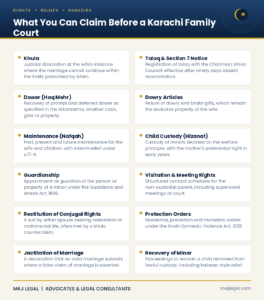
What you can claim before a Karachi Family Court, rights and reliefs matrix by MAJ Legal family lawyers
Khula , Dissolution at the Wife’s Instance
Khula is a judicial process in Pakistan. It requires a decree from the Family Court; it is not something the parties can complete privately. A wife seeking khula must satisfy the Court that she cannot live with her husband within the limits prescribed by Islam.
Under Section 10 of the Family Courts Act, 1964, a khula decree may be passed at the pre-trial reconciliation stage where the wife presses her claim and the Court is satisfied reconciliation has failed. In practice, an uncontested khula in Karachi where the husband does not seriously resist can conclude in a few months. A contested khula runs considerably longer.
The financial consequence is the point most clients misunderstand. A khula decree ordinarily requires the wife to return the dower, or to relinquish her claim to it, as the consideration for the dissolution. That is a real cost , and, as explained below, the Supreme Court in 2026 made clear that a woman must not be pushed into it without her consent.
Talaq and the Section 7 Notice
For a husband, the process is administrative before it is judicial: pronounce talaq, then serve written notice on the Chairman of the Union Council with a copy to the wife. The Union Council constitutes an Arbitration Council and attempts reconciliation. Absent revocation, the talaq becomes effective ninety days after the notice is received.
A family lawyer in Karachi is worth engaging here even where nothing is contested, because the paperwork must be correct for NADRA registration and for any future remarriage.
Maintenance (Nafqah)
Maintenance claims cover the wife during the subsistence of the marriage and the iddat period, and children until they attain majority , with daughters generally maintained until marriage.
Courts assess maintenance against the husband’s means and status. Where a father conceals his income, courts have been prepared to draw an adverse inference: superior court authority establishes that where a father makes it impossible to reach a just conclusion as to his earning capacity through misdeclaration, that withholding of the best evidence tells against him. Salary slips, bank statements, property records, business registrations and even lifestyle evidence are all relevant.
There is also a rarely-invoked but real point on the liability of a grandfather: where the father is poor, infirm and incapable of earning by his own labour, and the mother is also poor, the obligation to maintain the children may fall on an affluent grandfather.
Dower (Haq Mehr)
Dower is fixed in the Nikahnama and may be prompt (payable on demand) or deferred (payable on dissolution or death). It may be cash, gold, or immovable property. Recovery is a straightforward claim in principle and a heavily contested one in practice, particularly where the Nikahnama entries are incomplete , a very common problem in Karachi.
Dowry Articles and Bridal Gifts
Dowry articles remain the property of the wife. A list of dowry articles does not become inadmissible merely because a copy was not handed to the Nikah Registrar , a point worth knowing, since the absence of a registered list is routinely used to resist these claims. Photographs, purchase receipts, video from the wedding and witness testimony all assist.
Child Custody (Hizanat) and Guardianship
Custody is decided on the welfare of the minor , the paramount and overriding consideration. Under Hanafi principles applied in Pakistan, the mother has a preferential right of hizanat during the child’s early years, but this is a presumption serving the child’s welfare rather than an absolute entitlement. The father remains the natural guardian, responsible for maintenance regardless of who has custody.
Courts in Karachi will consider the child’s age and sex, the character and capacity of each parent, the child’s own preference where old enough to express an intelligent view, the stability of each household, and the practical realities of schooling and healthcare.
Guardianship is distinct from custody. A guardianship certificate under the Guardians and Wards Act, 1890 is what allows a parent to deal with a minor’s property , indispensable where a minor has inherited a share in a Karachi property that the family wishes to sell.
Visitation and Meeting Rights
Where custody is with one parent, the other is entitled to structured contact. Karachi Family Courts commonly order supervised meetings at the court premises initially, moving to broader arrangements as matters settle. Enforcement of visitation orders is a distinct workstream and often needs its own applications.
Protection Orders and Domestic Violence
Where there is violence or credible threat, relief under the Sindh Domestic Violence (Prevention and Protection) Act, 2013 can be sought in parallel with family proceedings. Protection, residence and monetary orders are available, and the residence order in particular can prevent a woman being turned out of the matrimonial home while her suit is pending.
Restitution of Conjugal Rights and Jactitation
A suit for restitution of conjugal rights seeks restoration of matrimonial life. In Karachi it is very frequently filed defensively, in response to a wife’s maintenance or dissolution claim, and is typically met with a khula counterclaim. Jactitation of marriage is a declaratory suit denying that any valid marriage subsists , used where a false claim of marriage is asserted, sometimes to cloud a property title.
The Family Court Process in Karachi: Step by Step
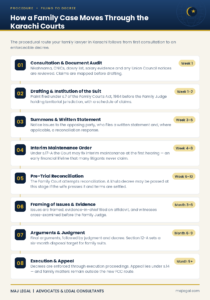
How a family case moves through the Karachi courts , filing to decree timeline by MAJ Legal
1. Consultation and Document Audit
Everything is decided by what you can prove. The first meeting with your family lawyer should be a document audit: Nikahnama, CNICs of both parties and the children, birth certificates, the dowry list, any Union Council notice, salary or income evidence for the opposing party, WhatsApp and message records, medical or police records where violence is alleged, and property documents.
2. Drafting and Institution of the Suit
The plaint is filed under Section 7 of the Family Courts Act, 1964 before the Family Judge holding territorial jurisdiction. All heads of claim , dissolution, dower, dowry, past maintenance, future maintenance, custody , should be pleaded and quantified together.
3. Summons and Written Statement
Summons issue to the defendant, who files a written statement. Service is a frequent cause of delay in Karachi, especially where the defendant is abroad or has moved. Substituted service by publication is available where personal service fails.
4. Interim Maintenance
At an early hearing, the Court may fix interim maintenance under Section 17-A. This is one of the most valuable early steps in the case and should be applied for at the first opportunity.
5. Pre-Trial Reconciliation
The Family Court attempts reconciliation. Where reconciliation fails and the wife presses her claim, a khula decree may be passed at this stage. This is also the natural point for a negotiated settlement covering dower, dowry and custody together.
6. Framing of Issues and Evidence
Issues are framed from the pleadings. Evidence-in-chief is filed on affidavit and witnesses are cross-examined. This is the longest phase of a contested family case in Karachi.
7. Arguments and Judgment
Final arguments, followed by judgment and decree. Section 12-A sets a six-month disposal target. It is a target rather than a guarantee, and contested matters with property or income disputes commonly exceed it.
8. Execution and Appeal
A decree is enforced through execution proceedings , attachment of property, recovery of maintenance arrears, or warrants where a decree for delivery of a minor is disobeyed. Appeal lies under Section 14 of the Family Courts Act, 1964.
Realistic Timelines in Karachi
| Type of matter | Typical duration |
| Uncontested khula | 3–6 months |
| Contested khula or dissolution | 8–18 months |
| Maintenance suit (contested) | 6–14 months |
| Child custody (contested) | 8–18 months |
| Guardianship certificate | 3–8 months |
| Recovery of dower and dowry | 8–16 months |
| Family appeal | 6–14 months |
These reflect ordinary experience before Karachi Family Courts. They are estimates, not commitments, and depend heavily on service, adjournments and the conduct of the opposing party.
Which Karachi Family Court Will Hear Your Case?
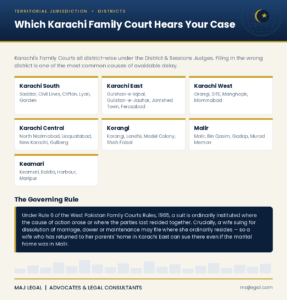
Karachi family court districts and territorial jurisdiction, filing guide by MAJ Legal
Karachi’s Family Courts sit district-wise under the District and Sessions Judges of Karachi South, East, West, Central, , Malir.and Filing in the wrong district is among the most common causes of avoidable delay and cost.
Under Rule 6 of the West Pakistan Family Courts Rules, 1965, a suit is ordinarily instituted where the cause of action arose or where the parties last resided together. Critically, a wife suing for dissolution of marriage, dower or maintenance may file where she ordinarily resides.
The practical consequence is significant and frequently overlooked. A wife who has left the matrimonial home in Malir and returned to her parents in Gulshan-e-Iqbal may institute her suit in Karachi East. She is not obliged to litigate in the district of the marital home. For a woman who has left an unsafe situation, that is not a technicality , it is the difference between a court twenty minutes away and one across the city.
Overseas Pakistani clients should note that a wife resident abroad does not automatically lose the ability to sue in Karachi; the cause of action and the last place of joint residence remain relevant connecting factors, and this should be assessed before filing.
Family Lawyer in Karachi for Overseas Pakistanis
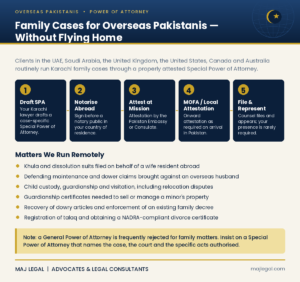
Family cases for overseas Pakistanis , Special Power of Attorney process by MAJ Legal, Karachi
A large proportion of MAJ Legal’s family caseload involves clients in the UAE, Saudi Arabia, Qatar, Oman, the United Kingdom, the United States, Canada and Australia. Most of these cases are conducted without the client returning to Pakistan.
The Special Power of Attorney Route
- Draft the SPA. Your Karachi lawyer prepares a case-specific Special Power of Attorney naming the parties, the court, the suit, and the specific acts authorised.
- Notarise abroad. Sign before a notary public in your country of residence.
- Attest at the Pakistan mission. Attestation by the Pakistan Embassy, High Commission or Consulate having jurisdiction over your area.
- Onward attestation. Ministry of Foreign Affairs or other attestation as required on arrival in Pakistan.
- File and represent. Counsel files and appears. Your personal attendance is rarely required.
A warning worth heeding: a General Power of Attorney is frequently rejected for family matters. Insist on a Special Power of Attorney that names the case, the court and the specific acts authorised. A defective SPA can cost months.
Matters Commonly Run Remotely
- Khula and dissolution suits on behalf of a wife resident abroad
- Defending maintenance and dower claims brought against an overseas husband
- Child custody, guardianship and visitation, including relocation disputes
- Guardianship certificates required to sell or manage a minor’s property
- Recovery of dowry articles and enforcement of an existing family decree
- Registration of talaq and obtaining a NADRA-compliant divorce certificate
Points Specific to Overseas Clients
Ex-parte decrees. Overseas Pakistanis are particularly exposed to decrees passed in their absence, often because service was effected at an address they left years ago. Where an ex-parte decree is passed, the Family Court is required to send notice with a certified copy of the decree to the defendant within three days, by process server, registered post, courier or other permitted mode. Time to apply for setting aside runs from knowledge. Move quickly.
Attestation of foreign documents. Foreign divorce decrees, foreign birth certificates and foreign marriage certificates must be properly attested before a Pakistani court will act on them.
NADRA and the divorce certificate. A talaq is not administratively complete until the Union Council issues its effectiveness certificate, which is what NADRA requires. Overseas clients frequently discover this only when attempting to remarry.
What Changed in 2026: Developments Every Karachi Family Litigant Should Know
This is the section most online guides have not caught up with. Three developments between November 2025 and May 2026 have changed how family cases in Karachi should be pleaded and argued.
1. Khula Cannot Be Imposed Where a Wife Pleads Cruelty
In a judgment reported in May 2026, a three-member bench of the Supreme Court headed by the Chief Justice of Pakistan, in a detailed judgment authored by Justice Shahid Bilal Hassan, held that a Family Court should not ordinarily grant khula without the wife’s clear consent where she has sought dissolution on the ground of cruelty and significant financial rights are at stake. The case concerned a wife who had claimed dissolution on grounds of cruelty together with thirty tolas of gold as dower (or its market value) and maintenance from the date of neglect.
The reasoning matters more than the result. Converting a cruelty case into a khula case changes the financial outcome dramatically: khula ordinarily requires the wife to surrender her dower, whereas dissolution on the ground of proven cruelty does not. The Court directed that trial judges must investigate cruelty allegations, and that where cruelty is proven the marriage should be dissolved on that ground , leaving the wife’s dower, gold and dowry articles intact.
2. A Divorce Plea Cannot Be Converted into Khula Without Explicit Consent
Earlier, in January 2026, the Supreme Court laid down a related principle: a court cannot convert a woman’s plea for divorce into khula without her clear and explicit consent. In that case a two-member bench, in a judgment authored by Justice Musarrat Hilali with the Chief Justice concurring, set aside the decisions of the Family Court and the High Court below and directed payment of dower to the petitioner.
What this means in Karachi practice. For years the path of least resistance in a crowded family list was to convert a contested cruelty or neglect case into a khula decree , quick for the court, disastrous for the wife’s financial claims. That shortcut is no longer available. If you are a wife pleading cruelty, neglect or failure to maintain, your pleadings should be drafted to press those grounds specifically, and your counsel should resist conversion to khula unless you have decided, on advice, that you want it. If you have already suffered a khula decree imposed on a cruelty plea, this is worth reviewing on appeal.
3. The 27th Amendment, and Why Family Cases Are Carved Out
The Constitution (Twenty-seventh Amendment) Act, 2025 was passed on 13 November 2025 and created the Federal Constitutional Court, seated in Islamabad, with exclusive jurisdiction over constitutional interpretation, federal-provincial disputes and enforcement of fundamental rights.
For family litigants there is a specific and useful carve-out. The FCC’s jurisdiction over writ petitions under Article 199 expressly excludes family and rent cases. In a detailed judgment reported in May 2026, a two-member bench of the Supreme Court headed by the Chief Justice clarified the division: appeals arising from constitutional petitions under Article 199 go to the Federal Constitutional Court, while ordinary civil and regular appeals remain with the Supreme Court, and tenancy and certain family matters remain outside the FCC’s scope. The two courts were held to be parallel rather than hierarchically ordered.
Practical effect for a family lawyer in Karachi: the appellate route in ordinary family litigation is materially unchanged. Appeal from the Family Court lies under Section 14 of the Family Courts Act, 1964, constitutional petitions in family matters continue before the Sindh High Court, and onward challenges in family matters have not been redirected to the FCC. Anyone telling you that your family appeal must now be filed in Islamabad has misread the amendment.
The constitutional position remains subject to ongoing litigation and further judicial clarification. Advice should be taken on the position current at the date of filing.
Documents Checklist for a Family Case in Karachi
Bring what you have. Missing items can usually be reconstructed, but the case moves faster if the file is complete.
Always required
- Original and copies of the Nikahnama
- CNIC of the client (and of the opposing party if available)
- CNICs or B-Forms of the children
- Birth certificates of the children
For dissolution or khula
- Any talaq notice or Union Council correspondence
- Evidence of the grounds relied on: medical reports, police reports, photographs, message records
- Correspondence showing attempted reconciliation
For maintenance and dower
- Salary slips, employment letter, bank statements of the opposing party
- Property documents, vehicle registration, business or tax records
- School fee receipts, medical bills and other proof of the children’s expenses
- Nikahnama columns recording dower , prompt and deferred
For dowry articles
- The dowry list
- Purchase receipts, wedding photographs and video
- Names and details of witnesses present at rukhsati
For custody and guardianship
- School records and reports
- Medical records and vaccination cards
- Evidence of the current living arrangement
- Proof of the applicant’s income and accommodation
- Passport and visa or residence permit
- Proof of foreign address
- Draft Special Power of Attorney for attestation
Legal Fees: What a Family Lawyer in Karachi Actually Costs
Fee levels in Karachi vary widely by complexity, by whether the matter is contested, and by the seniority of counsel. Rather than quote figures that will date, the following is how fees are typically structured:
- Consultation fee , a fixed fee for the first substantive meeting and written advice.
- Fixed-fee matters , uncontested khula, talaq notice and registration, and straightforward guardianship certificates are commonly handled on a fixed fee.
- Staged fees for contested litigation , payment tied to stages: institution, evidence, arguments, judgment. This is fairer to the client than a single upfront figure.
- Separate fees for appeals and execution , an appeal or execution proceeding is a fresh matter, not a continuation of the trial engagement.
- Out-of-pocket expenses , court fees, process fees, publication costs for substituted service, and attestation charges are billed at cost.
Two cautions. First, any lawyer who guarantees an outcome is telling you something they cannot know. Second, unusually low quotations frequently signal a practice that files a thin plaint and leaves the financial claims unpleaded , which costs far more than it saves.
MAJ Legal provides a written fee structure before an engagement begins.
How to Choose the Best Family Lawyer in Karachi
If you are comparing firms, these are the questions worth asking.
- Do they file in the district where your case belongs? Ask directly about their practice in Karachi East, South, Central, West, or Malir
- Will they plead all your financial claims from the outset? Dower, dowry, past maintenance and future maintenance should be in the first plaint.
- Will they apply for interim maintenance under Section 17-A immediately? If they cannot explain Section 17-A, keep looking.
- Are they current on the 2026 khula rulings? A firm still treating khula as the default route for a cruelty case is working from outdated assumptions.
- Can they run the case for an overseas client? Ask specifically about Special Power of Attorney practice.
- Is the fee structure in writing? It should be, before you engage.
Frequently Asked Questions , Family Lawyer in Karachi
- How long does khula take in Karachi?
An uncontested khula typically concludes in three to six months. A contested khula, particularly where dower, dowry and custody are also disputed, commonly runs eight to eighteen months. Section 12-A of the Family Courts Act, 1964 sets a six-month disposal target, though it is not always met.
- Do I lose my haq mehr if I take khula?
Ordinarily yes , a khula decree generally requires the wife to return or relinquish her dower as consideration for the dissolution. This is precisely why the 2026 Supreme Court rulings matter: if your case is genuinely one of cruelty, neglect or failure to maintain, dissolution on those grounds preserves your dower, and the Court has held you should not be pushed into khula without your consent.
- Can my husband refuse to give me khula?
No. Khula is granted by decree of the Family Court, not by the husband’s agreement. The Court’s satisfaction that the marriage cannot continue within the limits prescribed by Islam is what matters.
- Can I file a family case in Karachi if I live abroad?
Yes, in the great majority of cases, through a properly attested Special Power of Attorney. Most overseas clients never need to travel.
- Who gets custody of children in Pakistan?
Custody is decided on the welfare of the minor. The mother has a preferential right of hizanat in the child’s early years, but this is a presumption serving the child’s welfare rather than an absolute rule. The father remains the natural guardian and is liable for maintenance regardless of who has custody.
- How much maintenance will the court award?
There is no fixed formula. Courts assess the husband’s means, income and social standing against the reasonable needs of the wife and children. Where a father conceals his income, courts may draw an adverse inference against him.
- What is interim maintenance and how do I get it?
Interim maintenance is an early order under Section 17-A of the Family Courts Act, 1964 fixing maintenance while the suit is pending. It should be applied for at the earliest hearing.
- Is talaq valid without notice to the Union Council?
Section 7 of the Muslim Family Laws Ordinance, 1961 requires written notice to the Chairman of the Union Council with a copy to the wife, and the talaq is not effective until ninety days from that notice unless revoked earlier. Without the notice, the divorce is not administratively complete and NADRA will not issue a divorce certificate.
- Can I recover my dowry articles?
Yes. Dowry articles and bridal gifts are the wife’s exclusive property. A dowry list is not inadmissible merely because a copy was not filed with the Nikah Registrar, though receipts, photographs and witnesses considerably strengthen the claim.
- Which court do I file in if I have moved back to my parents’ home?
Under Rule 6 of the West Pakistan Family Courts Rules, 1965, a wife suing for dissolution, dower or maintenance may file where she ordinarily resides. If you have returned to your parents in Karachi East, you may generally file there even if the marital home was in Malir or Korangi.
- What if a decree was passed against me in my absence?
Apply promptly to have the ex-parte decree set aside. The Family Court is required to send notice of the ex-parte decree with a certified copy to the defendant within three days through a permitted mode of service. Delay is the main obstacle, so act as soon as you learn of it.
- Has the 27th Amendment changed where I appeal a family case?
Not in ordinary family litigation. The Federal Constitutional Court’s jurisdiction over Article 199 petitions expressly excludes family and rent matters, and the Supreme Court has confirmed that tenancy and certain family cases remain outside the FCC’s scope. Appeal from the Family Court continues under Section 14 of the Family Courts Act, 1964.
- What is the minimum age of marriage in Sindh?
Eighteen, for both parties, under the Sindh Child Marriages Restraint Act, 2013 , stricter than the federal position. The Act penalises the male contracting party, the person solemnising the marriage, and the parent or guardian concerned.
- Do family laws in Karachi apply to non-Muslims?
The Family Courts hear these matters, but the substantive law differs. Hindu marriages in Sindh are governed by the Sindh Hindu Marriage Act, 2016 as amended in 2018 , not the federal Hindu Marriage Act, 2017, which does not extend to Sindh. Christian marriage and divorce are governed by the Christian Marriage Act, 1872 and the Divorce Act, 1869.
- Can I get a protection order against domestic violence in Karachi?
Yes. The Sindh Domestic Violence (Prevention and Protection) Act, 2013 provides for protection, residence and monetary orders, and these can be pursued alongside family proceedings.
Speak to a Family Lawyer in Karachi
MAJ Legal, Barristers | Advocates & Corporate Legal Consultants advises and represents clients across Karachi’s Family Courts and acts for overseas Pakistanis in family matters throughout Sindh.
If you are dealing with khula, talaq, maintenance, dower, dowry recovery, child custody, guardianship or a domestic violence situation, an early consultation is almost always cheaper than a late one , particularly where interim maintenance or an ex-parte decree is in play.
MAJ Legal, Barristers | Advocates & Legal Consultants
Website: majlegal.com
Mobile No. : +923003444617
Email: info@majlegal.com
This article is general legal information about family law as applied in Karachi, Pakistan, and is current to the date of publication. It is not legal advice and does not create a lawyer-client relationship. Family law is fact-specific and the law continues to develop, particularly following the constitutional changes of November 2025 and the Supreme Court rulings of 2026. Please obtain advice on your own circumstances before acting.