

Rent Laws in Karachi (Pakistan)
MAJ LEGAL • BARRISTERS | ADVOCATES & LEGAL CONSULTANTS • KARACHI
Rent Laws in Karachi Pakistan, a complete guide to the Sindh Rented Premises Ordinance 1979 by MAJ Legal, the best Rent law firm in Karachi
Karachi runs on rent. From a two-bedroom flat in Gulshan-e-Iqbal to a showroom on Tariq Road, a warehouse in SITE or a bungalow in Defence, a very large share of this city’s property is occupied by somebody who does not own it. And wherever there is rent, there is dispute — over increases, over arrears, over repairs, over who is entitled to stay and who must go.
The law that decides most of those disputes is the Sindh Rented Premises Ordinance, 1979 (Sindh Ordinance No. XVII of 1979), in force since 21 November 1979. It is a short statute — twenty-seven sections — but it is unforgiving of parties who do not understand it. Landlords lose years of possession because they filed on the wrong ground. Tenants lose their homes and shops in a single hearing because they missed a deposit by a few days.
At MAJ Legal, Advocates & Legal Consultants, we act for both landlords and tenants before the Rent Controllers of Karachi East, West, South, Central, Malir and Korangi, and in First Rent Appeals before the District Courts. This guide sets out how rent law actually works in Karachi — the statutory rules, the procedure, the traps, and what overseas Pakistanis in particular need to do to protect a rented-out property from six thousand miles away.
Which Rent Law Applies to Your Karachi Property?
Before anything else, establish which statute governs your premises. This single question decides which forum you file in, and getting it wrong costs months.

Comparison of the Sindh Rented Premises Ordinance 1979 and the Cantonments Rent Restriction Act 1963 for Karachi properties
The Sindh Rented Premises Ordinance, 1979 applies to all premises situated within an urban area — defined as an area within the jurisdiction of a Town Committee, Municipal Committee, Municipal Corporation or Metropolitan Corporation — other than premises owned or requisitioned by the Federal or Provincial Government. That covers the overwhelming majority of Karachi: Gulshan-e-Iqbal, Gulistan-e-Johar, North Nazimabad, Nazimabad, Saddar, Lyari, Korangi, Landhi, and the town areas of Malir.
The Cantonments Rent Restriction Act, 1963 is a separate federal statute governing buildings inside cantonment limits. In Karachi that means DHA and Clifton Cantonment, Karachi Cantonment, Faisal Cantonment, Malir Cantonment and Korangi Creek Cantonment. These areas have their own Controller of Rents and Additional Controller of Rents, and the appellate route has historically differed — rent appeals from cantonment Controllers in Karachi have been heard by the High Court of Sindh rather than the District Judge. Because forum questions in cantonment matters have shifted over time, confirm the current position before filing.
Note also that the Sindh Government retains a power, under section 3(2), to exclude any class of premises, or all premises in any area, from the operation of all or any provisions of the Ordinance by notification.
If you are unsure which side of a cantonment boundary your property sits on, that is precisely the kind of question the top property lawyers in Karachi resolve in an hour rather than discovering after a year of wasted litigation.
Who Counts as a Landlord, a Tenant, and What Counts as “Premises”
Section 2 of the Ordinance defines the vocabulary, and each definition does real work in litigation.
“Landlord” means the owner of the premises and includes any person who is for the time being authorised or entitled to receive rent. An attorney collecting rent for an overseas owner, a manager of an estate, or a co-owner receiving rent can all fall within it.
“Tenant” means any person who undertakes or is bound to pay rent as consideration for possession or occupation. Critically, it also includes a person who continues in possession after the tenancy has terminated — the “statutory tenant” — and the heirs of a deceased tenant who remain in possession. This is why a landlord cannot simply say “the lease expired, therefore you are a trespasser.” An expired tenancy does not end the Ordinance’s protection.
“Premises” means a building or land let out on rent, but expressly does not include a hotel. Litigation has turned on whether a converted property is a hotel or a restaurant, since the answer determines whether the Rent Controller has jurisdiction at all.
“Rent” is defined to include water charges, electricity charges and other charges payable by the tenant but unpaid — so a default in utility payments the tenant was contractually bound to pay can form part of a rent default.
“Personal use” means use by the owner or the owner’s wife (or husband), son or daughter. This narrow definition matters enormously in bona fide personal-need cases.
The Tenancy Agreement: Section 5 and Why Oral Tenancies Cause Chaos
Section 5 requires that the agreement by which a landlord lets out premises shall be in writing. If the agreement is not compulsorily registrable under any other law, it must be attested — signed and sealed — by the Controller within whose jurisdiction the premises are situated, or by a Civil Judge or a First-Class Magistrate.
Where the agreement is compulsorily registrable, a certified copy of the registered deed is what gets produced. Where it is not, the original attested deed is produced and accepted as proof of the landlord–tenant relationship.
In practice, a great many Karachi tenancies are documented on a plain stamp paper that was never attested, and a good number are purely oral. This does not automatically destroy a case. The superior courts have held that the relationship of landlord and tenant may be proved by other means recognised by law, and that the mere absence of a written tenancy agreement is not by itself sufficient to dismiss an ejectment application. But it converts what should be a documentary case into a contested evidentiary one, adding a year or more.
Practical drafting points our rent lawyers in Karachi insist on:
- Record the exact monthly rent, the due date, and the mode of payment.
- Record the purpose for which the premises are let — residential, shop, office, godown. Change of use is a statutory eviction ground, and you cannot prove a change without proving the original purpose.
- Record the security deposit and the conditions for its refund.
- Identify precisely which portion is let: floor, unit number, plot number, survey number and society.
- Specify who bears which utility bills and maintenance charges.
- Attach CNIC copies of both parties.
- Have it attested as section 5 requires.
Rent, Fair Rent and Rent Increases in Karachi
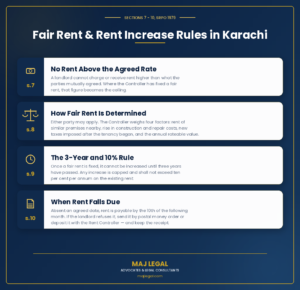
Fair rent and rent increase rules under Sections 7 to 10 of the Sindh Rented Premises Ordinance 1979 in Karachi
Section 7 — Higher rent is not chargeable
No landlord may charge or receive rent at a rate higher than what the parties mutually agreed. Where the Controller has fixed a fair rent for the premises, that fair rent becomes the ceiling.
Section 8 — How fair rent is determined
Either the landlord or the tenant may apply to the Controller to determine fair rent. The Controller must take into account four factors:
- The rent of similar premises in similar circumstances in the same or an adjoining locality;
- The rise in cost of construction and repair charges;
- The imposition of new taxes, if any, after the commencement of the tenancy; and
- The annual value of the premises, if any, on which property tax is levied.
Where an addition or improvement has been made after fair rent was fixed, or a tax has been levied, enhanced, reduced or withdrawn, or fixtures such as lifts or electrical fittings have been provided, the fair rent may be determined or revised taking those changes into account — notwithstanding the three-year restriction in section 9.
Section 9 — The three-year and ten per cent rule
Two limits, and they are frequently misquoted in Karachi:
- Once fair rent has been fixed for premises, no further increase may be effected until three years have elapsed from the date of fixation or from the commencement of the Ordinance, whichever is later.
- The increase shall not in any case exceed ten per cent per annum on the existing rent.
Note what this section does not say. It regulates increases where a fair rent has been fixed under the Ordinance. Where parties freely negotiate a fresh rent by mutual agreement, section 7 permits what they agreed. The statutory machinery becomes decisive when one side refuses to agree and the other seeks the Controller’s intervention.
Section 10 — When rent falls due, and what to do if it is refused
In the absence of a date fixed by mutual agreement, rent is payable not later than the tenth of the month following the month for which it is due. Rent should be paid to the landlord, who must acknowledge receipt in writing.
This next part is the single most valuable piece of knowledge a Karachi tenant can have. Where the landlord has refused or avoided accepting the rent, the tenant may send it by postal money order, or deposit it with the Controller within whose jurisdiction the premises are situated. The written acknowledgement, the money order receipt, or the Controller’s receipt is then produced and accepted as proof of payment.
A landlord who wants an eviction on default will sometimes simply stop accepting rent, wait for the arrears to accumulate, and then file. A tenant who knows section 10 defeats that manoeuvre with a money order receipt. A tenant who does not know it loses the premises.
Utilities and Repairs: Sections 11 and 12
Section 11 — Discontinuance of amenities and services. No landlord may discontinue, or cause to be discontinued, any service such as electricity, gas or water, except with the tenant’s previous consent, in compliance with a requisition of the concerned authority, or after obtaining the Controller’s direction.
If a landlord cuts a service in breach of this, the tenant may apply to the Controller for restoration. Where the Controller is satisfied after inquiry that the service was discontinued without sufficient cause, he must direct restoration within a specified period. If the landlord still fails to comply, the Controller may take steps to restore the service and recover the cost of restoration from the landlord.
There is also a criminal consequence: a landlord contravening section 11(1) is punishable with simple imprisonment up to six months, or fine, or both. Cutting the water connection to force a tenant out is not a pressure tactic in Karachi; it is an offence.
Section 12 — Repairs. Subject to the agreement, if the landlord fails to carry out repairs or whitewashing necessary to keep the premises in proper shape, the Controller may — on the tenant’s application and after inquiry — direct that the tenant make the repairs and deduct the cost from the rent payable.
Separately, where an authority empowered by law has required the landlord to make repairs within a specified period and the landlord defaults, that authority may require the tenant to do them. Once done, the authority verifies the expenditure, certifies the cost, and the tenant may deduct the certified amount from the rent.
The discipline here is documentation. Deduct without a Controller’s direction or a certified cost and you have simply created a rent default against yourself.
Eviction of a Tenant in Karachi: Sections 13, 14 and 15
Section 13 states the governing principle in one line: no tenant shall be evicted from the premises in his possession except in accordance with the provisions of this Ordinance. Changing locks, removing doors, dumping belongings on the street, deploying muscle — none of these are lawful, and all of them expose a landlord to civil and criminal consequences while wrecking the ejectment case he was probably going to win.
Section 14 — The fast-track route for a narrow class of landlords
Section 14 gives a summary remedy to a defined category of landlord: a widow; a minor whose both parents are dead; a salaried employee due to retire within the next six months or already retired; or a person due to attain the age of sixty within the next six months or who has already attained sixty.
Such a landlord may, by notice in writing, inform the tenant that the building is needed for personal use and require delivery of vacant possession within a time specified in the notice — not earlier than two months from receipt. If the tenant fails to deliver possession, the Controller shall, on the landlord’s application, order eviction in a summary manner, using such force as may be necessary.
Two important limits:
- The proviso excludes a landlord who rented the building out after retiring, attaining sixty, or becoming a widow or orphan. You cannot acquire the status, then let the property, then use section 14 against your own new tenant.
- Section 14(2) denies the benefit to a landlord who is already in occupation of a building owned by him in any locality.
Note also that under section 21(2), while an appellate authority may stay proceedings on a Controller’s order pending appeal, no injunction may be granted where the appeal is from an order under section 14.
Section 15 — The eight ordinary grounds of eviction

The 8 legal grounds for eviction of a tenant under Section 15 of the Sindh Rented Premises Ordinance 1979 in Karachi
Where a landlord seeks eviction otherwise than under section 14, he applies to the Controller under section 15. The Controller shall order the tenant to hand over possession within a specified period if satisfied that:
- Default in payment of rent — s.15(2)(ii). The tenant failed to pay rent within fifteen days after expiry of the period fixed by mutual agreement, or, absent such agreement, within sixty days after the rent became due.
There is a significant proviso, inserted in 2001. Where the application is on the sole ground of default and the tenant, on the first day of hearing, admits liability to pay the rent claimed, the Controller shall — if satisfied that the tenant has not defaulted on any previous occasion and the default does not exceed six months — direct payment by a fixed date, and on such payment reject the application. This is a genuine second chance, but it is narrow: sole ground, first hearing, no prior default, not more than six months.
- Subletting or handing over possession — s.15(2)(iii)(a). The tenant handed over possession to another person without the landlord’s written consent.
- Change of use — s.15(2)(iii)(b). The premises were used for a purpose other than that for which they were let. Converting a shop into a restaurant without permission has been held to render a tenant liable to eviction.
- Breach of tenancy conditions — s.15(2)(iii)(c). The tenant infringed the conditions on which the premises were let out.
- Impairing the premises — s.15(2)(iv). The tenant committed acts likely to impair the material value or utility of the premises.
- Nuisance to neighbours — s.15(2)(v). The tenant indulged in activities causing nuisance to the neighbours.
- Reconstruction — s.15(2)(vi). The premises are required for reconstruction or erection of a new building at the site, and the landlord has already obtained the necessary sanction from the competent authority. The sanction is not optional; it is the statutory condition.
- Bona fide personal need — s.15(2)(vii). The landlord requires the premises in good faith for his own occupation or use, or for the occupation or use of his spouse or any of his children.
Safeguards against a false reconstruction or personal-need claim
The Ordinance anticipates abuse and legislates against it.
Under section 15(3), a landlord who obtained possession for reconstruction must demolish the existing building within six months of taking possession, or commence erection of the new building within two years. If he fails, the tenant is entitled to be put back into possession and may apply to the Controller accordingly. Under section 15(4), where the landlord does construct, the evicted tenant may apply before completion for accommodation in the new building, and the Controller may order allotment of the area applied for — or a smaller area, having regard to location, type of building and the tenant’s needs — at a rent determined on the basis of comparable accommodation in the locality.
Under section 15-A, where a landlord who obtained possession under section 14, or under the personal-need ground in section 15(2)(vii), relets the premises to someone other than the previous tenant, or puts it to a use other than personal use, within one year, he is punishable with a fine not exceeding one year’s rent, and the evicted tenant may apply to the Controller to be restored to possession.
Under section 17, where the Controller is satisfied that a landlord’s eviction application is frivolous or vexatious, he may direct the landlord to pay the tenant compensation not exceeding ten times the monthly rent.
Section 16: The Provision That Decides Most Karachi Rent Cases
If you read one part of this guide twice, read this one.
Where an eviction case has been filed, the landlord may apply under section 16(1). After a summary inquiry, the Controller determines the arrears due and orders the tenant to deposit them within a fixed period, and further directs the tenant to deposit monthly rent regularly, on or before the tenth of every month, until final disposal of the case. A 2001 proviso allows the Controller to direct that arrears or approximate rent be paid to the landlord through pay order or another agreed mode.
Then comes section 16(2): where the tenant fails to deposit the arrears, or fails to pay monthly rent as directed, his defence shall be struck off and the landlord shall be put into possession within the period specified by the Controller.
Understand what that means. The tenant does not get to argue the merits. Whether the landlord’s personal need was genuine, whether the alleged subletting happened, whether the premises were ever used for a different purpose — none of it is heard. The defence is gone and possession follows. A very large proportion of the eviction orders passed in Karachi are section 16(2) orders, not merits judgments, and the appeals against them mostly fail.
The courts have shown some flexibility where a default was genuinely unavoidable and bona fide — for example where the tenth fell on a Sunday and the deposit was made on the next working day — but this is a narrow equitable window, not a rule. Under section 16(3), rent deposited is paid out to the landlord at the conclusion of the case, or earlier if the Controller so directs.
If you are a tenant under a tentative rent order in Karachi: diarise the tenth of every month, deposit early, and keep every challan. If you are a landlord, an early and well-supported section 16 application is usually the most effective step available to you.
Change of Ownership: Section 18
Where ownership of tenanted premises is transferred by sale, gift, inheritance or otherwise, the new owner must send written intimation of the transfer to the tenant by registered post. The tenant is not deemed to have defaulted for the purposes of the default ground if the rent due is paid within thirty days from the date the intimation should, in the normal course, have reached him.
Buyers of tenanted property in Karachi routinely skip this step, then file for eviction on default — and find the default ground defeated by their own omission. Send the notice by registered post, and preserve the receipt.
The Rent Case Procedure in Karachi, Step by Step
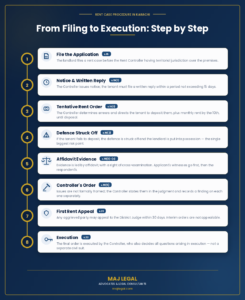
Step by step rent case procedure before the Rent Controller in Karachi under the Sindh Rented Premises Ordinance 1979
Filing. The application goes to the Rent Controller with territorial jurisdiction over the premises. In Karachi the Controllers sit district-wise East, West, South, Central, and Malir and the courts are ordinarily presided over by a Senior Civil Judge functioning as Rent Controller. Under section 4(2), no person may be appointed Controller unless he has worked as a Civil Judge for not less than three years.
Notice and written reply — section 19(1). Unless the application is summarily dismissed for recorded reasons, the Controller issues notice to the respondent to file a written reply within a period not exceeding fifteen days of receipt.
Ex parte risk — section 19(2). If the notice has been served and the respondent fails to file a reply without reasonable excuse, the Controller may proceed to make an ex parte order and once such an order has been made, the Controller has no power to rescind it. This is far harsher than ordinary civil procedure. Missing a notice in a rent case in Karachi can be terminal.
Section 16 application. Usually moved by the landlord early, producing the tentative rent order discussed above.
Evidence — section 19(3) and (4). The Controller receives the applicant’s evidence first, then the respondent’s. Evidence-in-chief is given by affidavit, a copy of which must be supplied simultaneously to the other side, who then has the right to cross-examine. The party producing the witness may re-examine.
Judgment — section 19(5). The Controller does not formally frame issues; he states them briefly in the judgment and records a separate finding on each.
Powers — section 20. For the purposes of a case under the Ordinance, the Controller and the appellate authority have the powers of a Civil Court under the CPC in respect of four matters only: summoning and examining persons on oath, compelling production or discovery of documents, inspecting the site, and issuing commissions for examination of witnesses or documents. Under section 23, the Controller and the appellate authority are deemed to be a Civil Court within the meaning of section 480 of the Criminal Procedure Code, 1898.
Appeal — section 21. Any party aggrieved by an order which is not an interim order may appeal within thirty days to the District Judge having jurisdiction in the area where the premises are situated. The District Judge may hear the appeal himself or refer it to an Additional District Judge, and may recall and reassign it. The appellate authority may attempt a compromise at any stage, and may — where it deems fit — allow the tenant to continue the tenancy subject to an enhanced rent it fixes. The appellate authority may withdraw an application from one Controller and transfer it to another; the High Court may similarly transfer a pending appeal. After perusing the record, hearing the parties and making any further inquiry, the appellate authority makes an order which shall be final.
Before the Sindh Rented Premises (Amendment) Ordinance, 2001, appeals lay to the High Court; section 21-A transferred pending appeals to the District Judge, save those already fixed for judgment.
Finality under section 21(3) does not oust the constitutional jurisdiction of the High Court of Sindh under Article 199, but that jurisdiction is supervisory and narrow. Concurrent findings of the Controller and the appellate court are rarely disturbed.
Execution — section 22. A final order is executed by the Controller, and all questions between the parties relating to execution, discharge or satisfaction are determined by the Controller and not by a separate suit. The explanation adds a trap for the unwary: in execution proceedings relating to an ejectment order, no payment, compromise or agreement is valid unless made before, or with the permission of, the authority that passed the order. A private side-deal struck after an ejectment order, without the Controller’s permission, is worth nothing.
Prosecutions — section 24. No court may take cognizance of an offence under the Ordinance except on a written complaint made by the Controller.
Landlord Duties and Tenant Rights at a Glance

Landlord duties and tenant rights under the Sindh Rented Premises Ordinance 1979 explained by MAJ Legal Karachi
The Ordinance is often described as tenant-protective, and in its structural design it is — but the practical balance in Karachi is different. Section 16 gives landlords a powerful, fast lever. Tenants who understand sections 10, 11, 12, 15-A and 17 are far better protected than those who do not.
Tenant Registration with the Police in Karachi
Distinct from the Ordinance, and often forgotten: under the Sindh Information of Temporary Residents Act, 2015, when a house, flat or hostel room is rented out in Sindh, the owner, tenant or property dealer must register the owner’s, property’s and tenant’s details with the concerned police station. Registration can be completed at the concerned or a nearby police station or a Facilitation Centre, after which the front desk officer issues a certificate that helps avoid difficulties during any search operation.
Registration can also be completed online through the Tenant Registration Portal (TRUST) operated by the Sindh Police. The province-wide online system, “Tenant Registration For Urban Security & Tracking,” allows property owners to register tenant information from home rather than attending in person.
This is a security and criminal-law compliance obligation, not a rent-law one — but a landlord who has never registered a tenant is in a poor position when that tenant turns out to be a problem. Do it, and keep the certificate.
Rent Law for Overseas Pakistanis: Protecting a Karachi Property from Abroad
A large part of our practice as property lawyers in Karachi involves clients in Dubai, Jeddah, London, Toronto and New York who own tenanted property here. The pattern is depressingly consistent: rent flows for a few years, then stops; the relative or agent collecting it becomes evasive; the tenant claims to have been paying someone; and by the time the owner can travel, years of arrears have accumulated and possession has become entrenched.
What protects you:
A properly executed Special Power of Attorney. Execute it before the Pakistan Embassy or Consulate in your country of residence, have it attested there, and then have it attested by the Ministry of Foreign Affairs in Pakistan before it is used. A general, vaguely worded authority causes problems; specify the property, and specify the powers — to receive rent, issue notices, institute and defend rent proceedings, engage counsel, verify pleadings, swear affidavits, and execute orders.
Naming your advocate directly. Where a family arrangement has already broken down, granting the power of attorney to counsel rather than to a relative removes the intermediary who is often the source of the problem.
A rent account in your own name. Direct the tenant to deposit rent into a bank account held in your own name. It converts every payment into independent, dated documentary evidence and removes any dispute about whether an agent received and remitted it.
Written, attested tenancy agreements with fixed terms. Overseas owners are the most likely to inherit undocumented tenancies from an earlier arrangement, and the most damaged by them.
Early action on default. Section 15(2)(ii) turns on defined periods, and section 16 is at its most effective when moved promptly. Waiting three years to “give them a chance” weakens the case and multiplies the loss.
Evidence by affidavit helps you. Because section 19(4) allows evidence-in-chief by affidavit, much of an overseas landlord’s case can be built without continuous physical presence — though attendance for cross-examination may still be required, and should be planned around a single trip rather than several.
Common Mistakes We See in Karachi Rent Cases
By landlords:
- Self-help eviction — changing locks or cutting utilities — which converts a strong case into criminal exposure under section 11(5).
- Filing on reconstruction without having obtained the building sanction that section 15(2)(vi) requires.
- Pleading personal need loosely, when “personal use” is confined to the owner, spouse, son or daughter.
- Buying tenanted property and never sending the section 18 registered-post intimation.
- Not moving under section 16 early, and then litigating for years without receiving any rent.
- Reletting within a year of a personal-need eviction, and facing a fine plus restoration of the old tenant under section 15-A.
By tenants:
- Ignoring a notice and suffering an ex parte order under section 19(2) that the Controller has no power to rescind.
- Missing a deposit under a section 16(1) order and losing the defence altogether.
- Stopping payment because the landlord refuses to accept, instead of using money order or deposit with the Controller under section 10(3).
- Carrying out repairs and deducting the cost without a Controller’s direction or certification under section 12.
- Subletting or converting the use of the premises without written consent.
- Letting the thirty-day appeal period under section 21 lapse.
Frequently Asked Questions About Rent Laws in Karachi
How much can a landlord increase rent in Karachi?
Where fair rent has been fixed under the Ordinance, no increase may be effected until three years have elapsed, and the increase may not exceed ten per cent per annum on the existing rent. Where no fair rent has been fixed, section 7 permits what the parties mutually agreed — and either party may apply to the Controller under section 8 to have a fair rent determined.
Can a landlord evict a tenant without going to court in Karachi?
No. Section 13 prohibits eviction except in accordance with the Ordinance. The only summary route is section 14, and it is available only to a widow, an orphaned minor, a retiree or a landlord of sixty or above — and even then it requires two months’ written notice and a Controller’s order.
What happens if my landlord refuses to accept the rent?
Send it by postal money order or deposit it with the Rent Controller having jurisdiction over the premises, and preserve the receipt. Under section 10(4) that receipt is accepted as proof of payment and defeats a subsequent default allegation.
How long does a rent case take in Karachi?
It varies with the ground, the forum and the conduct of the parties. Straightforward default cases can conclude comparatively quickly, particularly where a section 16(2) order follows a failure to deposit. Contested bona fide personal-need or subletting cases involving full evidence, followed by a First Rent Appeal, commonly run to several years.
Can my landlord cut my electricity or water?
No. Section 11 prohibits it without your consent, an authority’s requisition or the Controller’s direction. You may apply for restoration, the Controller may restore the service and recover the cost from the landlord, and the landlord faces simple imprisonment up to six months, a fine, or both.
My landlord evicted me for personal use and rented it out to someone else. What can I do?
Section 15-A applies. If the reletting or the change to non-personal use occurred within one year of possession being obtained, the landlord is punishable with a fine up to one year’s rent, and you may apply to the Controller to be restored to possession.
Does an expired tenancy agreement mean I must vacate?
Not automatically. The definition of “tenant” in section 2 includes a person who continues in possession after termination of the tenancy. The landlord must still establish a statutory ground for eviction.
Is an unregistered or unattested rent agreement valid in Karachi?
Section 5 requires writing and attestation, and non-compliance creates evidentiary difficulty. However, the relationship of landlord and tenant may be proved by other legally recognised means, and the mere absence of a written agreement is not by itself fatal to an ejectment application.
Where do I appeal a Rent Controller’s order?
To the District Judge having jurisdiction over the area, within thirty days, under section 21 — for orders that are not interim. The District Judge may hear it or refer it to an Additional District Judge, and the appellate order is expressed to be final, subject to the constitutional jurisdiction of the High Court of Sindh.
Do rent laws differ in DHA and Clifton?
Yes. Cantonment areas are governed by the Cantonments Rent Restriction Act, 1963, with their own Controller of Rents, rather than by the Sindh Rented Premises Ordinance, 1979. Establish which applies before filing.
Can an overseas Pakistani pursue a rent case without coming to Pakistan?
Largely, yes — through a properly attested Special Power of Attorney, and because section 19(4) permits evidence-in-chief by affidavit. Attendance may still be needed for cross-examination, which can usually be consolidated into one trip.
Why Clients Choose MAJ Legal for Rent and Property Matters in Karachi
Rent litigation rewards precision and punishes delay. The difference between a case won in months and a possession lost for a decade is usually a decision taken in the first fortnight: the correct forum, the correct ground, the correct application, the correct evidence.
MAJ Legal, Barristers | Advocates & Corporate Legal Consultants advises and represents landlords, tenants, buyers of tenanted property, housing societies and overseas Pakistanis across Karachi in:
- Ejectment and eviction applications under sections 14 and 15, SRPO 1979
- Defending tenants against ejectment, and against section 16(2) strike-off
- Fair rent determination and rent enhancement under sections 8 and 9
- Applications for restoration of disconnected utilities under section 11
- Recovery of rent arrears and execution of ejectment orders under section 22
- First Rent Appeals before the District Courts and constitutional petitions before the High Court of Sindh
- Drafting and attestation of tenancy agreements compliant with section 5
- Tenant registration compliance under the Sindh Information of Temporary Residents Act, 2015
- Power of attorney drafting, attestation guidance and end-to-end property management litigation for overseas clients
- Related property disputes: title, possession, specific performance, partition and declaration suits
If you are dealing with a tenant who has stopped paying, a landlord who is pressuring you to leave, a rent increase you believe is unlawful, or a Karachi property you cannot supervise from abroad, speak to us before the position hardens.
MAJ Legal, Barristers | Advocates & Corporate Legal Consultants, Karachi
Website: majlegal.com
Phone: 0092-3003444617
Office: G4, Building No. 8-C, Stadium Lane No. 1 Khayaban-e-Shamsheer DHA Phase 5, Karachi, Sindh, Pakistan
Disclaimer: This article is general legal information about rent laws in Karachi and the Sindh Rented Premises Ordinance, 1979. It is not legal advice and does not create a lawyer–client relationship. Statutory provisions and forum arrangements are subject to amendment, and outcomes depend on the specific facts of each case. Please consult a qualified advocate before acting.
Last reviewed: August 2026.