Landlord and tenant laws in Karachi explained by MAJ Legal trusted property and rent case lawyers in Karachi.
Few legal disputes are as common, or as bitterly fought, as those between a landlord and a tenant. In a city of more than twenty million people, where a large share of families and businesses live and operate on rented premises, the law of rent touches almost every street. Yet most landlords and tenants in Karachi sign a rent agreement without ever reading the statute that will actually govern their relationship — and then discover, far too late, that the document they relied upon was never going to protect them.
This guide from MAJ Legal, widely regarded as one of the best law firms in Karachi for property and rent matters, explains the landlord and tenant laws in Karachi in plain language: the governing legislation, the rights and duties of each side, the lawful grounds of eviction, and exactly how a rent case proceeds before the Rent Controller.
If you are a landlord whose tenant has stopped paying, or a tenant facing an unlawful attempt to throw you out, the practical guidance below will tell you where you stand and our top property lawyers in Karachi are available to take it from there.
Which Law Governs Rent in Karachi?
The principal statute is the Sindh Rented Premises Ordinance, 1979 (commonly abbreviated as the SRPO). It regulates the letting of premises in the urban areas of Sindh, including virtually all of Karachi — Clifton, Defence, Gulshan-e-Iqbal, North Nazimabad, Saddar, Gulistan-e-Johar, Bahadurabad, Korangi, Malir, Lyari and the rest of the metropolitan area.
The Ordinance is a special law. That has three consequences which surprise people every single day at our office:
- Rent disputes do not go to the ordinary civil court. They are filed before the Rent Controller, a specially designated forum with exclusive jurisdiction over rented premises in the area where the property is situated.
- A landlord cannot recover possession simply because the lease period has ended. He must satisfy the Controller of a ground recognised by the Ordinance.
- Self-help is unlawful. Changing locks, removing a tenant’s belongings, or disconnecting utilities to force a vacation is not “taking back your own property” — it exposes the landlord to legal consequences.
There are two important carve-outs that our best property lawyers in Karachi always check before filing:
- Cantonment areas. Properties falling within the cantonment limits of Karachi — including Karachi Cantonment, Clifton Cantonment, Faisal Cantonment, Korangi Creek and Malir Cantonment — are governed by the Cantonments Rent Restriction Act, 1963, with its own Rent Controller. Filing in the wrong forum can cost you a year.
- Registration and stamp requirements. A lease of immovable property from year to year, or for a term exceeding one year, attracts compulsory registration under the Registration Act, 1908, and the instrument must be properly stamped under the stamp law applicable in Sindh. An improperly stamped or unregistered long lease can create serious evidentiary problems.
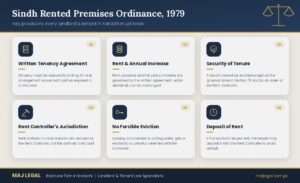
Six key provisions of the Sindh Rented Premises Ordinance, 1979 that every landlord and tenant in Karachi should know.
The Rent Agreement: Where Most Cases Are Won or Lost
The Ordinance requires the tenancy to be reduced to writing. In practice, this single requirement decides the outcome of a large proportion of rent cases in Karachi.
An oral tenancy is not automatically void but it leaves both sides fighting about the most basic facts: what the rent was, when it was due, what the agreed increase was, and whether the premises were let for residential or commercial use. When the parties have no written agreement, the Rent Controller must reconstruct the bargain from receipts, bank transfers, utility bills and witness testimony. That is expensive, slow and unpredictable.
Our experience as rent case lawyers in Karachi is blunt: a properly drafted eleven-month or annual rent agreement, correctly stamped and, where required, registered, is the cheapest legal insurance a landlord will ever buy — and the strongest shield a tenant will ever hold.
What a Sound Tenancy Agreement Must Contain
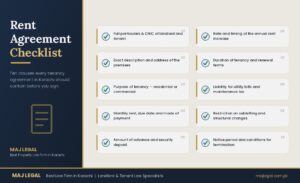
Ten clauses every rent agreement in Karachi should contain — drafting checklist by MAJ Legal, best property law firm in Karachi.
A tenancy agreement drafted by competent counsel will always deal with the following, and will deal with them precisely rather than in boilerplate:
- Full particulars and CNIC numbers of both landlord and tenant, along with witnesses;
- An exact description of the demised premises, including floor, portion, parking and any excluded areas;
- The purpose of the tenancy — residential or commercial — since using premises for a purpose other than that for which they were let is itself a ground of eviction;
- The monthly rent, the due date, and the mode of payment (bank transfer is strongly preferred over cash, for evidentiary reasons);
- The advance and security deposit, and the precise conditions and timeline for its refund;
- The rate and timing of the annual increase in rent, expressed as a percentage and a date;
- The duration of the tenancy and the mechanism for renewal;
- Allocation of liability for utility bills, maintenance charges and taxes;
- Express restrictions on subletting, assignment and structural alterations;
- The notice period and the circumstances in which either party may terminate.
Registration of Tenants with the Police
Separately from the civil law, landlords in Karachi are required to register their tenants with the local police station. Sindh Police maintains a tenant registration process for precisely this purpose, and failure to comply can attract penal consequences for the landlord. It is a small administrative step that is regularly overlooked and it is one of the first things a well-advised landlord should complete after handing over possession.
Rights and Duties of Landlord and Tenant in Karachi
The Ordinance is often described as tenant-protective, and in one narrow sense it is: it removes the landlord’s power to evict at will. But it is more accurate to say the statute is balance-seeking. It secures the tenant’s possession while guaranteeing the landlord’s rent, and it gives each side a swift remedy against the other’s misconduct.
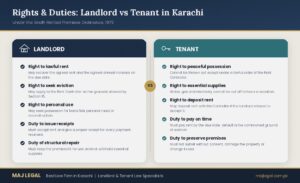
Rights and duties of landlords and tenants in Karachi under the Sindh Rented Premises Ordinance, 1979.
The Landlord’s Position
A landlord is entitled to receive the agreed rent on the agreed date, together with the agreed annual increase. He is entitled to apply for eviction on any of the statutory grounds. He may seek possession where he genuinely requires the premises for his own occupation or that of his family, or where the building is genuinely required for reconstruction or demolition.
Against those rights sit real duties. The landlord must accept rent when it is tendered and issue a receipt. He must keep the structure in tenantable repair. And he must not, under any circumstances, resort to pressure tactics — the disconnection of water, gas or electricity in order to force a tenant out is unlawful, and the Rent Controller can order restoration of those supplies.
The Tenant’s Position
A tenant enjoys security of tenure. He cannot be dispossessed except under an order of the Rent Controller made on a recognised ground, and even then only through lawful execution of that order. He is entitled to the essential supplies attached to the premises. Crucially, if the landlord refuses to accept rent — a common tactic designed to manufacture a default — the tenant may deposit the rent with the Rent Controller, which protects him completely.
The tenant’s duties are equally real. He must pay rent by the due date; default in payment is by a wide margin the most common ground on which tenants are evicted in Karachi. He must not sublet or part with possession without the landlord’s written consent. He must not damage the premises, cause nuisance to neighbours, or change the use of the property.
Rent, Advance and the Annual Increase
Three financial questions dominate landlord–tenant disputes in Karachi.
How much can the rent be increased? The Ordinance leaves the primary field to the contract: the increase is what the parties have agreed in writing. A market convention of roughly ten per cent per annum has taken root in Karachi, but a convention is not a law. Where the agreement is silent or where the demand is arbitrary, the matter can be placed before the Rent Controller for determination of a fair rent, taking into account the nature and location of the premises, the facilities provided and the prevailing rent for comparable properties in the locality.
Can a landlord demand a large advance or “pagri”? The Ordinance restricts the taking of a premium or consideration beyond the agreed rent and permissible advance. Demands for unlawful premium are challengeable, and are among the issues on which tenants most often obtain relief.
What happens to the security deposit? It is refundable at the end of the tenancy, subject to lawful deductions for unpaid rent, unpaid utility bills and damage beyond fair wear and tear. Where a landlord refuses to refund it without justification, the remedy lies in proceedings — which is why the agreement should state the refund timeline explicitly.
Grounds for Eviction of a Tenant in Karachi
This is the heart of the statute. Section 15 of the Sindh Rented Premises Ordinance, 1979 sets out the grounds on which the Rent Controller may order a tenant to be evicted. A landlord who cannot bring his case within one of these grounds cannot succeed, no matter how strongly he feels about the property.
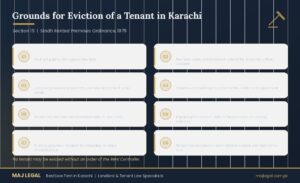
Grounds for eviction of a tenant in Karachi under Section 15 of the Sindh Rented Premises Ordinance, 1979.
The recognised grounds include:
- Default in payment of rent — the tenant has failed to pay rent by the agreed due date.
- Unauthorised subletting — the premises have been sublet, assigned or parted with without the landlord’s written consent.
- Bona fide personal requirement — the landlord genuinely and in good faith requires the premises for himself or for a member of his family. The requirement must be real, not a device to obtain a higher rent from a new tenant.
- Breach of the terms of tenancy — the tenant has violated a material condition of the written agreement.
- Change of the permitted use — premises let for residential purposes are being used commercially, or vice versa.
- Damage or nuisance — the tenant has impaired the value or utility of the premises, or has caused nuisance or annoyance.
- Reconstruction or demolition — the building is genuinely required for rebuilding or major reconstruction.
- Alternative accommodation — the tenant has acquired, been allotted or built suitable premises of his own.
Two points deserve emphasis, because they are the two most misunderstood propositions in the whole of Karachi rent practice.
First, the mere expiry of the tenancy period does not, by itself, entitle a landlord to possession. The Ordinance overrides the contractual position. The landlord must still establish a statutory ground.
Second, the burden of proof is real. Bona fide personal need in particular is closely scrutinised, and a landlord who obtains possession on that ground and then promptly re-lets the premises to a third party at a higher rent exposes himself to serious consequences. Our top lawyers in Karachi regularly succeed in resisting eviction petitions precisely because the pleaded need did not survive cross-examination.
How a Rent Case Actually Proceeds Before the Rent Controller
Clients rarely want a lecture on procedure; they want to know how long it will take and what will be required of them. The sequence below reflects how these matters run in practice in Karachi.
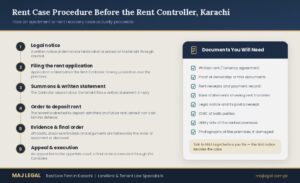
How a rent or ejectment case proceeds before the Rent Controller in Karachi — procedure and documents required.
Step 1 — Legal notice. A properly drafted notice of demand or termination is served on the tenant through counsel. This is not a formality. The notice frames the dispute, fixes the default, and very often produces a settlement without litigation.
Step 2 — Filing the rent application. The application is filed before the Rent Controller exercising jurisdiction over the area in which the premises are situated, supported by the tenancy agreement, title documents and proof of default.
Step 3 — Summons and written statement. The Controller issues notice to the tenant, who files a written statement setting out his defence.
Step 4 — Order to deposit rent. The Controller will ordinarily direct the tenant to deposit the admitted arrears and to continue depositing future rent month by month during the pendency of the proceedings. This is the single most important stage for a tenant. Failure to comply can result in the tenant’s defence being struck off, after which an order of ejectment tends to follow rapidly.
Step 5 — Evidence and final order. Affidavits are filed, witnesses are cross-examined, arguments are heard, and the Controller passes an order either directing ejectment or dismissing the application.
Step 6 — Appeal and execution. An appeal against the Controller’s order lies to the appellate forum provided under the Ordinance and must be filed within the prescribed limitation period — ordinarily thirty days — after which the order becomes final and is executed through the Controller, with police assistance where necessary.
The Ordinance contemplates the expeditious disposal of rent matters, and rent proceedings are considerably faster than ordinary civil suits. Realistically, however, a contested ejectment case in Karachi should be planned for in terms of months rather than weeks, and an appeal can extend that timeline further.
Common Mistakes That Cost Landlords and Tenants Their Case
After years of appearing in rent matters across the city, the same avoidable errors recur:
- Accepting rent in cash without receipts. Landlords lose the ability to prove the rate; tenants lose the ability to prove payment. Use bank transfers.
- Continuing to accept rent after issuing a notice to quit. This can undermine the very default the landlord is relying upon.
- Filing before the wrong forum. A cantonment property filed before the SRPO Controller, or a rent matter filed as a civil suit, will simply be returned — months later.
- Ignoring the deposit order. Tenants who treat the direction to deposit rent as optional almost always lose.
- Relying on a template agreement downloaded from the internet. These documents are drafted for no jurisdiction in particular and address none of the Sindh-specific requirements.
- Resorting to self-help. Landlords who change locks or cut utilities convert a straightforward ejectment case into a defensive battle on two fronts.
- Letting limitation expire. Rights of appeal are lost quietly and permanently.
Why Choose MAJ Legal — Among the Best Law Firms in Karachi for Rent and Property Matters
Rent litigation looks simple and is not. It is a specialist jurisdiction with its own forum, its own procedure and a body of case law that rewards precise pleading and punishes casual drafting.
MAJ Legal offers landlords and tenants across Karachi a complete rent and property law service:
- Drafting, vetting, stamping and registration of rent and lease agreements for residential and commercial premises;
- Legal notices for recovery of rent, enhancement of rent and termination of tenancy;
- Ejectment applications and defence of eviction proceedings before the Rent Controller;
- Applications for deposit of rent, restoration of essential supplies and refund of security deposits;
- Appeals and revisions against orders of the Rent Controller;
- Execution proceedings for recovery of possession;
- Allied property services — title verification, sale and purchase agreements, transfer and mutation, partition, and possession suits.
Clients come to us because we combine courtroom experience with commercial realism. Our best property lawyers in Karachi will tell you candidly whether your case is worth fighting, what it will cost, and how long it will take — before you commit to it.
Speak to a rent case lawyer in Karachi. Whether you are a landlord seeking possession or a tenant defending your home or business, contact MAJ Legal today for a confidential consultation with one of the top lawyers in Karachi for landlord and tenant matters.
Frequently Asked Questions on Landlord and Tenant Laws in Karachi
Can a landlord evict a tenant in Karachi without a court order?
No. Eviction requires an order of the Rent Controller. Changing locks, removing belongings or cutting off utilities to force a tenant out is unlawful, and the tenant can seek immediate relief.
How much rent increase is allowed in Karachi each year?
The increase is governed primarily by the written agreement. A ten per cent annual increase is a widespread market practice, but where the agreement is silent or the demand is arbitrary, the Rent Controller can be asked to determine a fair rent.
What happens if my landlord refuses to accept the rent?
Deposit it with the Rent Controller. This preserves your position and prevents the landlord from later alleging default. Do not simply hold the money.
Is a rent agreement valid if it is not registered?
A tenancy of eleven months is commonly used precisely to avoid compulsory registration. A lease from year to year or for a term exceeding one year attracts compulsory registration under the Registration Act, 1908, and an unregistered instrument can create serious evidentiary difficulties.
How long does an eviction case take in Karachi?
Rent proceedings are designed to be expeditious and are faster than ordinary civil suits, but a contested ejectment case realistically takes several months, and longer if an appeal is filed.
My tenancy period has expired. Can I take back my property?
Not automatically. The Ordinance overrides the contractual expiry; the landlord must establish a statutory ground under Section 15 before the Rent Controller.
Does the law apply to shops and offices as well as houses?
Yes. The Ordinance covers commercial as well as residential premises, though certain considerations — goodwill, fit-out and the purpose of letting — arise differently in commercial tenancies.
What if the property is sold during my tenancy?
The purchaser ordinarily steps into the shoes of the landlord and the tenancy continues. The new owner cannot evict you merely because ownership has changed.
Which law applies in DHA, Clifton Cantonment or Malir Cantonment?
Premises within cantonment limits are governed by the Cantonments Rent Restriction Act, 1963, and proceedings lie before the Rent Controller under that Act. Confirming the correct forum at the outset is essential.
Contact MAJ Legal
MAJ Legal property, rent and civil litigation advocates. For advice on landlord and tenant laws in Karachi, rent agreements, rent increase disputes, ejectment applications or Rent Controller proceedings, contact our office to arrange a consultation.
Disclaimer: This article is intended for general information only and does not constitute legal advice. The law, and its application, depends on the facts of each case and may have changed since publication. Readers should obtain specific advice from a qualified advocate before acting on anything stated here.