
Overseas Pakistani Property Disputes Resolution in Karachi (Pakistan)
Every year, thousands of Pakistanis living in the United Kingdom, the United States, Canada, Australia, Saudi Arabia, the UAE, Europe or any other country discover that the plot, flat, shop or family house they own in Karachi has been occupied, sold, transferred or mutated without their knowledge. Distance is the single biggest vulnerability an overseas property owner has — and in a city the size of Karachi, that vulnerability is regularly exploited.
The reassuring news is that Pakistani law gives the overseas owner strong, specific and enforceable remedies. Illegal occupation is not merely a civil wrong in Pakistan; it is a criminal offence. A sale carried out on a forged power of attorney is void, not merely voidable. An heir living abroad does not lose an inheritance share by being absent. And, critically, almost the entire process can be run from overseas through a properly executed and registered power of attorney, without the owner ever boarding a flight.
This guide, prepared by MAJ Legal, recognised among the best property law firms in Karachi sets out exactly how overseas Pakistani property disputes are resolved in Karachi: the disputes that arise most often, the statutes that apply, the courts that hear them, the step-by-step filing procedure from abroad, the remedies available, the limitation deadlines that quietly kill strong cases, and the preventive measures every non-resident owner should have in place.
Why Overseas Pakistanis Are the Most Targeted Property Owners in Karachi
Property disputes affect every category of owner in Pakistan, but non-resident owners face a distinct risk profile. Understanding why the risk exists is the first step to defeating it.
The property is physically unattended. A locked flat in Gulshan-e-Iqbal or an empty plot in Scheme 33 signals to opportunists that nobody is watching. Encroachment often begins quietly — a boundary wall, a temporary structure, a “caretaker” who moves his family in.
Trust is placed in relatives without documentation. A brother, cousin or family friend is asked to “look after” the property. Years pass. No written arrangement exists. When the owner finally asserts title, the caretaker claims an oral gift, a family settlement or long possession.
Powers of attorney are drafted too widely. A general power of attorney given for the limited purpose of paying utility bills is later used to execute a sale deed. Because the document on its face conferred broad authority, unwinding the transaction becomes a litigation exercise rather than an administrative one.
Delay is mistaken for patience. Owners abroad often wait years hoping the family will resolve matters amicably. Meanwhile limitation periods run, the occupant builds a claim of adverse possession, and the property changes hands to a purchaser who will claim to be a bona fide buyer without notice.
Karachi’s land record is fragmented. Title in Karachi may sit with the Sub-Registrar, the Karachi Development Authority, the Malir Development Authority, the Lyari Development Authority, a cantonment board, DHA, or one of hundreds of cooperative housing societies — each with its own transfer file. Fragmentation creates gaps, and gaps are where fraud lives.
None of these problems is unsolvable. Each one, however, is significantly cheaper to fix early. That is why engaging the top property lawyers in Karachi at the first sign of trouble — rather than after a third-party sale — materially changes the outcome.
The Most Common Property Disputes Faced by Overseas Pakistanis in Karachi
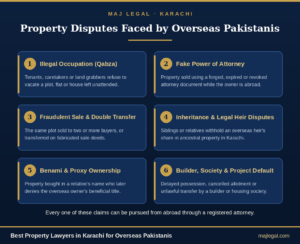
Common property disputes faced by overseas Pakistanis in Karachi — illegal occupation, fake power of attorney, inheritance and benami claims”
1. Illegal Occupation and Qabza
This is the classic case. A tenant stops paying rent and refuses to vacate; a caretaker asserts ownership; or an organised group occupies a vacant plot and erects a structure overnight. Pakistani law treats this seriously. Under the Illegal Dispossession Act, 2005, entering into or remaining in possession of another’s immovable property unlawfully and with dishonest intent is a criminal offence carrying imprisonment of up to ten years and a fine, in addition to liability to compensate the owner. Crucially, the trial court can order restoration of possession to the lawful owner — including through an interim order while the case is still pending.
2. Sale on a Fake, Expired or Revoked Power of Attorney
An attorney sells the property after the authority has been revoked, after the principal has died (which automatically terminates the agency), or on the strength of an outright forgery bearing a fabricated consular attestation. Pakistani courts construe powers of attorney strictly: an attorney authorised to manage or lease has no authority to sell, and a transaction beyond the four corners of the instrument confers no title on the purchaser.
3. Fraudulent Sale and Double Transfer
The same plot is sold to two or more buyers, or a sale deed is manufactured on forged signatures and thumb impressions. These matters typically require a combined approach — a civil suit for declaration and cancellation of the instrument, alongside a criminal complaint for forgery and cheating.
4. Inheritance and Legal Heir Disputes
A parent dies in Karachi. The heirs living in Pakistan take control of the estate, distribute it informally, and the sibling abroad is told there was “nothing left” or that the property was gifted before death. Under Islamic law as applied in Pakistan, inheritance vests in the heirs immediately upon death, and an overseas heir’s share does not lapse through absence. A gift (hiba) asserted against an heir must be proved by offer, acceptance and delivery of possession — a standard that oral, undocumented gifts frequently fail to meet.
5. Benami and Proxy Ownership
An overseas Pakistani remits funds and buys property in the name of a sibling, spouse or friend for convenience. Years later, the named holder denies the arrangement. The Benami Transactions (Prohibition) Act, 2017 provides a route to challenge such holdings, though the statute carves out genuine exceptions — for example, property held in the name of a spouse or child purchased from the buyer’s own declared sources. Banking trails of remittances are decisive evidence in these cases.
6. Builder, Developer and Housing Society Default
Payments are made in full from abroad, but possession is never delivered, the allotment is cancelled without notice, or the file is transferred to another buyer. Depending on the structure of the transaction, remedies may lie in a civil suit for specific performance, before a consumer forum, or through the relevant regulatory or society authority.
The Legal Framework Protecting Overseas Pakistani Property Owners
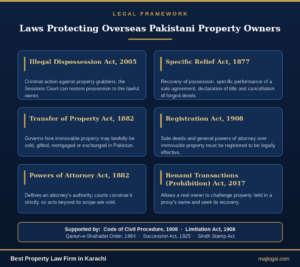
“Legal framework for overseas Pakistani property disputes in Pakistan — Illegal Dispossession Act 2005, Specific Relief Act 1877, Transfer of Property Act 1882”
Overseas property litigation in Karachi is not governed by a single statute. It is assembled from several, and the skill of the best property lawyers in Karachi lies in selecting the right combination for the facts.
| Statute | What It Does for an Overseas Owner |
| Illegal Dispossession Act, 2005 | Criminalises unlawful dispossession of immovable property; the Court of Sessions can order restoration of possession, including on an interim basis. |
| Specific Relief Act, 1877 | Suits for recovery of possession, specific performance of an agreement to sell, declaration of title (s. 42) and cancellation of a forged or void instrument (s. 39). |
| Transfer of Property Act, 1882 | Sets the conditions for a valid sale, gift, mortgage, lease or exchange of immovable property. |
| Registration Act, 1908 | Requires compulsory registration of sale deeds and of general powers of attorney relating to immovable property; an unregistered instrument that ought to have been registered generally cannot pass title. |
| Powers of Attorney Act, 1882 | Governs the authority of an attorney; read together with the Registration Act and a large body of Supreme Court precedent requiring strict construction. |
| Benami Transactions (Prohibition) Act, 2017 | Enables a real owner to challenge property held through a proxy holder, subject to statutory exceptions. |
| Code of Civil Procedure, 1908 | Procedure for suits, including s. 16 (suits for immovable property are filed where the property is situated), Order XXXIX (injunctions) and Order XXI (execution). |
| Limitation Act, 1908 | Fixes the deadline for each type of claim — the provision that most often defeats otherwise strong overseas cases. |
| Qanun-e-Shahadat Order, 1984 | Rules of evidence, including proof of documents, handwriting, thumb impressions and the reception of electronic evidence. |
| Succession Act, 1925 / Letters of Administration and Succession Certificates Act, 2021 | Establishes an heir’s entitlement; NADRA’s succession certificate process offers a faster route than a full probate suit in straightforward, undisputed estates. |
Which Forum Hears Your Case in Karachi?
Choosing the wrong forum wastes months. The correct forum depends on the nature of the relief sought, not on the size of the grievance.
Civil courts (District Judiciary, Karachi). Suits for declaration of title, cancellation of a sale deed, permanent injunction, possession, partition of inherited property and specific performance are filed before the civil courts of the district where the property is located — Karachi East, West, South, Central, Korangi, Malir or Keamari. Historically, higher-value suits in Karachi went to the original side of the Sindh High Court. Following the Sindh Civil Courts (Amendment) Act, 2025, the pecuniary ceiling on the District Courts at Karachi was removed and civil matters were channelled to the district judiciary. Because that amendment has itself been the subject of constitutional litigation, the position at the moment of filing should always be confirmed with counsel.
Court of Sessions. Complaints under the Illegal Dispossession Act, 2005 are filed directly before the Sessions Court, which may direct the police to investigate and may pass an interim order regarding possession.
Police and criminal courts. Where a sale deed, attorney document or identity card has been forged, an FIR for offences including forgery, cheating and criminal breach of trust runs in parallel with the civil suit. A criminal case does not by itself return the property, but it applies significant pressure and preserves evidence.
Rent controller. Where the occupant entered as a tenant, eviction proceeds before the Rent Controller under the Sindh Rented Premises Ordinance rather than by civil suit.
Development authorities and housing societies. Where the dispute concerns an allotment, transfer file or society record, an application to the relevant authority — KDA, MDA, LDA, DHA, a cantonment board or the society’s registrar — may be required before or alongside court proceedings.
Wafaqi Mohtasib — Overseas Pakistanis Commissionerate. The Federal Ombudsman operates a dedicated commissionerate for overseas Pakistanis. It is an effective route for complaints of maladministration against government departments and agencies. It cannot, however, decide title disputes between private parties; those remain squarely within the courts.
How to File a Property Case in Karachi From Abroad: Step by Step
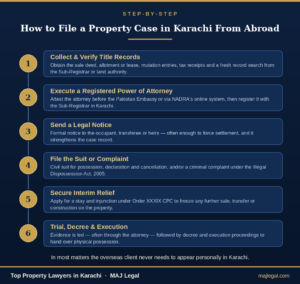
“Step-by-step process to file a property case in Karachi from abroad — power of attorney, legal notice, suit, injunction, decree and execution”
Step 1 — Collect and Verify the Title Record
Before any notice is issued, the file must be built: the sale deed or allotment letter, the lease, mutation and transfer entries, the property tax and utility record, the society or authority transfer file, remittance receipts showing who actually paid, and a fresh search of the Sub-Registrar’s record to establish whether any transaction has already been registered against the property. This search frequently reveals the fraud for the first time.
Step 2 — Execute a Registered Power of Attorney
This is the pivotal step for an overseas client and is discussed in detail in the next section.
Step 3 — Serve a Legal Notice
A properly drafted legal notice from a Karachi law firm sets out the ownership, the unlawful act and the consequences of non-compliance. A meaningful proportion of family and tenancy disputes settle at this stage. Where they do not, the notice becomes part of the evidentiary record and establishes the date of the owner’s formal demand.
Step 4 — File the Suit or Complaint
Depending on the facts, this may be a civil suit for declaration, cancellation and possession; a complaint under the Illegal Dispossession Act, 2005; a suit for specific performance; a partition suit among heirs; or a combination. Court fee is calculated on the value of the relief claimed under the applicable Sindh schedule.
Step 5 — Secure Interim Relief Immediately
An application under Order XXXIX, Rules 1 and 2 CPC for a stay and temporary injunction is filed with the plaint. Its purpose is to freeze the position: no further sale, no transfer of the file, no construction, no third-party interest created. Obtaining this order early is often the difference between recovering the property and recovering only damages, because once the property reaches a bona fide purchaser the litigation becomes considerably harder.
Step 6 — Trial, Decree and Execution
Pleadings close, issues are framed, and evidence is led — in most matters through the registered attorney, so the overseas client is not required to travel. Where the client’s personal testimony is genuinely necessary, video-link evidence may be sought at the court’s discretion. On decree, execution proceedings under Order XXI CPC deliver physical possession through the court bailiff, with police assistance where resistance is offered.
Power of Attorney: The Single Most Important Document You Will Sign
For an overseas Pakistani, the power of attorney is both the primary tool of protection and the primary instrument of fraud. Getting it right matters more than any other document in the file.
Executing a Valid Power of Attorney From Abroad
- Draft it narrowly and specifically. State the exact property, the exact powers granted, and an express validity period. If the purpose is litigation, say so — and expressly exclude the power to sell, gift, mortgage or otherwise alienate the property. A litigation attorney has no business holding a power of sale.
- Attest it before the Pakistan Mission. Sign before the consular officer at the Pakistan Embassy or Consulate with your CNIC/NICOP, passport, photographs and two witnesses. Alternatively, use NADRA’s online power of attorney system, which allows eligible overseas Pakistanis to complete verification and attestation by video interview without attending in person.
- Complete attestation in Pakistan. A manually attested instrument is then processed through the Ministry of Foreign Affairs.
- Register it with the Sub-Registrar. Under the Registration Act, 1908, a general power of attorney concerning immovable property must be registered with the Sub-Registrar of the area where the property is situated. Registration is what makes the document usable in a Karachi property transaction.
Red Flags That Signal a Forged Attorney Document
- Consular attestation numbers that do not appear in the mission’s record on verification.
- A document executed on a date when the principal’s passport shows him or her in a different country.
- An attorney who never contacted the principal directly, or who “cannot locate” the original instrument.
- A general power of attorney that surfaces only after the sale is complete.
- A sale price recorded far below prevailing market value in the locality.
Revoking a Power of Attorney
Revocation should be executed in the same form as the original — attested through the Pakistan Mission — registered with the same Sub-Registrar, communicated in writing to the attorney and to the relevant society or development authority, and, where the risk is serious, published in a newspaper. A power of attorney also terminates automatically on the death of the principal, which is why sales executed after death are void regardless of how genuine the original instrument was.
Remedies a Karachi Court Can Grant
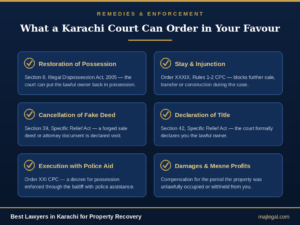
“Remedies and enforcement in Karachi property disputes — restoration of possession, injunction, cancellation of deed, declaration of title”
A well-pleaded overseas property case rarely seeks a single remedy. The usual approach is to combine several so that the court can grant complete relief in one proceeding:
- Declaration of title under section 42 of the Specific Relief Act, formally establishing you as the lawful owner.
- Cancellation of a void or forged instrument under section 39, removing the fraudulent deed or attorney document from the record.
- Recovery of possession, either by civil decree or through restoration ordered under the Illegal Dispossession Act, 2005.
- Permanent and temporary injunctions restraining further transfer, sale, construction or alienation.
- Specific performance where a genuine agreement to sell exists and the other side refuses to complete.
- Partition of jointly inherited property, with separate possession of the overseas heir’s share.
- Mesne profits and damages for the period during which the property was unlawfully withheld.
- Execution with police assistance under Order XXI CPC, converting a paper decree into actual keys in hand.
Limitation: The Deadline That Quietly Destroys Strong Cases
More overseas property claims are lost to delay than to weak facts. The Limitation Act, 1908 prescribes a period for each category of claim, and the courts apply it strictly. The following are general indicators only — the precise article and starting point depend on how the claim is framed, and must be assessed on the specific facts:
| Nature of Claim | Indicative Limitation Period |
| Suit for possession based on title | 12 years from the date possession became adverse |
| Cancellation or setting aside of an instrument | 3 years from when the fraud became known |
| Specific performance of an agreement to sell | 3 years from the date fixed for performance, or from refusal |
| Declaration of right where no other period is prescribed | 6 years |
| Recovery of possession from a tenant | 12 years from determination of the tenancy |
Two points deserve emphasis. First, in fraud cases time generally runs from knowledge of the fraud, not from the date of the fraudulent document — which is why documenting the moment you discovered the transaction is valuable. Second, continuous adverse possession for twelve years can extinguish an owner’s title altogether. An overseas owner who leaves an occupied property untouched for over a decade may find the law has moved against them. Acting promptly is not merely advisable; it is legally decisive.
Evidence That Wins Overseas Property Cases
Because the overseas client is usually absent from the country, documentary evidence carries proportionately more weight. The following materially strengthen a case:
- Registered title documents — sale deed, allotment order, lease, conveyance deed.
- Banking evidence of payment — remittance advices, SWIFT records and bank statements showing funds moved from the overseas account to the vendor or builder. In benami and inheritance matters, this is frequently the single most persuasive item on file.
- A record search from the Sub-Registrar or authority, showing every transaction registered against the property.
- Property tax, utility and society dues receipts in the owner’s name, evidencing continuous assertion of ownership.
- Correspondence — emails, WhatsApp messages and letters in which the occupant or relative acknowledges the owner’s title. Electronic evidence is admissible under the Qanun-e-Shahadat Order, 1984, subject to proof requirements.
- Passport and immigration records placing the owner outside Pakistan on the date a disputed document was allegedly executed — often fatal to a forged instrument.
- Photographs and surveys documenting the current physical state of the property and any encroachment.
How Long Does It Take, and What Does It Cost?
Honest expectation-setting matters more than optimistic promises.
Timeline. A complaint under the Illegal Dispossession Act, 2005 is comparatively expedited, and an interim order on possession may come within weeks of institution. A contested civil suit for declaration, cancellation and possession in Karachi typically runs one to three years at first instance, with appeal adding further time. Uncontested or settled matters conclude far faster; a well-timed legal notice sometimes resolves a family dispute in a matter of weeks. Applications for interim injunction are heard early, which is precisely why they should be filed with the plaint.
Costs. Costs comprise court fee (calculated on the valuation of the relief claimed), the cost of executing and registering the power of attorney, process and record-search fees, and professional fees. MAJ Legal provides overseas clients with a written fee structure and scope of work before engagement, so there are no surprises across time zones.
Communication. Overseas clients should expect scheduled updates after each hearing, copies of every document filed on their behalf, and access to counsel by video call at times that work in their own time zone. Any firm that goes silent between hearings is not serving a non-resident client properly.
Preventive Steps: Protecting Karachi Property While You Live Abroad
The cheapest property case is the one that never has to be filed. Overseas owners should treat the following as a standing checklist:
- Keep the property occupied or actively supervised. A tenant on a written, registered agreement is safer than an empty property. Vacancy is an invitation.
- Never give a general power of attorney where a special one will do. Grant the narrowest power that achieves the purpose, and put an expiry date in the instrument itself.
- Register every instrument. Registration creates a public record and is the strongest defence against a competing forged deed.
- Run a record search annually. An annual search at the Sub-Registrar, society or development authority will surface an unauthorised mutation while it is still reversible.
- Keep the tax and utility record alive in your own name. Continuous payment is powerful evidence of continuous assertion of ownership.
- Document family arrangements in writing. Verbal understandings between siblings become contested memories a decade later.
- Complete the inheritance formalities promptly on a death in the family. Obtain the succession certificate and effect the mutation in the heirs’ names without waiting years.
- Retain a Karachi law firm on a watching brief. A modest annual retainer for periodic verification and monitoring is a fraction of the cost of recovery litigation.
Why Overseas Clients Choose MAJ Legal
MAJ Legal is among the best law firms in Karachi for overseas Pakistani property matters, and non-resident clients across the UK, USA, Canada, Australia, the Gulf and Europe rely on the firm for one reason above all: they can litigate in Karachi without being in Karachi.
- Complete representation from abroad. We prepare and guide the execution of the power of attorney, register it, and conduct the litigation so that travel is not required in the ordinary course.
- Karachi-specific court experience. Practice across the District Courts of Karachi East, West, South, Central, Korangi, Malir and Keamari, the Court of Sessions and the Sindh High Court.
- Combined civil and criminal strategy. Where the facts justify it, a civil suit and a criminal complaint are run in parallel to maximise pressure and protect the property.
- Full-spectrum property practice. Illegal dispossession, cancellation of fraudulent transfers, declaration and possession suits, partition and inheritance, specific performance, benami claims, builder and society disputes, and title due diligence.
- Transparent, time-zone-aware communication. Scheduled video consultations, written hearing updates and complete document copies.
Contact MAJ Legal — best property lawyers in Karachi. Send us the title documents you hold and a short summary of what has happened, and we will advise on the correct forum, the applicable limitation position and the realistic remedy available to you.
Frequently Asked Questions
Can I file a property case in Karachi without travelling to Pakistan?
Yes. In most matters an overseas Pakistani can pursue a property case in Karachi entirely through a registered power of attorney. The attorney signs the pleadings, appears at hearings and can give evidence on the owner’s behalf. Personal appearance is required only where the court specifically directs it, and video-link evidence may be sought in appropriate cases.
What can I do if someone has illegally occupied my property in Karachi?
You can file a complaint under the Illegal Dispossession Act, 2005 before the Court of Sessions, which can order restoration of possession and impose imprisonment of up to ten years and a fine on the occupier. In parallel, a civil suit for declaration, possession and permanent injunction protects your title. Both can be pursued together and both can be conducted through an attorney while you remain abroad.
My property in Karachi was sold using a fake power of attorney. What are my options?
A sale executed on a forged, revoked or expired power of attorney is void and passes no title. The remedy is a civil suit for declaration and cancellation of the sale deed under the Specific Relief Act, 1877, together with an application for an injunction to prevent further transfer, and a criminal complaint for forgery and cheating. Passport and immigration records showing you were outside Pakistan on the date of execution are particularly strong evidence.
How do I give a power of attorney to a lawyer in Karachi from abroad?
Draft the instrument specifying the exact property and powers, sign it before the Pakistan Embassy or Consulate with two witnesses, or use NADRA’s online power of attorney system where you are eligible. Manually attested documents are then processed through the Ministry of Foreign Affairs in Pakistan, after which the instrument is registered with the Sub-Registrar in the area where the property is located.
Do overseas Pakistanis lose their inheritance share by living abroad?
No. Under Islamic law as applied in Pakistan, inheritance vests in the legal heirs immediately upon the death of the deceased, regardless of where an heir resides. An overseas heir may obtain a succession certificate or letters of administration and, if other heirs refuse to cooperate, may file a suit for declaration and partition to obtain separate possession of their share.
How long does a property case take in Karachi?
A complaint under the Illegal Dispossession Act, 2005 is relatively expedited and interim relief on possession may come within weeks to months. A contested civil suit for declaration, cancellation and possession commonly takes one to three years at first instance, with appeals extending that. Matters that settle after a legal notice conclude far more quickly.
Which court hears property disputes in Karachi?
Civil suits concerning immovable property are filed in the district where the property is situated Karachi East, West, South, Central, Korangi, and Malir. Complaints under the Illegal Dispossession Act, 2005 go to the Court of Sessions, and tenant eviction goes to the Rent Controller. Following the Sindh Civil Courts (Amendment) Act, 2025, the pecuniary ceiling on the District Courts at Karachi was removed; because that amendment has been the subject of litigation, the current position should be confirmed before filing.
Is there a time limit for filing a property case in Pakistan?
Yes. Under the Limitation Act, 1908, a suit for possession based on title is generally limited to twelve years, cancellation of an instrument to three years from knowledge of the fraud, and specific performance to three years. Continuous adverse possession for twelve years can extinguish an owner’s title entirely, so overseas owners should act as soon as a problem is discovered.
Can I recover property bought in a relative’s name?
Possibly. The Benami Transactions (Prohibition) Act, 2017 provides a route for a real owner to challenge property held through a proxy holder, subject to statutory exceptions such as property purchased in the name of a spouse or child from the buyer’s own declared sources. Documentary proof of the remittances and payments made by you is central to succeeding in such a claim.
How do I choose the best property lawyer in Karachi for an overseas case?
Look for demonstrable experience in the specific district courts of Karachi, a track record in illegal dispossession and cancellation matters, willingness to provide a written scope and fee structure in advance, familiarity with power of attorney attestation from your country of residence, and a communication routine that accounts for your time zone. MAJ Legal offers all of these to overseas Pakistani clients.