Khula, Maintenance and Custody of Minors for Overseas Pakistanis in Karachi
Every year, thousands of Pakistanis living in Dubai, Jeddah, London, Toronto, New York, Melbourne and Europe find themselves facing a painful reality: a marriage that has broken down back home, children they cannot reach, and a legal system that feels a continent away. The questions are almost always the same. Can I file for khula from abroad? Will I have to fly to Karachi for every hearing? Can I claim maintenance for my children from an ex-husband who lives overseas? Will a Pakistani court give me custody of my minor children if I live in another country?
The short answer is reassuring. Pakistani family law does not require your physical presence for most of the proceedings. With a properly drafted Special Power of Attorney and the right representation, an overseas Pakistani can file for khula, obtain a maintenance decree and pursue custody or visitation rights before the Family Courts in Karachi without ever boarding a flight.
This guide, prepared by MAJ Legal — recognised among the best family law firms in Karachi explains exactly how these three interconnected claims work, what documents you need, how long each stage takes, and where overseas clients most often go wrong. If you are searching for the best family lawyers in Karachi to handle a cross-border matrimonial dispute, this article will help you understand your position before you pick up the phone.
Why Overseas Pakistanis Face a Harder Road
Distance changes everything in a family law dispute. An overseas client typically has:
- No physical access to evidence. The Nikahnama sits in a cupboard in Karachi. Bank statements, school records and medical reports are in someone else’s possession.
- A time-zone problem. Court hearings in Karachi are listed at times that may fall in the middle of the night wherever you live.
- Communication breakdown. The opposing party knows you cannot simply appear, and often exploits that fact by delaying proceedings.
- Fear of losing contact with the children. In custody matters, delay is not neutral — every month a minor spends exclusively with one parent shifts the practical status quo.
- Uncertainty about who to trust. Many overseas Pakistanis hand their case to a distant relative rather than a professional, and lose years to mismanagement.
None of these problems is insurmountable. All of them require a family law firm in Karachi that is genuinely set up for overseas representation with proper client reporting, digital document handling and the willingness to explain each order as it is passed. That is precisely the gap MAJ Legal was built to fill.
The Legal Framework: Which Laws Govern Your Case
Before looking at procedure, it helps to know which statutes the Family Court in Karachi will actually apply. Khula, maintenance and custody are governed by different laws, even though they are usually litigated together.
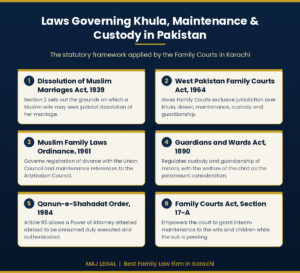
The Dissolution of Muslim Marriages Act, 1939 sets out, in Section 2, the grounds on which a Muslim wife may seek judicial dissolution of her marriage — including desertion, failure to maintain, cruelty, imprisonment of the husband, failure to perform marital obligations, and impotence.
The West Pakistan Family Courts Act, 1964 is the procedural backbone. It gives Family Courts exclusive jurisdiction over dissolution of marriage including khula, dower, dowry articles, maintenance, custody and guardianship. It also contains Section 17-A, which allows the court to fix interim maintenance while the suit is pending — an enormously important provision for a wife or mother with no income.
The Muslim Family Laws Ordinance, 1961 governs what happens after the decree: the notice to the Chairman of the Union Council, the iddat period, and the issuance of the divorce certificate through NADRA.
The Guardians and Wards Act, 1890 regulates custody and guardianship of minors. Sections 7, 12, 17 and 25 give the court power to appoint a guardian, to pass interim custody and visitation orders, and to return a minor to lawful custody — always subject to the paramount consideration of the child’s welfare.
The Qanun-e-Shahadat Order, 1984 matters enormously to overseas clients. Article 95 provides that a document purporting to be a power of attorney executed before and authenticated by a Notary Public, a Court, a Magistrate or a Pakistani consular officer is presumed to have been duly executed and authenticated. This is the legal foundation on which remote representation rests.
Khula for Overseas Pakistani Women
What is Khula?
Khula is the right of a Muslim wife to have her marriage dissolved by the court where she satisfies the judge that she cannot live with her husband within the limits prescribed by Allah. It is not the same as talaq, which is the husband’s unilateral pronouncement. Khula is a judicial remedy it requires a suit, a hearing, and a decree.
Critically, khula does not require you to prove misconduct. A wife who simply cannot continue in the marriage is entitled to a decree. What she must ordinarily do in exchange is return the haq mehr (dower) she received, or such other consideration as the court considers just. Where the dower was never actually paid, there is often nothing to return.
Many overseas clients confuse khula with dissolution on fault grounds under the 1939 Act. In practice, the best family lawyers in Karachi will often plead both dissolution on statutory grounds and, in the alternative, khula — so that the suit succeeds even if the fault allegations are not fully proved.
Where the suit is filed
Territorial jurisdiction is one of the first questions in an overseas case. Under the Family Courts Rules, a suit for dissolution of marriage, dower or maintenance may generally be instituted where the wife ordinarily resides. Where the wife is living abroad, Karachi courts commonly take jurisdiction on the basis of her last ordinary residence in Karachi, or on the basis of the husband’s residence there. Because a wrong forum wastes months, this is a point your lawyer should settle in writing before drafting the plaint.
The step-by-step process
The sequence is predictable, and each stage can be handled remotely:
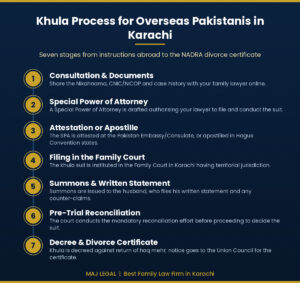
- Consultation and documents. You share the Nikahnama, CNIC or NICOP, passport copy and a written account of the marriage with your lawyer by email or WhatsApp.
- Special Power of Attorney. A precisely worded SPA is drafted authorising your counsel to institute and conduct the suit, to make statements on oath, and to sign court documents.
- Attestation or apostille. The SPA is signed before, and attested by, the Pakistan Embassy or Consulate in your country of residence. Alternatively, since Pakistan’s accession to the Hague Apostille Convention took effect on 9 March 2023, documents from contracting states may be apostilled by the designated authority there. Confirm with your lawyer which route your particular court is comfortable with.
- The khula suit is instituted in the Family Court in Karachi having territorial jurisdiction, along with the schedule of documents and list of witnesses.
- Summons and written statement. Summons are issued to the husband, who files his written statement and any counter-claims, such as restitution of conjugal rights.
- Pre-trial reconciliation. The court is required to attempt reconciliation. If the wife maintains her position, the court proceeds.
- Decree and divorce certificate. The court passes a decree for dissolution on the basis of khula against return of the agreed consideration. Notice goes to the Chairman of the Union Council, the iddat period of ninety days runs, and the divorce becomes effective. The NADRA divorce certificate follows.
How long does khula take?
An uncontested khula in Karachi, properly prosecuted, is frequently decreed within four to eight months. A heavily contested matter with counter-suits for restitution of conjugal rights and custody can run considerably longer. Overseas clients should budget for a further four to eight weeks at the front end simply to execute and courier the attested Power of Attorney.
The Special Power of Attorney: The Document Everything Depends On
If there is one document that decides whether an overseas family law case runs smoothly or collapses, it is the Special Power of Attorney.
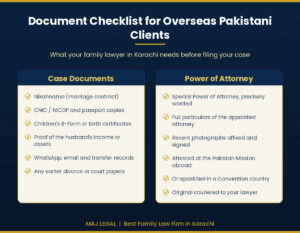
A defective SPA is the single most common reason overseas cases stall. Courts have refused to act on powers of attorney that were vague, that omitted the specific power to institute a particular suit, that carried no photograph of the executant, or that were notarised abroad without consular authentication.
A properly drafted SPA for a family matter should:
- Name the principal and the attorney with full particulars, CNIC/NICOP numbers and addresses;
- Specify the exact proceedings covered — for example, “to institute and prosecute a suit for dissolution of marriage on the basis of khula, and a suit for maintenance under the West Pakistan Family Courts Act, 1964, against Mr. X before the Family Court at Karachi”;
- Expressly authorise the attorney to appear, to file and sign pleadings, to engage counsel, to make statements, to receive process and to compromise where instructed;
- Carry recent photographs of the principal, signed across;
- Be attested by the Pakistan Mission abroad (or apostilled, where accepted) and, where required, verified on receipt in Pakistan.
A word of caution on choosing your attorney. Do not sign a general power of attorney in favour of a relative “just in case”. A general power is a standing invitation to misuse, particularly where property is involved. Keep it special, keep it narrow, and give it a time limit.
Where personal testimony is unavoidable, the picture is not hopeless either. Courts in Sindh have become considerably more receptive to recording the evidence of overseas parties through commission or video link, and the Sindh High Court operates a dedicated facility for the grievances of overseas Pakistanis. Your counsel should apply for this at the appropriate stage rather than allowing the case to drift.
Maintenance (Nafqah) Claims: Wife and Children
Maintenance is often the most urgent issue for an overseas Pakistani woman, and it is where the strongest orders are available fastest.
Who can claim what
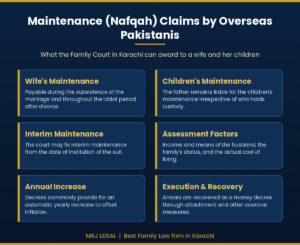
A wife is entitled to maintenance during the subsistence of the marriage and throughout the iddat period following dissolution. A wife who has been deserted or left unmaintained has a straightforward claim; the husband’s obligation is not suspended merely because he is displeased with her.
Children are entitled to maintenance from the father regardless of who has custody. The father’s liability continues for a son until he attains majority and is able to maintain himself, and for a daughter until her marriage. A father cannot escape liability by pointing to the mother’s income.
Interim maintenance is the key tool
Section 17-A of the Family Courts Act allows the court to fix interim maintenance at an early stage of the proceedings, payable from the date the suit was instituted. Where the defendant fails to pay, the court may strike off his defence. For a mother abroad who is supporting children on her own, this provision frequently produces relief within weeks rather than years.
How the amount is fixed
There is no statutory formula. The court weighs the husband’s income and earning capacity, his assets, the social and financial status of the family, the number of dependants, and the actual cost of living — school fees, rent, medical expenses, utilities. Where the husband is himself an overseas Pakistani earning in dirhams, riyals or pounds, evidence of his foreign salary, remittance history and lifestyle becomes central. Bank statements, employer letters, WhatsApp records of past transfers and social media evidence of expenditure are all routinely used.
Well-drafted decrees also include an automatic annual increase so that the award does not lose its value to inflation, and so that the mother is not forced to re-litigate every two years.
Enforcing a maintenance decree
An unpaid maintenance decree is not a piece of paper. Arrears are recoverable as arrears of land revenue or as a money decree, and the Family Court has coercive powers including attachment and sale of property and, in appropriate cases, arrest and detention. Where the judgment debtor lives abroad but retains assets in Pakistan — a flat in DHA, a plot in Bahria Town, a bank account, a share in a family business — those assets are the realistic target of execution. This is where an experienced maintenance case lawyer in Karachi earns the fee: not in obtaining the decree, but in recovering the money.
Custody of Minors: What the Karachi Family Court Really Considers
Custody is the most emotionally charged of the three claims, and the most misunderstood.
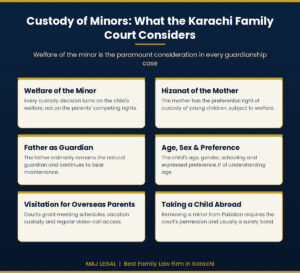
Welfare is paramount, everything else is secondary
Section 17 of the Guardians and Wards Act requires the court to be guided by the welfare of the minor. This is not a tie-breaker applied at the end; it is the governing test throughout. A parent who arrives in court insisting on a “right” to the child has already misread the exercise. The question the judge asks is: with whom, and under what arrangements, will this child’s physical, emotional, educational and moral development be best served?
Hizanat: the mother’s preferential right
Under classical Hanafi principles applied by Pakistani courts, the mother has the preferential right of custody (hizanat) of a male child until roughly the age of seven, and of a female child until puberty. These ages are a guideline, not a statutory guarantee. Courts have repeatedly held that the right of hizanat yields where the welfare of the minor demands otherwise.
The father, meanwhile, remains the natural guardian of the person and property of the minor, and continues to bear the child’s maintenance even where custody rests with the mother. Custody and guardianship are two different things — a distinction overseas clients frequently miss.
The factors that actually move a judge
- The age and sex of the child, and the stage of schooling;
- The preference of the child, where the child is old enough to form an intelligent view;
- The stability of the proposed home — housing, schooling arrangements, extended family support;
- The conduct and character of each parent, and the child’s existing emotional attachment;
- The practical ability of the custodial parent to meet the child’s needs day to day.
The specific problem of the overseas parent
If you live abroad and your children are in Karachi with the other parent, you are not without remedy — but you must be realistic. Courts are cautious about uprooting a settled child from school and family. The more achievable objectives, in the short term, are usually:
- A structured visitation schedule at a designated venue or at the child’s residence;
- Vacation custody, allowing the children to spend school holidays with you;
- Regular video-call access, which Pakistani courts now grant readily and enforce;
- Interim custody orders where the child’s current environment is demonstrably unsafe.
If you wish to take a minor out of Pakistan — to live with you in the UAE, the UK or elsewhere — you require the court’s permission. Judges typically require a surety bond, an undertaking to return the child, deposit of documents, and sometimes an order preserving the other parent’s contact. Removing a child from Pakistan without permission risks contempt proceedings and severely damages any future application.
Where a foreign court has already passed a custody order, the Pakistani court will consider it as relevant evidence, but is not bound by it. It will conduct its own inquiry into welfare. A foreign order is a strong card; it is not a trump card.
Common Mistakes Overseas Pakistanis Make
In our experience as family lawyers in Karachi acting for clients across the Gulf, Europe and North America, the same errors recur:
- Signing a general power of attorney in favour of a relative. This is the leading cause of overseas legal disasters, particularly where property overlaps with the matrimonial dispute.
- Delay in custody matters entrenches the status quo. Delay in maintenance matters means arrears you may never recover.
- Filing a bare khula and nothing else. Khula, maintenance, dower, dowry articles and custody should be pleaded together where appropriate. Splitting them multiplies cost and time.
- Destroying the evidence. Deleting WhatsApp chats, email threads and transfer receipts in a moment of anger removes exactly what your case needs.
- Relying on informal “settlements” that are never decreed. An arrangement not recorded in a court order is unenforceable when it breaks down — and it always breaks down.
- Choosing counsel on price alone. A cheaply drafted plaint filed in the wrong forum with a defective power of attorney costs far more to fix than it saved.
Why Clients Choose MAJ Legal
MAJ Legal is a dedicated family law practice based in Karachi, representing clients throughout Pakistan and across the diaspora. Our work is concentrated on exactly the issues this article addresses: khula and dissolution of marriage, wife and child maintenance, custody and guardianship of minors, recovery of dower and dowry articles, and the drafting and execution of powers of attorney for overseas Pakistanis.
What overseas clients tell us matters most:
- You never have to guess what is happening. We report after every hearing, in writing, with the next date and the next step.
- We build the file for enforcement from day one. A decree you cannot execute is not a result.
- We are candid about outcomes. If your custody application is unrealistic, you will hear that from us before you spend money on it, not afterwards.
- We work around your time zone. Consultations are scheduled to suit Dubai, Riyadh, London, Toronto and Sydney — not only Karachi.
If you are looking for the best family law firm in Karachi to handle a khula, maintenance or child custody matter from abroad, we would be glad to review your position.
Contact MAJ Legal today for a confidential consultation.
Frequently Asked Questions
Can I file for khula in Karachi without coming to Pakistan?
Yes. An overseas Pakistani woman can institute and prosecute a khula suit in Karachi through a Special Power of Attorney executed abroad and attested by the Pakistan Embassy or Consulate, or apostilled where that route is accepted. Your physical presence is generally not required, and where the court needs your statement, an application can be made for evidence by commission or video link.
How long does khula take for an overseas Pakistani?
An uncontested khula is often decreed within four to eight months of filing. Add roughly four to eight weeks at the outset for executing, attesting and couriering the Power of Attorney. Contested matters involving counter-suits for restitution of conjugal rights or custody take longer.
Do I have to return the haq mehr to obtain khula?
Usually the court will require the wife to return the dower she actually received, or such other consideration as it considers just in the circumstances. Where the dower was never paid, there is frequently nothing to return. The exact figure is a matter for the court.
Can I claim maintenance from a husband who lives abroad?
Yes. The Family Court in Karachi can pass a maintenance decree against a husband residing overseas, provided it has jurisdiction and he has been properly served. Enforcement in practice focuses on his assets and interests within Pakistan — property, bank accounts and business shares.
Will the court give me custody of my children if I live outside Pakistan?
It depends entirely on the welfare of the minor. Courts are cautious about relocating a settled child, but overseas parents regularly obtain visitation, vacation custody and enforceable video-call access, and can obtain full custody where the child’s present circumstances are shown to be against his or her welfare.
Can I take my child abroad after obtaining custody?
Not without the court’s permission. Judges typically require a surety bond, undertakings regarding return, and arrangements preserving the other parent’s contact. Removing a minor from Pakistan without leave of the court can expose you to contempt proceedings.
Is a divorce or custody order from a foreign court valid in Pakistan?
A foreign order is treated as relevant evidence and is given weight, but Pakistani courts conduct their own assessment — particularly in custody matters, where welfare must be independently determined. Foreign divorce decrees usually require separate steps in Pakistan for registration and issuance of the NADRA certificate.
What documents do I need to start my case from abroad?
At minimum: the Nikahnama, your CNIC or NICOP and passport copy, the children’s B-Form or birth certificates, any evidence of the husband’s income or assets, and relevant correspondence such as WhatsApp messages, emails and remittance records — together with the attested Special Power of Attorney.
How do I choose the right family lawyer in Karachi from overseas?
Look for a firm that specialises in family law rather than one that handles everything, that gives you written reporting after each hearing, that explains the enforcement strategy at the outset, and that is willing to tell you when a claim is weak. Ask specifically how many overseas matters they currently handle.
This article is intended as general information on Pakistani family law and does not constitute legal advice. Every case turns on its own facts. For advice on your specific circumstances, please consult a family lawyer of MAJ Legal.