Wife Maintenance Law in Karachi, Pakistan — A Complete Guide by MAJ Legal
Introduction: Understanding Your Right to Maintenance
Maintenance known in Islamic law as nafqah is not charity. It is not a favour a husband does for his wife. Under both Islamic law and the statutory law of Pakistan, it is a legally enforceable right, and a wife in Karachi who is not being financially supported by her husband can walk into a Family Court and ask a judge to order him to pay.
Yet every week, our team at MAJ Legal recognised among the best family law firms in Karachi meets women who have gone months, sometimes years, without a rupee from their husband. Some were told that because they earn their own salary, they cannot claim anything. Some were told that because they left the house after being mistreated, they forfeited their rights. Some were told that a case would take a decade. None of these things are true.
This guide explains, in plain language, how wife maintenance law in Karachi (Pakistan) actually works: what the law says, how much a court usually awards, how long a case takes, what documents you need, and how a maintenance decree is enforced when a husband refuses to pay.
If you would prefer to discuss your own situation, the best family lawyers in Karachi at MAJ Legal offer confidential consultations. But read this first an informed client is always in a stronger position.
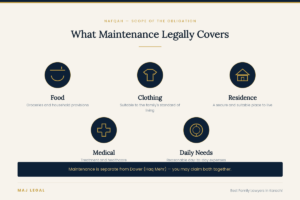
What Is “Maintenance” (Nafqah) Under Pakistani Law?
Maintenance is the financial support a husband is obliged to provide his wife for the ordinary necessities of life. Under Muslim personal law, this obligation attaches from the moment a valid nikah is performed and continues throughout the subsistence of the marriage and, in specified circumstances, for a period after its dissolution.
Maintenance is generally understood to include:
- Food and household groceries
- Clothing appropriate to the family’s standard of living
- Residence — a suitable and secure place to live
- Medical treatment and necessary healthcare expenses
- Reasonable incidental and day-to-day expenses
Crucially, maintenance is entirely separate from dower (haq mehr). A wife who has received her dower has not thereby been “paid off” for maintenance, and a wife whose dower is still outstanding can claim both in the same proceedings. Confusing the two is one of the most common and most costly mistakes we see in cases handled without proper legal advice.

The Legal Framework Governing Maintenance in Karachi
Maintenance claims in Karachi are governed by a combination of Islamic personal law and statutory law. The principal instruments are:
1. The West Pakistan Family Courts Act, 1964 (as applicable in Sindh)
This is the backbone of family litigation in Karachi. It creates the Family Courts, gives them exclusive jurisdiction over maintenance disputes, and prescribes a simplified, expedited procedure designed to avoid the delays of ordinary civil litigation.
2. The Muslim Family Laws Ordinance, 1961 Section 9
Section 9 provides an alternative route: where a husband fails to maintain his wife adequately, she may apply to the Chairman of the relevant Union Council, who constitutes an Arbitration Council empowered to issue a certificate specifying the amount payable. In modern practice, however, the Family Court route is faster, more robust and far more commonly used — and it is the route our lawyers almost always recommend.
3. The Dissolution of Muslim Marriages Act, 1939 — Section 2(ii)
This provision is significant and widely underused. Where a husband has neglected or failed to provide maintenance for a period of two years, the wife has an independent statutory ground to seek dissolution of the marriage. Non-payment of maintenance is therefore not merely a debt — it can be a basis for ending the marriage itself.
4. Amendments to the Family Courts Act
Legislative amendments have significantly strengthened the position of claimants by introducing interim maintenance during the pendency of proceedings, allowing suits to be filed where the wife resides, and requiring courts to dispose of family cases within fixed timelines.
For non-Muslim citizens of Pakistan, Family Courts also exercise jurisdiction, with claims determined under the relevant personal law including the Divorce Act, 1869 for Christian citizens and the Hindu Marriage Act, 2017 for Hindu citizens.
Who Is Entitled to Claim Maintenance?
A wife is entitled to maintenance from her husband where:
- There is a valid marriage (a registered nikahnama is the strongest proof, though marriage may be established by other evidence);
- She has not, without lawful justification, refused to perform her marital obligations; and
- The husband has failed or refused to maintain her adequately.
Does a Working Wife Lose Her Right?
No. This is perhaps the single most persistent myth in family law practice in Karachi. The superior courts of Pakistan have consistently held that a wife’s own income does not extinguish her husband’s legal obligation to maintain her. A woman who works as a doctor, teacher, banker or entrepreneur retains her right to maintenance. Her income may, in some cases, be a factor the court considers in fixing the quantum — but it is not a bar to the claim.
What If the Wife Is Living Separately?
Where a wife has been compelled to leave the matrimonial home because of cruelty, physical or emotional abuse, a second marriage contracted without her knowledge, or the husband’s failure to provide a separate and secure residence, her right to maintenance continues. The law does not require a woman to endure mistreatment as the price of financial support.
Conversely, where a wife withdraws from her husband’s society without lawful excuse, the husband may raise this as a defence. Whether the excuse is lawful is a question of fact and evidence — which is precisely why the quality of your legal representation matters. Our team at MAJ Legal, widely regarded among the top family lawyers in Karachi, builds these cases on documentary and testimonial evidence from the very first hearing.
How Much Maintenance Will the Court Award?
There is no fixed statutory formula and no published table of amounts. The Family Court exercises judicial discretion, guided by three broad considerations:
1. The husband’s financial capacity. Salary slips, bank statements, tax returns, business records, property holdings, vehicle registrations and lifestyle evidence all bear on this.
2. The status and standard of living of the parties. A wife is entitled to maintenance consistent with the standard of living she reasonably enjoyed during the marriage.
3. The reasonable needs of the wife, including rent, utilities, medical costs and dependent children where applicable.
In Karachi, awards vary enormously — from modest monthly sums where the husband is a daily-wage earner, to substantial figures where the husband is a professional, businessman or overseas Pakistani. What matters far more than any “average figure” is the quality of the financial evidence placed before the court. Husbands routinely understate their income. Establishing true earning capacity through documentary discovery, salary certificates, bank records and cross-examination is where an experienced maintenance lawyer in Karachi earns their fee.
Annual Increase in Maintenance
Recognising the reality of inflation, Family Courts now routinely fix an annual increase in the maintenance decreed, commonly in the region of ten percent per year. This means a decree obtained today does not lose its value over time. Your lawyer should specifically press for this at the time of final arguments — where a decree is silent on the point, disputes later arise at the execution stage.
Interim Maintenance: Relief While the Case Is Pending
This is one of the most important protections available to a wife, and it is frequently overlooked.
A maintenance suit takes time. A wife with no income cannot be expected to wait for a final decree while going hungry. The law therefore empowers the Family Court to pass an interim maintenance order at an early stage of proceedings, fixing a monthly amount payable during the pendency of the case.
The teeth in this provision are significant: where a husband fails to pay the interim maintenance by the date fixed by the court each month, the court may strike off his defence and decree the suit in the wife’s favour. In other words, a husband who ignores an interim order risks losing the entire case without ever presenting his side.
At MAJ Legal, we apply for interim maintenance at the earliest opportunity in virtually every case. It provides immediate financial relief and creates powerful pressure toward a fair settlement.
Maintenance After Divorce, Talaq and Khula
Maintenance During Iddat
Following a divorce, a wife observes the period of iddat ordinarily three menstrual cycles, or approximately ninety days, and in the case of a pregnant wife, until delivery. The husband remains liable to maintain her throughout the iddat period. This is a settled principle and is regularly decreed by Family Courts in Karachi.
Maintenance in Khula Cases
Where a wife obtains dissolution of marriage by way of khula, she ordinarily restores or forgoes her dower as consideration. The position regarding maintenance is more nuanced and depends on the terms of the decree, the conduct of the parties and the circumstances that led to the breakdown. Claims for past maintenance and arrears accrued before the khula decree are frequently maintainable and should not be abandoned without advice.
This is an area where generic advice is genuinely dangerous. If you are contemplating khula, speak to a qualified family lawyer in Karachi before filing, so that your maintenance and dower claims are properly protected in the same proceedings rather than lost.
Maintenance After Iddat
Under classical Muslim law, the husband’s obligation to maintain generally ends with the expiry of the iddat period. However, obligations relating to children continue entirely independently, and arrears accrued during the marriage remain recoverable as a decreed debt.
Past Maintenance and Arrears
A wife is not confined to claiming maintenance from the date she files her suit. Where a husband has failed to maintain her for a preceding period, Family Courts in Pakistan may decree arrears of past maintenance as well.
The period for which arrears are allowed lies within the court’s discretion and depends on the pleadings, the evidence and the facts of the case. What is essential is that past maintenance is specifically claimed in the plaint. A claim not pleaded is a claim not decreed. We have seen women lose years of legitimate arrears because a poorly drafted plaint asked only for future maintenance.
Maintenance for Children
Although this article concerns wife maintenance, the two claims almost always travel together, and it is worth being clear on the distinction.
A father is legally obliged to maintain his children sons until they attain majority and are able to earn, and daughters until their marriage. This obligation is independent of the wife’s claim and survives divorce entirely. A divorced mother who has no personal claim to maintenance after iddat retains the right to claim maintenance for the children in her custody, including their educational and medical expenses.
Both claims can be, and normally should be, combined in a single suit — along with custody, dower and recovery of dowry articles. Consolidating claims saves years of litigation. Our lawyers at MAJ Legal routinely structure family suits this way.
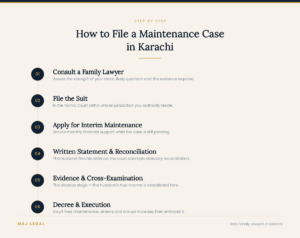
How to File a Maintenance Case in Karachi: Step by Step
Step 1 — Consult a Family Lawyer
An initial consultation establishes the strength of your claim, the likely quantum, and the documents required. At MAJ Legal, a leading family law firm in Karachi, this first meeting is entirely confidential.
Step 2 — Determine the Correct Family Court
The law permits a wife to institute a suit for maintenance in the Family Court within whose jurisdiction she ordinarily resides. This is a major practical protection a woman living in Gulshan-e-Iqbal is not obliged to litigate in a distant district merely because her husband lives there. Karachi’s Family Courts sit within the District Court complexes of District South, East, West, Central, and Malir
Step 3 — Draft and File the Plaint
The plaint must set out the marriage, the husband’s failure to maintain, his financial capacity, the amount claimed (both future and arrears), and the annual increase sought. Precision at this stage determines the ceiling of what you can recover.
Step 4 — Service of Summons
The court issues notice to the husband. Where a husband evades service — a very common tactic — service may be effected by substituted means, including publication and, increasingly, electronic modes.
Step 5 — Application for Interim Maintenance
Filed at the earliest stage to secure immediate monthly relief.
Step 6 — Written Statement and Framing of Issues
The husband files his defence; the court identifies the disputed questions requiring evidence.
Step 7 — Pre-Trial Reconciliation
The Family Court is statutorily required to attempt reconciliation. If a fair settlement emerges, it is recorded and made part of a consent decree.
Step 8 — Evidence and Cross-Examination
Both parties lead evidence. This is the decisive stage in maintenance litigation — the husband’s true income is established or exposed here.
Step 9 — Arguments and Judgment
The court passes a decree fixing monthly maintenance, arrears and annual increase.
Step 10 — Execution
If the husband does not pay, execution proceedings follow (discussed below).
Documents required for filling the Maintenance Case
Documents You Should Bring to Your First Consultation
- Nikahnama (marriage certificate) — the single most important document
- CNIC copies of yourself and your husband
- Children’s B-Forms or birth certificates, if applicable
- Any divorce deed or talaq notice, if divorce has occurred
- Evidence of your husband’s income: salary slips, appointment or employment letter, bank statements, tax returns, business or trade licence, property or vehicle documents
- Proof of your own expenses: rent agreement, utility bills, school fee receipts, medical bills
- Correspondence — WhatsApp messages, emails, text messages evidencing refusal to maintain or admissions of income
- Any earlier legal notices, FIRs or complaints filed by either party
Do not worry if you cannot obtain all of your husband’s financial records. Courts have the power to summon employers, banks and public authorities to produce records and an experienced lawyer knows exactly which applications to file.
How Long Does a Maintenance Case Take in Karachi?
The Family Courts Act requires family suits to be disposed of expeditiously, and courts are directed to conclude proceedings within a fixed statutory period ordinarily six months from institution.
In practice, timelines in Karachi vary with the district, the court’s docket, and above all the degree to which the husband contests or attempts to delay. A straightforward, well-pleaded maintenance suit may conclude within several months. A heavily contested matter involving disputed income, evasion of service or parallel proceedings can take longer.
What genuinely shortens a case: complete documentation at filing, an early interim maintenance application, and a lawyer who appears on every date. What lengthens it: adjournments, incomplete pleadings, and counsel who treat family matters as low-priority work.
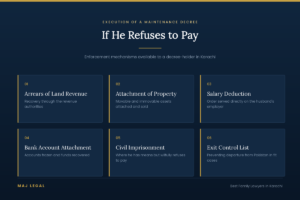
What If the Husband Refuses to Pay After the Decree?
A decree is not the end of the road, and Pakistani law provides real enforcement mechanisms. Through execution proceedings before the Family Court, a decree-holder may seek:
- Recovery as arrears of land revenue — a powerful mechanism engaging the revenue authorities in recovery
- Attachment and sale of the husband’s movable and immovable property
- Direct deduction from salary, through an order addressed to the husband’s employer
- Attachment of bank accounts
- Civil imprisonment of a judgment-debtor who has the means to pay but wilfully refuses
- Placement of the husband’s name on the Exit Control List in appropriate cases, preventing him from leaving Pakistan
We say this to every client: obtaining a decree is half the work. Enforcing it is where cases are truly won. At MAJ Legal, we pursue execution with the same seriousness as the trial itself.
Maintenance Claims Against Overseas Pakistani Husbands
Karachi’s Family Courts regularly deal with husbands residing in the Gulf, the United Kingdom, the United States, Canada and Australia. Absence from Pakistan is not a shield. Suits may proceed, service can be effected through substituted modes, and where a husband fails to appear, the court may decree the suit ex parte.
Enforcement against overseas assets requires strategy — including attachment of any property or accounts held in Pakistan and, where applicable, ECL placement. Our firm has handled numerous cross-border maintenance matters and understands both the procedural and the practical dimensions of recovery.
Common Mistakes That Weaken Maintenance Cases
- Claiming only future maintenance and omitting arrears from the plaint.
- Filing maintenance separately from dower, dowry articles and custody, resulting in years of parallel litigation.
- Failing to seek an annual increase, so the decree erodes with inflation.
- Not applying for interim maintenance early, leaving the wife without support for the duration of the trial.
- Understating the husband’s income for want of documentary evidence, when court process could have compelled disclosure.
- Accepting an informal verbal settlement with no decree — which is unenforceable when payments stop three months later.
- Delaying the case in the hope of reconciliation while the two-year period under the Dissolution of Muslim Marriages Act quietly runs.
Every one of these is avoidable with competent representation from the outset.
Why Choose MAJ Legal — Among the Best Family Law Firms in Karachi
Family litigation is not ordinary litigation. It involves your home, your children and your financial security, often at the most difficult point in your life. It demands both technical skill and genuine discretion.
MAJ Legal is a full-service law firm in Karachi with a dedicated family law practice. Clients across Karachi come to us because of:
- Focused family law expertise — maintenance, khula, divorce, custody, guardianship, dower and dowry recovery
- Extensive Family Court experience across all district courts in Karachi
- Strategic case consolidation, so you fight one case instead of five
- Aggressive interim relief applications, securing financial support from the earliest stage
- Serious execution and recovery practice, because a decree that is not enforced is only paper
- Complete confidentiality and a professional, non-judgmental approach
- Clear, honest advice on cost and timeline — no inflated promises
Whether you are a wife seeking to enforce your legal right to maintenance, or a husband facing a claim you believe to be excessive or unfounded, our team provides clear, strategic and effective representation.
Frequently Asked Questions
Can I claim maintenance while I am still married and living with my husband? Yes. The obligation to maintain arises from the marriage itself, not from separation. A wife living in the matrimonial home who is not being adequately maintained may file a suit.
I am working and earning well. Can I still claim maintenance? Yes. A wife’s independent income does not extinguish the husband’s legal obligation to maintain her.
Can I claim maintenance for the period before I filed the case? Yes — past maintenance and arrears may be decreed, provided the claim is specifically pleaded. The period allowed lies within the court’s discretion.
My husband says he will stop paying if I file a case. What can I do? File. An interim maintenance order can be obtained early in the proceedings, and a husband who fails to comply risks having his defence struck off and the suit decreed against him.
Am I entitled to maintenance after khula? The position depends on the terms of the decree and the circumstances of the case. Arrears accrued prior to the khula are frequently recoverable, and children’s maintenance continues regardless. Specific legal advice is essential here.
My husband lives abroad. Can I still file in Karachi? Yes. Suits may be filed in the Family Court where you ordinarily reside, service can be effected by substituted means, and the court may proceed ex parte if he does not appear.
How much does it cost to file a maintenance case in Karachi? Court fees in family matters are nominal by design, so that cost is not a barrier to justice. Professional fees vary with the complexity of the matter. MAJ Legal discusses fees transparently at the first consultation.
What if my husband hides his income or claims to be unemployed? Courts may summon employers, banks and public record-keepers to produce documents, and may draw adverse inferences from a husband’s failure to disclose. Lifestyle evidence is also relevant.
Does maintenance stop if I remarry? A wife’s entitlement to maintenance from her former husband ends upon remarriage. The father’s obligation to maintain his children, however, continues.
Speak to the Best Family Lawyers in Karachi
You do not have to accept being left without financial support. The law of Pakistan gives you a clear, enforceable right — what you need is someone who knows how to use it.
If you are dealing with a maintenance dispute, khula, divorce, child custody or recovery of dower and dowry articles, contact MAJ Legal today for a confidential consultation with one of the top family lawyers in Karachi.
MAJ Legal — Best Family Law Firm in Karachi 📞 Phone / WhatsApp: [0092-3003444617] 📧 Email: [info@gmail.com] 📍 Office: [G4, Building No. 8-C, Khayaban-e-Shamsheer DHA Phase V ], Karachi 🌐 Website: [www.majlegal.com]
Disclaimer: This article is provided for general information only and does not constitute legal advice. The law and its application vary with the facts of each case. Readers should obtain independent legal advice from a qualified advocate before acting on any information contained here. Reading this article does not create a lawyer–client relationship with MAJ Legal.