

Section 160 CrPC Notice by FIA in Pakistan (Karachi)
A complete legal guide by MAJ Legal — Barristers | Advocates & Legal Consultants, Karachi
An envelope arrives at your registered office. Or a WhatsApp message lands on your phone from an unknown number. It carries a Federal Investigation Agency letterhead, an inquiry number, and a line that stops most people cold: “You are hereby directed to appear before the undersigned under Section 160 Cr.P.C.”
For a chief executive, a company director, a finance manager, or an ordinary salaried employee, that single sheet of paper is often the first contact they will ever have with Pakistan’s federal criminal justice machinery. What you do in the first forty-eight hours after receiving it will shape everything that follows.
This guide explains exactly what a Section 160 CrPC notice is, where the FIA gets the power to issue one, what it can and cannot compel you to do, and how to respond. It is written by the team at MAJ Legal, widely regarded among the best law firms in Karachi for FIA, white-collar and corporate criminal defence work, and it reflects how these matters actually run in the FIA circles at Karachi — not just how the statute reads on paper.
Quick Answer: What Is a Section 160 CrPC Notice?
A Section 160 CrPC notice is a written order compelling a person to attend before an investigating officer so that their statement can be recorded. It is issued under Section 160 of the Code of Criminal Procedure, 1898. When the FIA issues one, it is exercising police powers conferred on it by Section 5 of the Federal Investigation Agency Act, 1974.
Three things matter more than anything else:
- It is a summons to attend, not an arrest warrant. It confers no power to detain you.
- It does not, by itself, make you an accused. Section 160 is directed at any person who “appears to be acquainted with the circumstances of the case” — most recipients are witnesses.
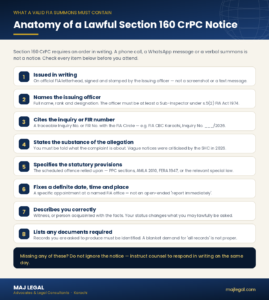
- It must be in writing. A phone call is not a Section 160 notice. Neither, strictly, is a WhatsApp forward.
The Statutory Text: Section 160 of the Code of Criminal Procedure, 1898
Section 160 sits in Chapter XIV of the Code, which governs information to the police and their powers to investigate. In Pakistan the provision reads:
- Police-officer’s power to require attendance of witnesses. Any police-officer making an investigation under this Chapter may, by order in writing, require the attendance before himself of any person being within the limits of his own or any adjoining station who, from the information given or otherwise, appears to be acquainted with the circumstances of the case; and such person shall attend as so required.
Four ingredients are built into that sentence, and each one is a potential ground of objection:
“Making an investigation under this Chapter.” The officer must be conducting an investigation — a defined statutory function, not a fishing expedition.
“By order in writing.” The mode is mandatory. The Code does not contemplate telephonic or verbal summonses.
“Within the limits of his own or any adjoining station.” There is a territorial component. For the FIA this is heavily modified by its own statute, discussed below.
“Appears to be acquainted with the circumstances of the case.” There must be some rational basis connecting you to the facts under inquiry. A notice issued to a person with no discernible nexus to the allegations is vulnerable.
Note what the Pakistani text does not contain: unlike the Indian Code of 1973, our Section 160 has no proviso exempting women, minors or the elderly from attending at a place other than their residence. That protection in Pakistan flows instead from constitutional guarantees, from the Police Rules, and from settled practice — a distinction the top lawyers in Karachi handling FIA matters will raise where a female client or an elderly director is summoned.
Where Does the FIA Get the Power to Issue a Section 160 Notice?
The FIA is not a provincial police force. Its authority comes from the Federal Investigation Agency Act, 1974 (Act VIII of 1975), and this is where most laypersons — and quite a few lawyers — go wrong.
Section 3: Only Scheduled Offences
The FIA is constituted for inquiry into and investigation of the offences specified in the Schedule to the Act, including attempts, conspiracies and abetment. If the conduct alleged against you does not fall within a scheduled offence, the FIA has no jurisdiction at all — and a Section 160 notice issued in such a matter is liable to be challenged at the threshold.
The Schedule covers, among other things, specified offences under the Pakistan Penal Code (cheating, criminal breach of trust, forgery, counterfeit currency, dishonoured cheques under section 489-F), offences under the Foreign Exchange Regulation Act 1947, the Anti-Money Laundering Act 2010, immigration and passport legislation, anti-trafficking law, copyright and intellectual property statutes, and offences relating to banks.
Section 5: Police Powers, and the Critical Words “Inquiry or Investigation”
Section 5 is the engine. In substance:
- Section 5(1) gives members of the Agency, throughout Pakistan, the powers of provincial police officers in relation to search, arrest and seizure of property — for the purpose of an inquiry or investigation under the Act.
- Section 5(2) provides that a member not below the rank of Sub-Inspector may, for the purposes of any inquiry or investigation, exercise the powers of an officer in charge of a police station in any area where he happens to be, and shall be deemed to be such an officer.
- Section 5(3) permits a member not below Sub-Inspector rank, authorised by the Director-General, to arrest without warrant in respect of scheduled offences.
- Section 5(5) allows a member conducting an investigation to direct, by written order, that property which is the subject-matter of the investigation not be removed, transferred or disposed of — the provision routinely used to debit-block bank accounts.
Two consequences follow, and they are the heart of most FIA litigation in Karachi.
First, the territorial limit in Section 160 largely falls away. Because Section 5(1) confers powers “throughout Pakistan,” an FIA officer at a Karachi circle can lawfully summon a person residing in Lahore or Peshawar in a way an ordinary SHO could not. Objections based purely on the “adjoining station” language rarely succeed against the FIA.
*Second and this is the crucial point, Section 5 expressly extends police powers to an inquiry, not merely an investigation. Ordinary police under the Code can only invoke Section 160 once an investigation has begun, which presupposes a registered FIR. The FIA’s own statute is drafted more widely. That is why the FIA can, and constantly does, issue Section 160 notices at the pre-FIR inquiry stage. Indian High Court authority holding that a Section 160 notice cannot precede an FIR is frequently cited by counsel in Pakistan, but it must be read subject to Section 5 of the FIA Act — a nuance the best criminal lawyers in Karachi* address head-on rather than ignore.
The FIA (Inquiries and Investigations) Rules, 2002
The Rules framed under Section 9 of the Act supply the procedural discipline:
- Rule 3 permits the Agency to initiate an inquiry or investigation on its own initiative or on a complaint or information, oral or written; once registered, it must proceed “with care and discretion” and without undue publicity.
- Complaints may be verified by an officer of Deputy Director rank or above to establish the complainant’s identity and the genuineness of the complaint.
- No action may be taken on an anonymous or pseudonymous complaint. This is a frequently overlooked and highly useful rule.
- Where the competent authority decides not to initiate an inquiry, it must record reasons.
- Rule 6 requires registration of a case and consequential arrest of a public servant to be reported to the head of his department within twenty-four hours.
- Rule 7 empowers the Secretary Interior and the Director-General to call for the record of any inquiry and issue directions for its fair and speedy disposal — a practical internal remedy that experienced counsel use before rushing to court.
The Sindh High Court has repeatedly reminded the Agency that it “is under obligation to strictly act in terms of the Federal Investigation Agency Act, 1974 and the Federal Investigation Agency (Inquiries and Investigations) Rules, 2002.”
What a lawful Section 160 CrPC notice from the FIA must contain — checklist by MAJ Legal, best FIA lawyers in Karachi
First Question: Was It Really the FIA? The NCCIA Split
Before you analyse anything else, look at the letterhead.
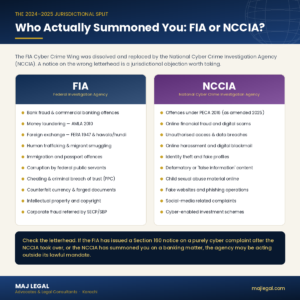
In May 2024 the Federal Government established the National Cyber Crime Investigation Agency (NCCIA) under Section 51 of the Prevention of Electronic Crimes Act, 2016. The FIA’s Cyber Crime Wing was dissolved, and all cybercrime cases, complaints and staff were transferred to the new agency, which became operationally active during 2025. The PECA (Amendment) Act, 2025 consolidated the position, and the NCCIA now exercises jurisdiction over offences under PECA.
This has a direct and practical consequence for anyone receiving a summons.
- If your matter concerns online fraud, digital harassment, hacking, unauthorised access, identity theft, defamatory online content, fake websites or social-media complaints, the correct agency is now the NCCIA, not the FIA.
- If your matter concerns banking fraud, money laundering, foreign exchange, hawala/hundi, human trafficking, immigration and passport offences, corruption by federal public servants, counterfeit currency, intellectual property or corporate fraud, it remains with the FIA.
A Section 160 notice issued by the wrong agency is a genuine jurisdictional objection — and in our experience one of the most productive early points available to the defence. The best cyber crime lawyers in Karachi and the top FIA lawyers in Karachi are now, in effect, dealing with two separate federal agencies with two separate mandates, and conflating them is a costly mistake.
The Sindh High Court has already been dealing with NCCIA notices in precisely this frame. In Murtaza v. Director General, NCCIA (C.P. No. D-551 of 2026, decided 21 April 2026), the petitioner — the owner of an SECP-registered IT services company — challenged repeated Section 160 notices sent by WhatsApp and later by consolidated courier, which failed to disclose the substance of the allegations against him. The Court declined to halt the inquiry outright, but held that the requirement to disclose sufficient particulars of the allegations “is inherent in the principle of fair treatment so that a person may meaningfully respond to the inquiry,” observed that the manner of service raised concerns about procedural propriety, and directed the agency to furnish a clear statement of allegations with relevant particulars before requiring further attendance, and to communicate through legally recognised modes.
That is now the working standard in Sindh: the agency may inquire, but it must tell you what the inquiry is about, and it must serve you properly.
FIA vs NCCIA jurisdiction after the 2024–2025 split — Section 160 notice guide by MAJ Legal Karachi
Inquiry, Investigation, FIR, Challan: Where Does Your Notice Sit?
The single most important diagnostic question when a client walks into our Karachi office with an FIA notice is: what stage are we at? The answer determines the entire strategy.
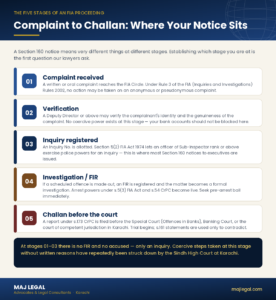
Stage 1 — Complaint
A written or oral complaint reaches the FIA circle. At this point nothing has been registered. No anonymous or pseudonymous complaint may be acted upon at all.
Stage 2 — Verification
An officer of Deputy Director rank or above may verify the complainant’s identity and the genuineness of the complaint. There is no coercive power at this stage. Your bank accounts should not be blocked; your property should not be attached; you should not be arrested.
Stage 3 — Inquiry
An Inquiry Number is allotted. This is where the large majority of Section 160 notices to company officers originate. You are not an accused. There is no FIR. But the FIA does hold statutory police powers under Section 5(2) for the purposes of the inquiry, so the notice is not a nullity and must not be ignored.
Stage 4 — Investigation and FIR
If a scheduled offence is disclosed, an FIR is registered and the matter converts into a formal investigation. Arrest powers under Section 5(3) of the FIA Act and Section 54 CrPC become live. This is the point at which pre-arrest bail becomes urgent.
Stage 5 — Challan
A report under Section 173 CrPC is submitted to the court of competent jurisdiction in Karachi — commonly the Special Court (Offences in Banks) for banking offences, the Banking Court, the Special Court (Central), or the relevant Sessions Court. Trial commences.
Understanding this ladder is what separates competent representation from panic. Coercive steps taken at Stages 1 to 3, without written reasons, have repeatedly been struck down by the Sindh High Court at Karachi.
The five stages of an FIA proceeding from complaint to challan — MAJ Legal, top criminal law firm in Karachi
Who Gets a Section 160 Notice? CEOs, Directors, Managers and Employees
Section 160 reaches any person who appears to be acquainted with the circumstances of the case. In corporate matters — which is where MAJ Legal does much of its FIA work — the Agency routinely issues notices across the whole hierarchy, sometimes on the same day.
The Chief Executive Officer
CEOs are typically summoned as the “controlling mind” of the company. Watch carefully for vicarious liability framing: the assumption that because you hold the office, you must have known. In Pakistani criminal law, designation alone is not evidence of knowledge or mens rea. A CEO’s first statement should establish, precisely and on the record, the limits of their personal involvement, the delegation structure, and the approvals that did and did not pass through them.
Directors and Board Members
Directors are called on approvals, board resolutions and signatures. Non-executive directors and nominee directors are particularly exposed to being swept into an inquiry on the basis of a name on a Form A or an annual return. Their limited role must be established in writing at the very first appearance, supported by minutes, terms of appointment and correspondence.
The Chief Financial Officer and Finance Head
CFOs are the most heavily targeted officers in banking, Anti-Money Laundering Act 2010 and Foreign Exchange Regulation Act 1947 matters. Expect detailed questioning on remittances, letters of credit, invoicing patterns, related-party transactions and account operations. Answers here have real consequences: a loose or speculative reply about a transaction you did not personally handle can anchor an allegation for years.
Company Secretary and Compliance Officers
Usually summoned as custodians of statutory records rather than to answer on the merits. The correct posture is cooperative production of identified documents against a written receipt — not a substantive interview on transactions you did not execute.
Branch, Department and Operations Managers
Managers are called on day-to-day execution: approvals, disbursements, dispatch, customer onboarding, hiring. They frequently have the best factual knowledge and the least legal protection, which is exactly why they should not attend alone.
Employees and Junior Staff
Almost always genuine witnesses. It is worth stating plainly to junior staff, who are often terrified: a statement recorded under Section 161 CrPC is not signed by you and is not substantive evidence. It may only be used at trial to contradict a witness. This is a real protection, and it is routinely misunderstood.
Former Employees
Ex-employees are frequently summoned long after leaving, sometimes years later. You may attend and state candidly that you no longer have access to company records and cannot produce them. You cannot be compelled to produce what you do not possess.
Bankers, Auditors, Vendors and Consultants
Third parties are called to corroborate. Professional privilege, client confidentiality and statutory secrecy obligations should be asserted where they genuinely apply — and only where they genuinely apply.
A critical practical warning: never allow two officers of the same company to attend on the same facts without separate legal advice. Their interests may diverge sharply, and a statement by one can be deployed against the other.
Who receives an FIA Section 160 notice — CEO, director, CFO, manager and employee exposure, MAJ Legal Karachi

What Actually Happens at the FIA Office
You present the notice at the reception of the relevant circle. You wait — often a long time. You are taken to the investigating officer’s room. Questions are asked and a statement is recorded under Section 161 CrPC, generally in Urdu, sometimes in English, typically in narrative form and written by the officer rather than by you.
Under Section 161(1) CrPC, the officer may examine orally any person supposed to be acquainted with the facts and circumstances of the case. Under Section 161(2), you are bound to answer all questions relating to the case truthfully — other than questions the answers to which would have a tendency to expose you to a criminal charge, penalty or forfeiture.
Under Section 162 CrPC, that statement is not to be signed by you, and its use at trial is confined to contradicting the maker.
In practice, four things go wrong repeatedly:
- The statement is written by the officer and reads nothing like what the witness said. Read it before you leave. Ask for corrections. If refused, record your objection in writing the same day.
- Documents are handed over without any receipt. Never do this. Always obtain a signed, dated acknowledgement listing each document.
- Devices are “voluntarily” surrendered. Handing over a laptop or phone under the impression that you have no choice is not consent. Seizure of digital devices requires lawful authority; where PECA applies, the framework of warrants and preservation orders under that Act governs, and the agency must approach the court. Ask what power is being exercised and ask to see it.
- The witness answers questions about matters outside their own knowledge. Speculation becomes “evidence.” Answer only what you actually know.
Can the FIA Arrest You on a Section 160 Notice?
No. A Section 160 notice is a direction to attend. It is not a warrant and it carries no power of detention.
That said, the honest answer is more layered, and clients deserve the full picture. If, during your attendance, the officer forms a reasonable suspicion that you have committed a scheduled offence, arrest powers exist independently — under Section 5(3) of the FIA Act 1974 for an authorised officer of Sub-Inspector rank or above, and under the general provisions of Section 54 CrPC. Those powers do not flow from the notice, but they can be exercised in the same building.
This is precisely why attending an FIA inquiry unaccompanied is unwise where the allegations are serious. Where there is any realistic apprehension of arrest, the correct sequence is to secure pre-arrest (anticipatory) bail under Section 498/498-A CrPC from the appropriate court in Karachi before the appearance, and then attend and cooperate fully. Cooperation and protection are not alternatives; a good defence secures both.
The issue has reached the highest level. In 2024, after the FIA issued Section 160 notices across the country to journalists in connection with inquiries registered at cyber crime reporting centres — notices that stated only the gist of allegations without particulars — the Attorney-General for Pakistan gave an undertaking to the Supreme Court that the recipients would not be arrested. The episode is a useful reminder that vague notices attract judicial scrutiny.
Bank Account Blocks: Section 5(5) and the Rayan Technology Judgment
For businesses, the most damaging thing the FIA does is rarely the summons. It is the debit block on company bank accounts under Section 5(5) of the FIA Act 1974 — an order that can freeze payroll, supplier payments and letters of credit overnight.
The law here is now firmly settled in Karachi, and it favours the citizen.
In Rayan Technology (Private) Limited v. Federation of Pakistan (C.P. No. D-2681 of 2025), decided by a Division Bench of the Sindh High Court at Karachi on 31 July 2025, a bank lodged a complaint with the FIA on 5 June 2025. On the very same day, the complaint was marked for verification and the FIA issued a notice directing the petitioner’s banks to block its accounts. No FIR had been registered and no investigation was pending.
The Court reviewed the established line of authority — Muhammad Muslim v. Federal Investigation Agency (PLD 1984 Karachi 71), Fazal Mahmood v. Sardar Khan (PLD 1996 Karachi 475), Uzma Adil Khan v. Federal Investigation Authority (2023 CLD 599), Muhammad Sohail Shaikh v. The State (PLD 2021 Lahore 612) and Muhammad Bilal Nawaz v. Director General FIA Punjab (PLD 2024 Lahore 584) — and distilled the following requirements:
- Normally there must be an order of the appropriate authority before property that is the subject-matter of an FIA investigation is seized. Section 5(5) is an exception for exceptional cases only.
- The officer must establish that sufficient time was not available to approach the appropriate authority.
- The officer must form an opinion in writing, with reasons, recorded in the case diary. Omission of that reasoning renders the order a nullity.
- The power is not unfettered; it must be used sparingly, with restraint and caution, because its misuse infringes Article 24(1) of the Constitution, which protects against being deprived of property save in accordance with law.
- Section 24-A of the General Clauses Act, 1897 independently requires every statutory power to be exercised reasonably, fairly, justly and for the advancement of the purposes of the enactment, with reasons given and a copy supplied to the person prejudicially affected.
Applying those principles, the Court held that the power had been used “in haste, without any caution or restrain, and without forming an opinion in writing in the case diaries,” declared the blocking notice void, unlawful and without jurisdiction, and ordered the block removed forthwith — while expressly preserving the FIA’s right to continue the inquiry lawfully.
If your company’s accounts have been blocked by the FIA, this is the judgment your counsel should be building on. Handling these petitions is core work for the best banking fraud lawyers in Karachi and the top corporate criminal defence lawyers in Karachi.
What Happens If You Ignore a Section 160 Notice?
Ignoring the notice is the worst available option, and it is remarkably common.
Legally, wilful non-attendance in obedience to a lawful order from a public servant competent to issue it is an offence under Section 174 of the Pakistan Penal Code, 1860 — a summary offence attracting simple imprisonment for a short term or a fine. Related provisions cover omission to produce a document to a public servant lawfully requiring it (Section 175 PPC) and omission to give information (Section 176 PPC). Section 94 CrPC separately empowers a written order for the production of documents.
Practically, the consequences are worse than the penalty:
- Repeated non-appearance is recorded in the case diary and read as consciousness of guilt.
- It substantially increases the likelihood of the inquiry converting into an FIR.
- It invites coercive measures: raids, account blocks, and placement on the Exit Control List or Provisional National Identification List.
- It destroys the single best argument available to you at the bail stage — that you cooperated fully throughout.
The correct response is never silence. It is a written reply, sent the same day, acknowledging receipt, seeking particulars of the allegations, and either confirming attendance on the fixed date or seeking a short, reasoned adjournment.
Your Rights When the FIA Summons You
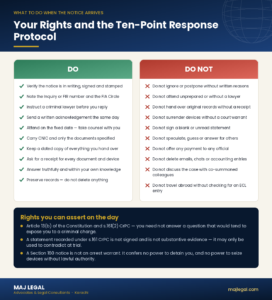
These are the protections you can assert, politely and on the record:
Article 13(b) of the Constitution of Pakistan, 1973 — no person accused of an offence shall be compelled to be a witness against himself. Read with Section 161(2) CrPC, you are not obliged to answer a question whose answer would tend to expose you to a criminal charge, penalty or forfeiture. Say so expressly rather than lying or evading.
Article 4 — the right to be dealt with in accordance with law, and the right not to be prevented from doing anything the law does not prohibit.
Article 10A — the right to a fair trial and due process, which the superior courts have applied to pre-trial investigative conduct.
Article 14 — the inviolability of dignity and, subject to law, the privacy of the home.
Article 24(1) — no compulsory deprivation of property save in accordance with law: the constitutional anchor for challenging account blocks and seizures.
Section 162 CrPC — your statement is not signed and is not substantive evidence; it may be used only to contradict you at trial.
The right to know the allegations. Following the Sindh High Court’s direction in 2026, a vague notice that does not disclose the substance of the complaint can be met with a written demand for particulars before attendance.
The right to counsel. Nothing in Section 160 or the FIA Act prohibits you from attending with your lawyer. Insist on it.
Your rights and a ten-point response protocol for an FIA Section 160 notice — MAJ Legal, best lawyers in Karachi
Overseas Pakistanis and FIA Notices
A large share of MAJ Legal’s FIA practice involves overseas Pakistanis, directors of Pakistani companies living in Dubai, London, Toronto or Jeddah who receive notices at a Karachi registered office they visit twice a year, or expatriates named in a complaint by a former business partner.
Section 160 contemplates personal attendance, and there is no general statutory mechanism for appearing through an attorney to record a statement. However, in practice a great deal can be achieved without an immediate flight to Karachi:
- Counsel can appear and file a written response on your behalf, placing your position and documents on record, and seeking particulars of the allegations.
- A reasoned application for a later date to coincide with a planned visit is routinely entertained where cooperation is evident from the outset.
- Pre-arrest bail can be obtained in advance so that your appearance in Karachi is protected.
- ECL and PNIL entries must be checked before you travel. Discovering a blacklist entry at Jinnah International Airport is a materially worse outcome than discovering it from counsel three weeks earlier.
- Where a complaint arises from a purely civil or contractual dispute — an unpaid invoice, a shareholder disagreement, a terminated services agreement — the conversion of that dispute into a criminal inquiry is itself challengeable, as the Sindh High Court recognised in the 2026 NCCIA case.
It is worth noting a jurisdictional point that distinguishes Sindh from Punjab: Sindh has no equivalent of Punjab’s dedicated overseas Pakistanis courts. Overseas clients with Karachi-based matters proceed through the ordinary criminal courts and the constitutional jurisdiction of the Sindh High Court, which makes early, correctly-framed representation more important, not less. This is one of the areas where an experienced Karachi firm adds disproportionate value.
Your Ten-Point Response Protocol
- Verify the notice is genuine — official letterhead, signature, stamp, officer’s name and rank, inquiry or FIR number, and the FIA circle.
- Identify the agency — FIA or NCCIA? Confirm the mandate matches the allegation.
- Identify the stage — verification, inquiry, or post-FIR investigation.
- Instruct a criminal lawyer immediately — before you reply, not after.
- Acknowledge in writing the same day and seek particulars of the allegations if the notice is vague.
- Assemble your documents — only those specified, indexed, with a covering list.
- Preserve everything — issue a litigation hold internally. Deleting emails, chats or accounting entries converts a weak case into a strong one against you.
- Assess arrest risk and secure pre-arrest bail if the allegations are serious.
- Attend on the fixed date with counsel, carry your CNIC, take a receipt for everything you hand over, and read your statement before leaving.
- Keep a complete file — every notice, reply, receipt and attendance record. It is the backbone of any subsequent petition.
Legal Remedies Against an Unlawful FIA Notice
Where a notice is vague, mala fide, jurisdictionally defective, or arises from a purely civil dispute, the following remedies are available in Karachi:
Constitutional petition under Article 199 before the Sindh High Court — the principal remedy for challenging jurisdiction, quashing coercive orders such as account blocks, and securing directions that particulars be furnished before further attendance. Courts will generally decline to halt an inquiry altogether at a preliminary stage, but they will discipline the manner in which it is conducted.
Application under Section 561-A CrPC invoking the High Court’s inherent jurisdiction to prevent abuse of process, primarily where an FIR has been registered.
Pre-arrest bail under Sections 498 and 498-A CrPC before the Sessions Court or the High Court.
Representation to the Director-General or the Secretary Interior under Rule 7 of the 2002 Rules, calling for the record and seeking directions — an underused and often rapid internal remedy.
Application for expunction of an ECL or PNIL entry through the Ministry of Interior and, on refusal, before the High Court.
Why Clients Choose MAJ Legal for FIA Matters in Karachi
MAJ Legal is a Karachi-based firm of advocates and legal consultants recognised among the best law firms in Karachi for federal criminal, white-collar and regulatory defence. Our FIA and NCCIA practice covers:
- Section 160 CrPC notice response and representation at all FIA circles in Karachi
- Banking and commercial fraud before the Special Courts and Banking Courts
- Anti-Money Laundering Act 2010 and Foreign Exchange Regulation Act 1947 matters
- Corporate criminal defence for CEOs, directors, CFOs and senior management
- Bank account debit-block challenges under Section 5(5) of the FIA Act
- Pre-arrest and post-arrest bail in scheduled offences
- Constitutional petitions before the Sindh High Court
- ECL and PNIL removal
- Cyber crime and PECA defence before the NCCIA
- Dedicated representation for overseas Pakistanis who cannot travel at short notice
If you have received a Section 160 CrPC notice from the FIA in Karachi, contact MAJ Legal before you reply to it. Early, correctly-framed intervention is consistently the difference between an inquiry that closes and an FIR that does not.
Frequently Asked Questions
What is a Section 160 CrPC notice by the FIA? It is a written order under Section 160 of the Code of Criminal Procedure, 1898, requiring you to appear before an FIA investigating officer so that your statement can be recorded. The FIA exercises this power through Section 5 of the Federal Investigation Agency Act, 1974. It is a summons to attend, not an arrest warrant, and receiving one does not make you an accused.
Can the FIA issue a Section 160 notice without an FIR? Yes. Unlike ordinary police, whose powers under Chapter XIV CrPC are tied to an investigation following an FIR, Section 5 of the FIA Act 1974 extends police powers to an inquiry as well as an investigation. Most Section 160 notices to company officers in Karachi are issued at the pre-FIR inquiry stage. The inquiry must still be registered in accordance with the FIA (Inquiries and Investigations) Rules, 2002.
Can I be arrested when I attend on a Section 160 notice? The notice itself confers no power of arrest or detention. However, independent arrest powers exist under Section 5(3) of the FIA Act and Section 54 CrPC if the officer forms a reasonable suspicion regarding a scheduled offence. Where the allegations are serious, obtain pre-arrest bail before attending.
Is a Section 160 notice sent on WhatsApp valid? Section 160 requires an order in writing. In Murtaza v. Director General, NCCIA (2026), the Sindh High Court held that service by WhatsApp followed by a consolidated courier dispatch raised concerns about procedural propriety, and directed that future communications be made through legally recognised and proper modes. Do not ignore such a message, but do have counsel raise the defect in writing.
What happens if I do not appear before the FIA? Wilful non-attendance is an offence under Section 174 of the Pakistan Penal Code. More importantly, it is recorded in the case diary, increases the risk of an FIR, and invites coercive measures including account blocks and ECL placement. Always respond in writing, even if you need more time.
Do I have to answer every question the FIA officer asks? Under Section 161(2) CrPC you must answer truthfully, except questions whose answers would tend to expose you to a criminal charge, penalty or forfeiture. That exception is reinforced by Article 13(b) of the Constitution. Assert the protection expressly rather than giving a false or evasive answer.
Can I take a lawyer with me to the FIA office? Yes. Nothing in Section 160 CrPC or the FIA Act prevents you from attending with counsel, and for any matter of substance you should.
Can the FIA take my mobile phone or laptop under a Section 160 notice? A Section 160 notice does not authorise seizure. Digital devices and data are governed by the warrant and preservation framework under the Prevention of Electronic Crimes Act, 2016, which requires the agency to approach the court. Ask what power is being exercised and obtain a written receipt for anything you hand over.
Should the FIA or the NCCIA have summoned me? It depends on the offence. Since the FIA Cyber Crime Wing was dissolved and replaced by the National Cyber Crime Investigation Agency in 2024–2025, PECA offences fall to the NCCIA, while banking, money laundering, foreign exchange, immigration, trafficking and corruption matters remain with the FIA. A notice from the wrong agency is a jurisdictional objection.
Can the FIA block my company’s bank account during an inquiry? Only in exceptional circumstances, and only where the officer records a written opinion with reasons in the case diary and establishes that there was no time to approach the appropriate authority. In Rayan Technology (Pvt) Ltd v. Federation of Pakistan (C.P. No. D-2681 of 2025), the Sindh High Court at Karachi declared such a block void where these requirements were not met.
Can a purely civil or business dispute be turned into an FIA inquiry? It should not be. Where a complaint arises from a contractual or shareholder dispute and discloses no scheduled offence, the FIA lacks jurisdiction under Section 3 of the FIA Act 1974, and the notice is challengeable under Article 199 before the Sindh High Court.
I live abroad. Do I have to fly to Karachi? Not necessarily at short notice. Counsel can appear, file a written response and seek particulars, and can apply for a date aligned with a planned visit. Check for ECL and PNIL entries before booking travel, and consider securing pre-arrest bail in advance.
Speak to MAJ Legal
MAJ Legal, Barristers | Advocates & Corporate Legal Consultants Karachi, Pakistan Website: majlegal.com
Ranked among the best lawyers in Karachi for FIA notices, white-collar crime and corporate criminal defence. We advise CEOs, directors, senior management, employees and overseas Pakistanis facing federal inquiries, from the first notice to the final order.
Disclaimer: This article is general legal information about the law of Pakistan as at the date of publication and is not legal advice. Procedure and practice vary between FIA circles and change over time. No lawyer-client relationship is created by reading this article. If you have received a Section 160 CrPC notice, obtain advice on your specific facts from a qualified advocate.