

Bail in FIA Cases in Karachi: Complete Guide to Arrest, Remand, Bail, Prosecution and Trial
Bail in FIA cases in Karachi | MAJ Legal, Barristers | Advocates & Legal Consultants
A call-up notice from the Federal Investigation Agency changes a family’s life in a single afternoon. A banking transaction is flagged. A travel agent’s client is offloaded at Jinnah International Airport. A company director’s name surfaces in an FIA enquiry. Suddenly the questions are urgent and unfamiliar: Can they arrest me? Can I get bail before arrest? Which court do I go to? What happens if I am abroad?
This guide is written by MAJ Legal, widely recognised among the best law firms in Karachi for criminal defence and FIA matters. It explains the complete criminal procedure of bail in Karachi, Pakistan — from the first inquiry notice through arrest, remand, bail, prosecution and trial. If you are searching for the best criminal lawyers in Karachi, the top FIA case lawyers in Karachi, or a bail lawyer in Karachi who handles federal offences, this article gives you the statutory framework our team applies every week before the Special Courts and the High Court of Sindh.
Table of Contents
- What the FIA Can — and Can No Longer — Investigate
- FIA Circles and Police Stations in Karachi
- Stage 1: Inquiry, Enquiry and the Section 160 Call-Up Notice
- Stage 2: FIR Registration
- Stage 3: Arrest and Remand
- Stage 4: Investigation, Interim Challan and Final Challan
- The Bail Framework Under the CrPC
- Statute-Specific Bail Bars in FIA Cases
- Which Court Hears Your Bail Application in Karachi
- Building a Winning FIA Bail Application
- Sureties, Bail Bonds and Surety Amounts
- After Bail: Prosecution and Trial Procedure
- Who Prosecutes FIA Cases
- Overseas Pakistanis, ECL, Blacklist and Red Notices
- Common Mistakes That Cost People Their Liberty
- Why MAJ Legal
- Frequently Asked Questions
1. What the FIA Can — and Can No Longer — Investigate
The Federal Investigation Agency is a federal law-enforcement body constituted under the Federal Investigation Agency Act, 1974. Its jurisdiction is not general. The FIA may only inquire into and investigate the offences listed in the Schedule to the FIA Act, 1974 — and, critically, only where those offences are connected with matters falling within federal legislative competence.
This single point is the foundation of a large proportion of successful bail applications drafted by the best criminal law firms in Karachi. If the offence is not a scheduled offence, or the federal nexus is absent, the FIA’s assumption of jurisdiction is itself open to challenge.
The FIA’s principal areas in Karachi
| Wing / Subject | Governing Law |
| Banking fraud, wilful default, offences in respect of banks | Offences in respect of Banks (Special Courts) Ordinance, 1984; PPC ss. 406, 409, 420, 468, 471, 477-A, 109 |
| Money laundering, hundi/hawala, illegal MVTS | Anti-Money Laundering Act, 2010 |
| Human smuggling and illegal emigration | Prevention of Smuggling of Migrants Act, 2018; Emigration Ordinance, 1979 |
| Human trafficking | Prevention of Trafficking in Persons Act, 2018 |
| Immigration, ECL, blacklist, deportees, offloading | Passports Act, 1974; Emigration Ordinance, 1979; Exit from Pakistan (Control) Ordinance, 1981 |
| Corruption by federal public servants | Prevention of Corruption Act, 1947, s. 5(2) |
| Foreign exchange offences | Foreign Exchange Regulation Act, 1947 |
| Intellectual property, corporate crime | Copyright Ordinance, 1962; Companies Act, 2017 (scheduled offences) |
The cybercrime shift most articles get wrong
Until 2025, cybercrime complaints in Karachi went to the FIA Cybercrime Reporting Centre. That is no longer the position.
The Prevention of Electronic Crimes (Amendment) Act, 2025 — enacted on 29 January 2025 — amended section 30 of PECA, which had earlier authorised the police and the FIA to investigate cyber crimes, to confer exclusive investigative powers on the newly created National Cyber Crime Investigation Agency (NCCIA). The FIA’s own position is that the FIA and the NCCIA are now independent law-enforcement agencies, each operating within a distinct mandate.
What this means for you in practice: if you have received a notice concerning online defamation, an obscene image, a fake social media account, or a digital fraud allegation, the correct respondent agency, the correct forum, and often the correct bail strategy have all changed. A defence prepared on the old FIA-cybercrime template is a defence with a hole in it. This is exactly the kind of currency that distinguishes the top lawyers in Karachi from firms recycling pre-2025 content.
That said, where a cyber-enabled fraud also constitutes banking fraud or money laundering, the FIA retains jurisdiction over those scheduled offences — and overlapping FIRs by two agencies raise their own, very argue-able, bail points.
2. FIA Circles and Police Stations in Karachi
Karachi is administered through the FIA Sindh-I and Sindh-II Zones. Each specialised circle functions as its own police station for the purposes of the CrPC, which matters because your FIR number, the investigating officer, and the trial forum all follow from the circle in which the case is registered.
The circles most frequently encountered in Karachi practice are:
- S. FIA Commercial Banking Circle (CBC), Karachi — bank fraud, cheque and account fraud, forged instruments. Reported cases confirm FIRs under sections 420, 468, 471, 477-A and 109 PPC read with sections 3 and 4 of the Anti-Money Laundering Act, 2010 and the Offences in respect of Banks (Special Courts) Ordinance, 1984, tried before the Special Court (Offences in Banks) Sindh at Karachi.
- S. FIA Corporate Crime Circle (CCC), Karachi — corporate frauds, investment and Ponzi schemes, securities-related offences.
- S. FIA Anti-Human Trafficking (AHT) Circle, Karachi — human smuggling and trafficking. In a 2025 case before the High Court of Sindh, an FIR was registered by the AHT Circle, Karachi under the Prevention of Smuggling of Migrants Act, 2018 after three intending emigrants arrived at Jinnah International Airport from Tehran with Schengen visas found to be bogus, and the pre-arrest bail application was first declined by the Sessions Judge, Malir, Karachi.
- FIA Immigration, Jinnah International Airport — offloading, deportees, Exit Control List and blacklist matters.
- FIA Anti-Corruption Circle (ACC), Karachi — federal public servants; FIRs under section 5(2) of the Prevention of Corruption Act, 1947 read with PPC provisions.
Knowing which circle holds the file determines everything: the trial court, the prosecutor, the appellate forum, and the realistic bail timeline. When clients ask why they should retain the best FIA lawyers in Karachi rather than a general practitioner, this is the first answer.
3. Stage 1: Inquiry, Enquiry and the Section 160 Call-Up Notice
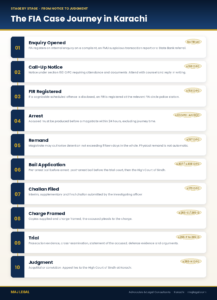
The FIA case journey in Karachi, stage by stage
Most FIA cases in Karachi begin without an FIR. They begin with a piece of paper.
The FIA opens an enquiry (internally numbered, e.g. “Enquiry No. 47/2026 of FIA CBC Karachi”) on a complaint, a Suspicious Transaction Report from the Financial Monitoring Unit, a State Bank referral, or a tip-off. During the enquiry stage the agency issues a call-up notice under section 160 CrPC requiring attendance and production of documents.
Your rights at the enquiry stage
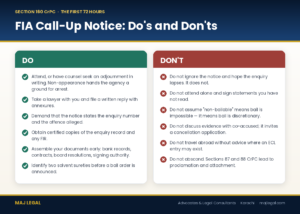
What to do — and what never to do — on receiving an FIA call-up notice
- A notice is not an arrest warrant. Section 160 CrPC empowers an investigating officer to require attendance; it does not authorise detention.
- The notice must disclose its purpose. The Islamabad High Court has held that the FIA, or any other entity empowered to investigate criminal offences, is obliged to disclose sufficient information in the notice so that the person knows its purpose. A vague notice that names no offence and no enquiry number is defective and should be answered in writing on that basis.
- You may attend with counsel. Sending a lawyer to accompany you, and filing a written reply with annexures, changes the tone of an enquiry immediately.
- You cannot be compelled to incriminate yourself. Article 13(b) of the Constitution protects against self-incrimination, and Article 10-A guarantees due process and a fair trial.
- Non-cognizable offences cannot be investigated without a magistrate’s order. Under section 155(2) CrPC, an officer may not investigate a non-cognizable offence without an order from a competent magistrate. Where a notice is issued in an enquiry concerning non-cognizable offences, that gap is a live legal point.
The strategic window
The enquiry stage is the single best opportunity to end an FIA case. Once an FIR is registered, the machinery of arrest, remand, challan and trial takes over, and the cost — financial and personal — multiplies. Engaging the best criminal defence lawyers in Karachi at notice stage, rather than at arrest stage, is the most valuable decision most clients make.
If arrest appears imminent, this is also the moment to move for pre-arrest bail under section 498 CrPC before the Sessions Court or the High Court of Sindh.
4. Stage 2: FIR Registration
If the enquiry concludes that a cognizable scheduled offence is disclosed, the FIA registers an FIR at the relevant circle police station under section 154 CrPC.
Three features of an FIA FIR matter for bail:
It is usually a state FIR. The complainant is typically an FIA sub-inspector or inspector, not a private party. There is no complainant to compromise with — which is why “settlement” strategies that work in ordinary PPC cases often fail here.
It is usually a composite FIR. FIA FIRs routinely combine PPC offences with one or more special statutes. This is deliberate: it drags the case into a special court and, where money laundering is added, into a far stricter bail regime.
The choice of sections often decides the bail outcome before a single argument is made. A challenge to over-charging — sections added without supporting material — is one of the most effective grounds available at bail stage, because the court’s assessment under section 497 CrPC is tentative and looks at the material actually on record, not the sections written on the FIR.
5. Stage 3: Arrest and Remand
The 24-hour rule
Under Article 10(2) of the Constitution and section 61 CrPC, an arrested person must be produced before a magistrate within twenty-four hours of arrest, excluding the time necessary for the journey. Detention beyond that period without judicial authorisation is unlawful, and the breach is a documented, arguable ground.
Physical remand under section 167 CrPC
When the FIA seeks custody for interrogation, it applies under section 167 CrPC. The magistrate may authorise detention for a period not exceeding fifteen days in the whole. Physical remand is not automatic. The agency must satisfy the court that custody is necessary for a specific investigative purpose — recovery, identification, confrontation — and the court is required to apply its mind to each application rather than rubber-stamp it.
Effective defence at remand stage involves:
- Opposing physical remand and seeking judicial remand instead;
- Demanding that the investigating officer state precisely what remains to be recovered or discovered;
- Recording, on the file, any complaint of ill-treatment and requesting a medical examination;
- Securing permission for counsel and family visits.
Remand is not a formality. Time spent in physical custody is time in which statements are recorded and documents are signed. The top criminal lawyers in Karachi treat the first remand hearing as the first substantive hearing of the case, not an administrative step before the “real” bail application.
Judicial remand
After physical remand, the accused is sent to judicial custody at Central Prison Karachi or Malir Prison. From that point, the bail application is heard on the material collected, and the practical question becomes forum and timing.
6. Stage 4: Investigation, Interim Challan and Final Challan
The investigating officer submits a report under section 173 CrPC — the challan. The CrPC requires this report to be submitted within fourteen days of the recording of the FIR, though in practice extensions are sought and granted.
In FIA cases, the sequence is almost always:
- Interim challan — filed to enable the trial court to take cognizance while investigation continues. Bank record, forensic reports and mutual legal assistance requests are typically shown as pending.
- Supplementary challan — filed as further material arrives.
- Final challan — completing the record.
The gap between interim and final challan, is where cases stall and where statutory delay bail is born A trial that cannot start because the prosecution has not completed a challan for eighteen months is a trial in which the third proviso to section 497(1) CrPC becomes the strongest card in the defence hand.
Section 173 also permits the investigating officer to place an accused in Column 2 of the challan, that is, to name the person but not send them for trial. Persuading the investigating officer, on documentary material, to place a client in Column 2 is often a better outcome than any bail order.
7. The Bail Framework Under the CrPC
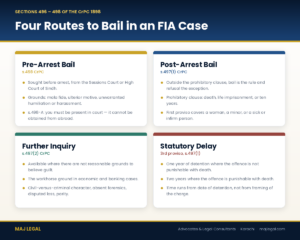
Four routes to bail under sections 496–498 of the CrPC 1898
Bail in Pakistan is governed by Chapter XXXIX of the Code of Criminal Procedure, 1898, sections 496 to 502. The Code remains in force; the criminal procedure of bail in Karachi is the same Code applied through Sindh’s court hierarchy.
7.1 Bailable offences — section 496 CrPC
Where the offence is bailable, bail is a matter of right, not discretion. The officer in charge or the court must release the accused on furnishing surety. Several FIA-adjacent offences remain bailable, and the first task of counsel is always to check whether the offence has been correctly classified.
7.2 Post-arrest bail — section 497 CrPC
Section 497(1) creates the central distinction. The prohibitory clause applies where there appear reasonable grounds for believing the accused is guilty of an offence punishable with death, imprisonment for life, or imprisonment for ten years.
- Outside the prohibitory clause, the settled rule is that grant of bail is the rule and refusal the exception. The High Court of Sindh has repeatedly applied this, holding that where the offences do not fall within the prohibitory clause, grant of bail in such cases is the rule while refusal is an exception, following Tariq Bashir v. State (PLD 1995 SC 34), Zafar Iqbal v. Muhammad Anwar (2009 SCMR 1488), Muhammad Tanveer v. State (PLD 2017 SC 733) and Shaikh Abdul Raheem v. The State (2021 SCMR 822).
- Inside the prohibitory clause, bail is restricted — but never mechanically refused. The Supreme Court’s position is that in cases falling within the prohibitory clause, post-arrest bail remains available through the enumerated exceptions: the first proviso to section 497(1) where the accused is a woman, minor, or sick or infirm person; the third proviso where there is unreasonable delay in the conclusion of the trial not attributable to the accused; and section 497(2) where the case requires further inquiry into the guilt of the accused.
The Peshawar High Court has put the principle bluntly: the mere fact that an offence falls under the restrictive clause of section 497 CrPC, or is heinous, is no ground for refusal of bail; courts must make a tentative assessment of the entire material collected during investigation rather than adopting a stereotyped approach.
7.3 Further inquiry — section 497(2) CrPC
Section 497(2) allows release where there are not reasonable grounds for believing the accused is guilty of a non-bailable offence, but there are sufficient grounds for further inquiry into guilt.
This is the workhorse provision in FIA economic-crime bail applications. Typical further-inquiry grounds in Karachi FIA cases include:
- The transactions relied upon are documented, banked and audited raising a genuine question of civil versus criminal liability;
- No forensic or handwriting report yet supports the allegation of forgery;
- The accused was a salaried employee acting on instructions, with no beneficial interest in the proceeds;
- The alleged loss is disputed and unquantified;
- The role attributed to the accused is indistinguishable from that of co-accused already on bail, engaging the rule of consistency though note the Supreme Court’s caution that parity applies only where the role attributed and the incriminating material are similar and identical; where they differ, the case is distinguishable and the benefit of parity cannot be extended.
7.4 Statutory delay — the third and fourth provisos
This is the most underused ground in FIA practice, and often the most powerful, because FIA trials are slow.
The Supreme Court has laid down the framework: the purpose of the third proviso to section 497(1) CrPC is to ensure that pre-conviction detention does not extend beyond two years in cases involving an offence punishable with death, or one year in other cases; the period runs from the date of detention of the accused, not from the date the charge was framed; and a statutory right to bail accrues if the trial is not concluded within that period.
Two exceptions apply. The right is lost where the delay was occasioned by the accused, and where the fourth proviso is engaged. On the first, the Supreme Court has held that mere mathematical counting of adjournment dates sought on behalf of the accused is not sufficient to deprive him of the right; the statutory right flows from the constitutional right to liberty and fair trial under Articles 9 and 10-A. The prosecution must show a concerted effort by the accused or counsel to delay the conclusion of the trial through adjournments without sufficient cause on crucial hearings, or frivolous miscellaneous applications.
On the fourth proviso, the statutory text excludes a previously convicted offender for an offence punishable with death or imprisonment for life, a person who in the opinion of the court is a hardened, desperate or dangerous criminal, or a person accused of an act of terrorism punishable with death or imprisonment for life. The Supreme Court has held that in the absence of material, this exception cannot be invoked, because the words paint a picture of a person likely to seriously injure and hurt others without caring for the consequences of his violent act, so there must be material showing the accused would pose a serious threat to society if released.
A white-collar accused in a banking or money-laundering case is very rarely a “hardened, desperate or dangerous criminal” within this meaning. Establishing that on the record is central to every statutory-delay application MAJ Legal files.
7.5 Pre-arrest bail — section 498 CrPC
Section 498 empowers the Court of Session and the High Court to admit a person to bail before arrest. It is an extraordinary, discretionary remedy. The recognised grounds are mala fide, ulterior motive, and the prospect of unwarranted humiliation, harassment or persecution — not the merits of the defence.
Two hard rules govern practice:
- You must be present. Section 498-A CrPC provides that nothing in sections 497 or 498 authorises a court to release on bail any person who is not in custody or is not present in court, or against whom no case stands registered; and the order is effective only for the case specified in it. A client in Dubai, Jeddah or Manchester cannot obtain pre-arrest bail by proxy — surrender to the jurisdiction of the court is a precondition. Superior courts have long held that bail before arrest is not possible unless the petitioner is in custody or under some form of restraint, and he must appear before the court to surrender himself.
- Dismissal has immediate consequences. Recent authority is clear that once a competent court declines pre-arrest bail, it has determined that arrest is lawful and necessary; interim protection is not automatic, and absent an express order a refusal remains fully operative and must be implemented promptly.
7.6 Protective and transitory bail
Where the case is registered in Karachi but the accused is in another province — or has just landed from abroad — the High Court may grant protective bail for a short, defined period to enable the accused to approach the court of competent jurisdiction safely. This is a genuinely important remedy for overseas Pakistanis returning to face an FIA case, and it is discussed further in section 14.
7.7 Cancellation of bail — section 497(5) CrPC
Bail once granted is not permanent. Under section 497(5), a High Court or Court of Session, and in the case of a person released by itself any other court, may cause the person to be re-arrested and committed to custody. In FIA cases, cancellation is usually sought where the accused tampers with evidence, influences bank witnesses, travels in breach of conditions, or repeats the offence.
8. Statute-Specific Bail Bars in FIA Cases
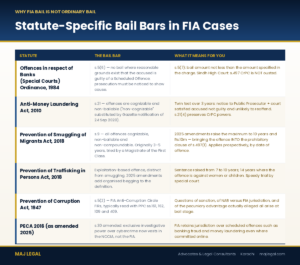
How each special statute layers its own bail bar on top of section 497 CrPC
This is where FIA bail differs fundamentally from ordinary criminal bail — and where most general-practice bail applications fail. Each special statute layers its own bar on top of section 497 CrPC.
8.1 Offences in respect of Banks (Special Courts) Ordinance, 1984
The Ordinance creates the Special Court (Offences in Banks) Sindh at Karachi for speedy trial of scheduled bank offences. Its bail provision is section 5(6): an accused person shall not be released on bail by a Special Court or any other court if there appear reasonable grounds for believing that he has been guilty of a Scheduled Offence, nor shall he be released unless the prosecution has been given notice to show cause.
Section 5(7) then adds a distinctive rule on quantum: where an accused is released on bail, the amount of bail shall be fixed having regard to the gravity of the charge, and where the charge specifies an amount in respect of which the offence is alleged to have been committed, the bail shall not be less than that amount.
Why this matters more than most people realise: in a case alleging a defalcation of Rs. 50 million, the bail bond can be fixed at Rs. 50 million. Securing a realistic surety is therefore part of the legal strategy, not an afterthought — and arguing for a reduced or apportioned amount, particularly where the alleged amount is attributed jointly to several accused, is a specialist skill.
The good news for the defence: the High Court of Sindh has held that section 5(6) does not oust section 497 CrPC. The Court reasoned that section 5(6) is an enabling section, and neither it nor any other provision of the Ordinance indicates that the power of a court to grant bail under section 497 CrPC has been taken away; a Special Court may allow bail to an accused charged with a scheduled offence even where reasonable grounds exist, inter alia on grounds of sickness, infirmity, delay in completion of the trial, where the case is one of further inquiry, where there is no likelihood of tampering with evidence, or where continued detention may hamper the defence.
The Court further observed that the only difference is that the 1984 Ordinance bars release where reasonable grounds exist that the accused has been guilty of a “scheduled offence”, while the Code bars release for offences punishable with death, life imprisonment or ten years — so in all other respects section 497 CrPC applies fully to the Ordinance.
8.2 Anti-Money Laundering Act, 2010
AMLA is the statute that converts a manageable banking case into a serious one. Note the legislative history carefully, because it is frequently misstated:
Originally, section 21 provided that every offence punishable under the Act shall be non-cognizable and non-bailable. That changed in 2020: the word “non-cognizable” was substituted, so that every offence punishable under the Act is now cognizable and non-bailable, by amendment notified in the official Gazette on 24 September 2020.
The operative bail bar is a twin-condition test. For an offence punishable with imprisonment of more than three years, no person shall be released on bail unless the Public Prosecutor has been given due notice, and — where the Public Prosecutor opposes the application — the Court is satisfied that there are reasonable grounds for believing that he is not guilty of such offence and that he is not likely to commit any offence while on bail.
Two defence points follow, and both are decisive:
- The bar is not absolute. Section 21(4) expressly provides that the power and discretion on granting of bail specified in clause (b) of sub-section (1) are in addition to the power and discretion under the Code of Criminal Procedure, 1898, or any other law for the time being in force. The CrPC route therefore survives alongside the AMLA test.
- The predicate offence must be established. Money laundering under AMLA requires property derived from a predicate offence listed in the Schedule. Where the predicate offence is itself weak, disputed, or has not resulted in any FIR, the AMLA charge is vulnerable — and its collapse usually collapses the bail bar with it. Note also that money laundering is not a scheduled offence under the Offences in respect of Banks (Special Courts) Ordinance 1984, which means special banking courts cannot take cognizance of anti-money laundering cases — a jurisdictional fault-line worth checking in every composite FIA FIR.
Section 22 of AMLA applies the CrPC to arrest, bail, bonds, search, seizure and forfeiture in so far as it is not inconsistent with the Act.
8.3 Prevention of Smuggling of Migrants Act, 2018 — and the 2025 change
This is the most important recent development for Karachi’s large agent-and-emigration caseload, and it cuts against the accused.
The original position (2018–2025). Section 9 of the Act provided that all offences shall be cognizable, non-bailable and non-compoundable as construed by the Code; section 10 provided that, notwithstanding anything in the Code, a Magistrate of the First Class shall try an offence under the Act; and section 3 punished the smuggling of migrants with imprisonment which may extend to five years but not less than three years, with a fine of up to one million rupees.
The critical consequence: a maximum sentence of five years does not attract the prohibitory clause of section 497(1) CrPC. Bail was therefore the rule, refusal the exception — even though the statute labelled the offence “non-bailable”. Many practitioners missed this, and clients spent months in Malir Prison who should not have.
The 2025 amendment. Both houses of Parliament passed the Prevention of Smuggling of Migrants (Amendment) Bill, 2025 in February 2025, alongside amendments to the Prevention of Trafficking in Persons Act, 2018 and the Emigration Ordinance, 1979. Presidential assent followed later in the year, and Pakistan’s National Action Plan to Counter the Smuggling of Migrants 2026–2030 is expressly anchored in the 2018 Act “including its by-laws and the legal amendments enacted in 2025”, confirming that the amended regime is now the operative law.
The changes are substantial:
- The punishment for smuggling migrants rises to a maximum of ten years’ imprisonment and a fine of one million to ten million rupees, up from three to five years and a maximum fine of one million rupees.
- The penalty for producing or procuring documents to enable smuggling rises to a minimum of ten years and a fine of up to five million rupees, up from one to three years.
- Offences are tried by a Special Court for Speedy Trials rather than a Magistrate of the First Class.
- Penalties for harbouring illegal residents and for aggravated offences are also increased.
- The Emigration Ordinance amendment removes the court’s power to release an accused after imposing a minor fine.
Why this is the single most consequential point in this article for emigration cases: raising the maximum to ten years brings the principal offence within the prohibitory clause of section 497(1) CrPC. The comfortable “bail is the rule” argument that governed human-smuggling bail applications until 2025 no longer runs automatically. Post-amendment cases must be argued on further inquiry under section 497(2), on the first proviso, or on statutory delay — a different application requiring a different evidentiary foundation.
Because an amendment enhancing punishment operates prospectively — Article 12 of the Constitution bars retrospective punishment — the regime that applies depends on the date of the offence, not the date of the bail hearing. An FIR concerning conduct before the amendment took effect is still governed by the three-to-five-year scale, and remains outside the prohibitory clause. The commencement date must therefore be checked against the date of the alleged offence in every individual case. Getting this wrong in either direction is a serious error, and it cuts both ways: prosecutors sometimes assert the harsher scale for older conduct, and defence counsel sometimes assume the older, softer scale still applies to current cases.
8.4 Prevention of Trafficking in Persons Act, 2018
Trafficking is distinct from smuggling: it turns on exploitation, not merely on illegal border crossing. The 2025 amendments expanded the definition to include organised begging — including allowing oneself to be used as an exhibit for soliciting or receiving alms — enhanced punishments, and allowed speedy trials by special courts where transportation of the victim into or out of Pakistan forms part of the transaction constituting the offence, with the sentence for human trafficking raised from seven to ten years, and fourteen years where the offence is committed against children and women.
In practice, a common defence is that the client is a licensed or unlicensed recruiting agent whose conduct falls under the Emigration Ordinance, 1979, not a trafficker — a distinction with a very large sentencing and bail consequence.
8.5 Prevention of Corruption Act, 1947
FIA Anti-Corruption Circle FIRs are typically registered under section 5(2) of the Prevention of Corruption Act, 1947 read with PPC sections 161, 162, 109 and 409, as the Supreme Court records in reported bail petitions from FIA/ACC police stations. Where the accused is a federal public servant, questions of sanction, of NAB versus FIA jurisdiction, and of the actual pecuniary advantage alleged, all arise at bail stage.
9. Which Court Hears Your Bail Application in Karachi
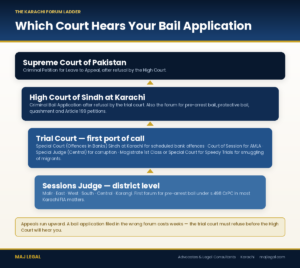
The Karachi bail forum ladder, from Sessions Judge to the Supreme Court
Filing in the wrong forum wastes weeks. This is the ladder as it operates in Karachi:
| Case type | Trial court | First bail forum | Then |
| Bank / scheduled bank offences | Special Court (Offences in Banks) Sindh at Karachi | The Special Court itself | High Court of Sindh |
| Money laundering (AMLA) | Court of Session, Karachi (as designated) | Sessions Court | High Court of Sindh |
| Human smuggling / trafficking | Magistrate 1st Class, or Special Court for Speedy Trials post-amendment | Sessions Judge (Malir / East / West / South / Central) | High Court of Sindh |
| Emigration Ordinance offences | Magistrate / designated court | Sessions Judge | High Court of Sindh |
| PPC offences with federal nexus | Sessions Court, Karachi | Sessions Court | High Court of Sindh |
| Corruption (PCA 1947) | Special Judge (Central), Karachi | Special Judge | High Court of Sindh |
Pre-arrest bail lies before the Court of Session or the High Court of Sindh under section 498 CrPC. Practice in Karachi is generally to approach the Sessions Judge of the relevant district first, unless there is a reason to go straight to the High Court.
Post-arrest bail is filed before the trial court first. Only after refusal does a Criminal Bail Application lie before the High Court of Sindh at Karachi, and thereafter a Criminal Petition for Leave to Appeal to the Supreme Court of Pakistan.
A note on the Sindh position for overseas clients. Sindh does not have the dedicated overseas-Pakistani courts that exist in Punjab. Overseas litigants with an FIA case in Karachi are heard in the ordinary criminal hierarchy, which makes competent local representation and a properly executed power of attorney more important, not less.
10. Building a Winning FIA Bail Application
FIA bail is won on documents. Judges in economic-crime cases respond to paper, not adjectives. A well-prepared application by the best bail lawyers in Karachi will assemble:
From the prosecution file
- Certified copy of the FIR and the enquiry report preceding it
- Interim and supplementary challans, with the list of witnesses under section 173
- Statements of prosecution witnesses recorded under section 161 CrPC
- Remand orders and custody certificate
- Bank statements, account opening forms and the audit trail relied upon
- Forensic, handwriting or IT expert reports — or proof that none exist
From the defence
- Documentary proof of the client’s actual role: employment contract, board resolutions, signing authority, delegation of powers
- Proof that transactions were routed through banking channels and disclosed to the tax authorities
- Evidence of co-accused already released on bail, with a role comparison for the parity argument
- Medical record, where the first proviso is invoked
- Custody chronology, cause list history and adjournment record, where statutory delay is invoked
- Proof of roots in Karachi: property, family, business, passport surrender undertaking
Grounds most likely to succeed in Karachi FIA practice
- Offence falls outside the prohibitory clause
- Case of further inquiry under section 497(2)
- Statutory delay under the third proviso
- First proviso — woman, minor, sick or infirm
- Rule of consistency / parity with released co-accused
- Absence of jurisdiction: offence not a scheduled offence under the FIA Act, 1974
- Civil dispute dressed as a criminal case, particularly in banking and recovery matters
- Mala fide or ulterior motive, in pre-arrest bail applications
11. Sureties, Bail Bonds and Surety Amounts
An order granting bail is not release. Release follows execution of the bond.
- The bond is executed under sections 499 and 500 CrPC before the trial court’s Nazir or the sheristadar.
- Sureties must be solvent, locally resident, and able to produce identity documents and proof of assets — commonly a property document, salary certificate or bank statement. Karachi courts routinely require verification of the surety’s property through the concerned authority, which takes time.
- Section 501 CrPC allows a court to demand fresh or additional surety where the original is insufficient.
- In banking cases, remember section 5(7) of the 1984 Ordinance — the bond may be fixed at not less than the amount specified in the charge.
Practical advice: identify and prepare two sureties, with documents, before the bail order is announced. Clients regularly obtain bail and remain in prison for a further week purely because no verified surety was ready.
12. After Bail: Prosecution and Trial Procedure
Bail ends the detention. It does not end the case. The trial that follows runs on the CrPC, supplemented by the special statute.
12.1 Cognizance and framing of charge
The trial court takes cognizance on the challan. Copies of the challan and statements are supplied to the accused under section 265-C CrPC. Charge is framed under section 265-D, and the accused pleads. This is the stage at which an application for discharge — that no case is made out on the prosecution’s own documents — should be considered, particularly in composite FIA FIRs where several sections are unsupported.
12.2 Prosecution evidence
Prosecution witnesses are examined under section 265-F CrPC, with cross-examination by the defence. In FIA cases the witness list is document-heavy and typically includes:
- The complainant FIA sub-inspector or inspector
- The investigating officer
- Bank officers producing account records, and the branch manager
- Handwriting, forensic and IT experts
- Recovery and seizure mashirs (witnesses to memos)
Electronic and documentary evidence. The Qanun-e-Shahadat Order, 1984 governs. Articles 46-A and 78-A address automated and electronic records, and Article 164 permits the court to allow evidence produced by modern devices and techniques. The prosecution must prove the chain of custody of a device, a bank record or a forensic image. In economic-crime trials, defects in the chain of custody are often more decisive than any dispute about the underlying transaction.
12.3 Statement of the accused
Under section 342 CrPC, the court examines the accused on the incriminating material. This statement is not on oath. It is nonetheless the most frequently mishandled stage of a criminal trial in Pakistan: material not put to the accused under section 342 cannot be used against him, and an explanation not offered here cannot be supplied later. The accused may also elect to give evidence on oath under section 340(2) CrPC, which exposes him to cross-examination and is a decision requiring careful advice.
12.4 Defence evidence, arguments and judgment
The defence may lead evidence under section 265-F(7). Final arguments follow under section 265-G, and judgment is pronounced under section 265-H. Acquittal follows if the prosecution has not proved the charge beyond reasonable doubt; conviction and sentencing follow if it has.
12.5 Appeal
Appeals from the Special Court (Offences in Banks) and from Sessions Courts lie to the High Court of Sindh at Karachi, and thereafter, by leave, to the Supreme Court of Pakistan. A convicted person may seek suspension of sentence and bail pending appeal — a distinct remedy with its own, more demanding, test.
13. Who Prosecutes FIA Cases
Understanding your opponent shapes strategy.
- FIA Prosecution Branch — Special Public Prosecutors and Deputy Directors (Law) attached to the agency conduct trials before Special Courts and Sessions Courts.
- Deputy Attorney General / Assistant Attorney General — appear for the Federation before the High Court of Sindh in FIA bail applications and constitutional petitions, as the reported bail applications from the Sindh High Court consistently show.
- Federal Prosecutor General’s office — supervises federal prosecutions.
- State Bank of Pakistan and the Financial Monitoring Unit — provide the technical evidentiary backbone in banking and AMLA cases. Note that AMLA restricts cognizance of the offence under section 4 to complaints made by authorised persons, and cognizance under section 33(1) to a written complaint by the FMU — a procedural bar worth checking in every AMLA challan.
Because FIA prosecutions are conducted by specialist prosecutors with in-house forensic and banking support, defending them requires equivalent specialisation. That is the practical case for retaining a firm that does this work continuously rather than occasionally.
14. Overseas Pakistanis, ECL, Blacklist and Red Notices
A substantial part of MAJ Legal’s FIA practice is conducted for clients in the UAE, Saudi Arabia, the United Kingdom, the United States, Canada and Australia who cannot simply fly to Karachi to attend court. The FIA’s immigration mandate covers immigration, the Exit Control List, the black list, the Provisional National Identification List (PNIL), travelling records under IBMS, and anti-human trafficking and smuggling.
The realities you need to understand
You cannot get pre-arrest bail from abroad. Section 498-A CrPC requires presence. Any adviser who promises bail while you remain overseas is not describing Pakistani law.
Protective bail is the bridge. The standard sequence for a returning client is: a family member or counsel obtains certified copies of the FIR and enquiry record; counsel assesses exposure; the client travels; protective bail is obtained from the High Court of Sindh for a limited period; the client then approaches the court of competent jurisdiction for pre-arrest or post-arrest bail within that window. Sequencing and timing are everything, and the arrival flight itself needs planning where the client’s name may be flagged at immigration.
ECL and blacklist are separate from bail. A grant of bail does not automatically remove your name from the Exit Control List or the blacklist. Removal is a separate process — representation to the Ministry of Interior, and where necessary a constitutional petition before the High Court of Sindh under Article 199. Similarly, an Interpol red notice requested through the FIA’s National Central Bureau is a distinct matter requiring its own challenge before the Commission for the Control of Interpol’s Files.
Absconsion is the worst possible strategy. If you do not appear, the court proceeds under sections 87 and 88 CrPC proclamation and attachment of property. A proclaimed offender loses the concession of bail almost entirely, and attached property in Karachi can be very difficult to recover. Every year, overseas clients turn a defensible case into an unwinnable one by staying away.
Powers of attorney must be properly executed. A power of attorney executed abroad must be attested at the Pakistani mission in the country of residence, or apostilled where applicable, and then endorsed by the Ministry of Foreign Affairs in Pakistan before it can be acted upon. Defects here cause avoidable delay in filing.
For overseas Pakistanis searching for the best lawyers in Karachi for FIA cases or a criminal lawyer in Karachi for overseas Pakistanis, the practical test of a firm is simple: can they run the entire matter — filings, appearances, prison visits, coordination with sureties, and regular written updates — without requiring you to be present until the moment the law requires it?
15. Common Mistakes That Cost People Their Liberty
- Ignoring the first call-up notice. Non-appearance converts a soft enquiry into a hard case and hands the agency a ground for arrest.
- Attending the FIA alone and signing everything. Statements recorded without advice are used at trial. Take counsel.
- Assuming a “non-bailable” offence means bail is impossible. Non-bailable means bail is discretionary, not prohibited.
- Assuming bail is automatic because the offence carries under ten years. It is the rule, not a right — and the 2025 smuggling amendment has changed the arithmetic for emigration cases.
- Filing in the wrong forum. A bail application filed before the Sessions Court in a case exclusively triable by the Special Court (Offences in Banks) is a wasted week.
- Ignoring the AMLA charge. Clients focus on the PPC sections and overlook the money-laundering section that actually controls the bail test.
- Not preparing sureties in advance, particularly where section 5(7) of the 1984 Ordinance applies.
- Missing hearings after bail. Non-appearance invites cancellation under section 497(5) and non-bailable warrants.
- Talking to co-accused about evidence. This produces cancellation applications alleging tampering.
- Staying abroad and hoping the case dies. It does not. It matures into proclamation and attachment.
16. Why MAJ Legal
MAJ Legal Barristers | Advocates & Legal Consultants is a Karachi-based law firm recognised for its criminal defence and federal-offence practice. Clients across Pakistan and among the overseas Pakistani community engage us as the best law firm in Karachi for matters requiring both technical statutory command and courtroom presence.
Our FIA and criminal practice covers:
- Representation at FIA enquiry stage and replies to section 160 CrPC call-up notices
- Pre-arrest bail, protective bail and transitory bail applications
- Post-arrest bail before the Special Court (Offences in Banks) Sindh at Karachi, the Sessions Courts of Karachi and the High Court of Sindh
- Bail applications under the Anti-Money Laundering Act, 2010
- Human smuggling, trafficking and Emigration Ordinance defence
- Banking fraud, corporate crime and economic-offence trials
- Quashment petitions and constitutional petitions under Article 199
- Exit Control List and blacklist removal, and Interpol red notice challenges
- Dedicated overseas Pakistani support with remote instruction and written case updates
Why clients choose the top criminal lawyers in Karachi at MAJ Legal:
- Current law, not recycled law. As this article shows, the 2025 PECA transfer of cybercrime to the NCCIA and the 2025 human-smuggling penalty increase have changed FIA defence materially. We track these changes because they decide cases.
- Special court experience. Our practice before the Special Court (Offences in Banks) Sindh at Karachi means we know the forum, the procedure and the evidentiary expectations.
- Documents first. We build bail applications on the record, not on rhetoric.
- Overseas-ready. Attestation, powers of attorney, remote instruction and coordinated returns are routine work for us, not an exception.
Contact MAJ Legal — Advocates & Legal Consultants, Karachi
Website: majlegal.com
If you or a family member has received an FIA notice, been arrested, or needs an urgent bail application in Karachi, contact us today. In FIA matters, the first seventy-two hours frequently determine the outcome.
17. Frequently Asked Questions
Q1. What is bail in an FIA case in Karachi?
Bail is the release of an accused from custody on furnishing a bond, with or without sureties, pending inquiry or trial. In FIA cases in Karachi it is governed by sections 496 to 502 of the Code of Criminal Procedure, 1898, read together with the bail provisions of whichever special statute applies — most commonly the Anti-Money Laundering Act, 2010, the Offences in respect of Banks (Special Courts) Ordinance, 1984, or the Prevention of Smuggling of Migrants Act, 2018.
Q2. Are all FIA offences non-bailable?
No. Whether an offence is bailable depends on the statute and the schedule to the CrPC. Many FIA-scheduled offences are non-bailable, but “non-bailable” means bail is discretionary rather than a matter of right. It does not mean bail is unavailable, and superior courts have repeatedly said bail must not be refused mechanically.
Q3. Can I get bail before arrest in an FIA case?
Yes. Pre-arrest bail is available under section 498 CrPC from the Court of Session or the High Court of Sindh, on grounds of mala fide, ulterior motive or unwarranted humiliation and harassment. However, section 498-A CrPC requires that you be present in court — you cannot obtain pre-arrest bail while abroad.
Q4. How long can the FIA keep me on physical remand?
An arrested person must be produced before a magistrate within twenty-four hours under Article 10(2) of the Constitution and section 61 CrPC. Under section 167 CrPC the magistrate may authorise detention for a period not exceeding fifteen days in the whole, and must apply judicial mind to each request rather than granting it as a matter of course.
Q5. What is the prohibitory clause of section 497 CrPC?
It is the part of section 497(1) that restricts bail where there appear reasonable grounds to believe the accused is guilty of an offence punishable with death, imprisonment for life, or imprisonment for ten years. Outside that clause, bail is the rule and refusal the exception. Inside it, bail remains available on further inquiry, on the first proviso for women, minors and the sick or infirm, and on statutory delay.
Q6. What is statutory delay bail?
Under the third proviso to section 497(1) CrPC, a statutory right to bail accrues if the trial is not concluded within one year of detention for offences not punishable with death, or two years where the offence is punishable with death. The period runs from the date of detention, not from the framing of charge. The right is lost only where the delay was caused by the accused, or where the fourth proviso applies.
Q7. What is the bail test under the Anti-Money Laundering Act, 2010?
For offences punishable with more than three years, section 21(1)(b) requires that the Public Prosecutor be given notice and, where he opposes, that the court be satisfied there are reasonable grounds to believe the accused is not guilty and is not likely to commit any offence while on bail. Importantly, section 21(4) provides that this power is in addition to the powers under the CrPC, so section 497 remains available.
Q8. Which court hears bail in FIA banking cases in Karachi?
Scheduled bank offences are tried by the Special Court (Offences in Banks) Sindh at Karachi, which hears the bail application first. If refused, a criminal bail application lies before the High Court of Sindh at Karachi, and thereafter a petition for leave to appeal to the Supreme Court of Pakistan.
Q9. Does the FIA still handle cybercrime cases in Karachi?
Not as it did before. The Prevention of Electronic Crimes (Amendment) Act, 2025 amended section 30 of PECA to confer exclusive investigative power over cybercrime on the National Cyber Crime Investigation Agency. The FIA and NCCIA now operate as separate agencies with distinct mandates, although the FIA retains jurisdiction over scheduled offences such as banking fraud and money laundering even where the conduct was carried out online.
Q10. Has the law on human smuggling bail changed?
Yes, significantly. Under the Prevention of Smuggling of Migrants Act, 2018 as originally enacted, the principal offence carried three to five years, which kept it outside the prohibitory clause of section 497(1) CrPC. Amendments passed by both houses in February 2025 and enacted later that year raised the maximum to ten years with fines up to ten million rupees, raised the document-offence penalty to a minimum of ten years, and provided for trial by a Special Court for Speedy Trials. Because a ten-year maximum engages the prohibitory clause, bail applications in these cases now require a different approach. Since enhanced punishment operates prospectively, the scale that applies depends on the date of the alleged offence — conduct predating the amendment is still governed by the three-to-five-year scale.
Q11. I am an overseas Pakistani with an FIA case in Karachi. What should I do first?
Instruct counsel in Karachi immediately to obtain certified copies of the FIR and enquiry record and assess your exposure. Do not travel before that assessment. Where return is necessary, protective bail from the High Court of Sindh can provide a defined window in which to approach the competent court. Do not stay away indefinitely — absconsion leads to proclamation and attachment of property under sections 87 and 88 CrPC.
Q12. Does bail remove my name from the Exit Control List?
No. Bail and ECL are separate. Removal from the ECL or the blacklist requires a representation to the Ministry of Interior and, where that fails, a constitutional petition before the High Court of Sindh under Article 199 of the Constitution.
Q13. Can bail once granted be cancelled?
Yes. Under section 497(5) CrPC, a High Court or Court of Session — and, in the case of a person released by itself, any other court — may cause the person to be arrested and committed to custody. In FIA cases, cancellation is commonly sought for tampering with evidence, influencing bank witnesses, breaching travel conditions or repeating the offence.
Q14. How much will the bail bond be in a banking fraud case?
Section 5(7) of the Offences in respect of Banks (Special Courts) Ordinance, 1984 provides that the amount is fixed having regard to the gravity of the charge and, where the charge specifies an amount, shall not be less than that amount. In large defalcation cases this can be substantial, so identifying solvent sureties in advance is essential.
Legal Disclaimer
This article is published by MAJ Legal — Advocates & Legal Consultants for general information about the criminal procedure of bail in FIA cases in Karachi, Pakistan. It is not legal advice and does not create an advocate-client relationship. Statutory provisions, particularly the 2025 amendments discussed above, are subject to notification, commencement and judicial interpretation, and the position may have changed since publication. No person should act or refrain from acting on the basis of this article without obtaining specific legal advice on their own facts from a qualified advocate.
MAJ Legal — Advocates & Legal Consultants, Karachi. Criminal defence, FIA cases, bail applications, banking and economic offences, and dedicated legal services for overseas Pakistanis.