Succession Certificate in Karachi: The Complete Guide to Succession Laws and Letters of Administration
Contents
▪ The short answer, before the detail
▪ Part 1: What a Succession Certificate actually is
▪ Part 2: The two routes in Karachi — NADRA and the courts
▪ Part 3: The Sindh rule that changes everything — filing through counsel
▪ Part 4: The NADRA route, step by step
▪ Part 5: The Decline Certificate — the gateway between NADRA and the court
▪ Part 6: Which court in Karachi — and the pecuniary rule nobody explains
▪ Part 7: Succession certificates for overseas Pakistanis
▪ Part 8: Who the legal heirs are
▪ Part 9: What it costs and how long it takes
▪ Part 10: Where Karachi succession matters go wrong
▪ Part 11: Using the certificate once you have it
▪ Frequently asked questions
▪ Why families choose MAJ Legal
By MAJ Legal Barristers | Advocates & Legal Consultants, Karachi
When a family member dies in Karachi, the grief arrives first and the paperwork arrives second. The bank freezes the account. The society office refuses to transfer the flat. The Excise Department will not touch the car file. Everyone tells you the same three words — succession certificate — and nobody explains what that actually means, which office issues it, or why the answer is different in Karachi than it is in Lahore.
This guide answers all of it.
MAJ Legal is a Karachi-based law firm handling succession and inheritance matters across all seven districts of the city — South, East, West, Central, Korangi, Malir and Keamari — as well as for overseas Pakistani families in the UAE, Saudi Arabia, the United Kingdom, the United States, Canada and Australia. As a succession law firm in Karachi, we act in both the NADRA route and the court route, and we know precisely where each one breaks down.
If you are searching for a succession certificate lawyer in Karachi, an inheritance lawyer in Karachi, or the best law firm in Karachi for a Letter of Administration, this article is written to give you the whole picture before you spend a rupee.
The short answer, before the detail
- A Succession Certificate covers movable assets — bank balances, term deposits, shares, mutual funds, provident fund, insurance proceeds, vehicles.
- A Letter of Administration (LoA) covers immovable property — a house, flat, plot, shop or agricultural land.
- Most Karachi estates need both, because most Karachi families hold both a bank account and a property.
- There are two routes: NADRA’s Succession Facilitation Unit (fast, for undisputed estates) and the civil court under the Succession Act, 1925 (slower, for anything contested or declined).
- In Sindh — and this is the single most important local rule — the NADRA application is filed through legal counsel. In Islamabad, Punjab and Khyber Pakhtunkhwa a legal heir walks in personally. In Sindh and Balochistan, an advocate files it. You do not have a choice about engaging a lawyer in Karachi; the system is built that way.
- Overseas heirs do not need to fly home. A properly drafted Special Power of Attorney, NADRA’s digital PoA facility and remote biometric verification make the whole matter workable from abroad.
Part 1: What a Succession Certificate actually is
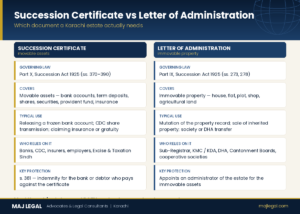
Figure 2 — Succession Certificate vs Letter of Administration: which document a Karachi estate needs.
A Succession Certificate is issued under Section 372 of the Succession Act, 1925. It is a formal declaration by the issuing authority that the named persons are the legal heirs of the deceased and are entitled to receive and administer specified debts and securities belonging to the estate.
It does two things. First, it identifies the heirs. Second — and this is the part most people miss — it protects the person paying out. Section 381 of the Succession Act gives the bank, company or debtor who pays against a valid certificate full indemnity. That is exactly why your bank manager will not budge without one: he is not being difficult, he is being lawful. Without the certificate, he pays at his own personal risk.
A Succession Certificate is not a title document. It does not determine ownership shares in a disputed property, it does not decide whether a gift or a benami transfer was genuine, and it does not settle a family feud. Those questions belong to a civil suit for declaration and partition. Confusing the two is the most common and most expensive mistake we see in Karachi succession matters.
What a Letter of Administration is, and why it is different
Where the estate includes immovable property, the correct instrument is a Letter of Administration under Sections 273 and 278 of the Succession Act (for an intestate estate — that is, where there is no will). An LoA appoints an administrator of the estate and is the document that KDA, the Sindh Board of Revenue, DHA, the Cantonment Board or a cooperative housing society will accept for mutation of the property record into the names of the heirs.
Where the deceased left a valid will, the instrument is probate under Section 276, granted to the executor named in the will. Probate is comparatively rare in Pakistani Muslim estates because a Muslim may bequeath no more than one-third of the estate by will, and only to a non-heir without the consent of the other heirs — so most Muslim estates in Karachi are administered as intestate estates even where a document calling itself a “will” exists.
Succession Certificate vs Letter of Administration: the comparison
| Succession Certificate | Letter of Administration | |
| Governing sections | Part X, Succession Act 1925 (ss. 370–390) | Part IX, Succession Act 1925 (ss. 273, 278) |
| Covers | Movable assets: bank accounts, shares, securities, debts owed to the deceased | Immovable property: house, flat, plot, shop, land |
| Typical use | Releasing a frozen bank account, transferring CDC shares, claiming insurance or provident fund | Mutation of a property record, sale of inherited property, society transfer |
| Who relies on it | Banks, NBP, CDC, insurers, employers, Excise & Taxation | Sub-Registrar, KDA/KMC, DHA, Cantonment Boards, cooperative societies |
| Both needed? | Yes, for the overwhelming majority of Karachi estates |
A practical rule: if you can carry it or cash it, you need a Succession Certificate. If it has a boundary wall or a plot number, you need a Letter of Administration.
Part 2: The two routes in Karachi — NADRA and the courts
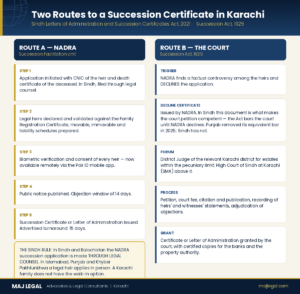
Figure 3 — The two routes to a succession certificate in Karachi: NADRA and the court.
Until 2021, every succession matter in Karachi went to court, and it took months at best and years at worst. The Supreme Court’s own assessment was that succession matters accounted for roughly thirty per cent of the entire judicial workload in Pakistan.
Sindh moved first. The Sindh Letters of Administration and Succession Certificates Act, 2021 (Sindh Act No. VII of 2021) was passed on 23 March 2021 and enforced from 23 April 2021, empowering NADRA to issue both instruments administratively. Sindh was the first province in Pakistan to do this — the one-window facility was inaugurated at the NADRA Mega Centre in DHA, Karachi, and issuance began in the city on 22 June 2021 before extending across Sindh three days later. Punjab, Islamabad and Khyber Pakhtunkhwa followed with their own equivalent statutes.
So today, in Karachi, you have two doors.
Route A — NADRA’s Succession Facilitation Unit (the administrative route)
This is the right route where all heirs agree, the family tree is clean on NADRA’s own records, and no third party is likely to object. NADRA validates the heirs against the Family Registration Certificate (FRC) it already holds, publishes a public notice, waits out the objection window, and prints the certificate.
The core requirements are that the deceased and the legal heirs must be Pakistani citizens and the assets must be located within Pakistan.
Route B — the civil court, under the Succession Act 1925
This is the route where the family disagrees, where an heir is missing or a minor’s interest needs protection, where NADRA’s FRC record does not match reality (an unregistered second marriage, an unregistered child, a disputed relationship), or where NADRA has issued a Decline Certificate.
Most contested Karachi estates end up here, and the quality of the drafting at the filing stage determines how long you spend in it.
Part 3: The Sindh rule that changes everything — filing through counsel
Here is the local rule that most national articles on succession certificates get wrong, and that costs Karachi families weeks of wasted effort.
NADRA’s succession procedure is not identical across Pakistan. Depending on the domicile of the deceased:
- In Islamabad Capital Territory, Punjab and Khyber Pakhtunkhwa, at least one legal heir must attend a designated centre personally to lodge the application.
- In Sindh and Balochistan, the application is made through an attorney — that is, through legal counsel.
If you are a Karachi family, you are in the second category. The NADRA counter at the DHA Mega Centre is not going to process a walk-in succession application from an heir the way a counter in Lahore would. This is not a bureaucratic quirk to be argued around; it is how the Sindh scheme is structured.
The practical consequence is that engaging a succession lawyer in Karachi is not an optional upgrade for speed — it is the entry condition. What varies is whether your counsel merely lodges the file or actually engineers it: verifying the FRC before submission, curing gaps in the heir record, structuring the asset schedules so that no bank later refuses the certificate as insufficiently specific, and preparing for the objection window rather than hoping nobody appears.
Part 4: The NADRA route, step by step
NADRA operates a five-stage process through its Succession Facilitation Units (SFUs). In broad terms:
Stage 1 — Application initiation. Lodged with the CNIC of the applicant heir and the death certificate of the deceased. In Sindh, through counsel.
Stage 2 — Heirs and assets. The full list of legal heirs is declared and validated against the FRC, and the movable and immovable assets are scheduled. In practice, three schedules are prepared: movable assets, immovable assets, and a statement of liabilities or encumbrances confirming whether the property is free of mortgage, lien or charge.
Stage 3 — Biometric verification and consent. Every declared legal heir must be biometrically verified and must consent. This is the stage that historically forced overseas families to fly home — and the stage that has changed most in the last year.
Stage 4 — Public notice. A notice is published so that any person with a competing claim can object. If no objection is filed within the statutory window — fourteen days from publication — the matter proceeds.
Stage 5 — Issuance. The Succession Certificate or Letter of Administration is printed and delivered. The advertised turnaround at launch was fifteen days from a complete application.
Documents NADRA requires
- Death certificate of the deceased (NADRA-issued, via the Union Council)
- CNIC cancellation certificate of the deceased, issued by NADRA
- Family Registration Certificate (FRC)
- List of legal heirs with CNIC copies of each
- Details of movable and immovable property
- Letter of authorisation or affidavit attested by an Oath Commissioner
- In Sindh: the instrument authorising counsel to act
The CNIC cancellation certificate is the item that trips up most families, because it requires the death to have been registered with the Union Council first. If your relative died abroad, this chain — foreign death certificate, attestation, Pakistani death registration, CNIC cancellation — is a project in itself, and it is worth starting the day you decide to pursue the estate rather than three weeks later.
What changed in 2025 — and why it matters for Karachi
Two NADRA reforms in 2025 materially improved the position for families with a Karachi connection:
Cross-province filing. Previously an application had to be filed in the province where the inherited property was situated. In August 2025 NADRA notified that legal heirs may submit succession applications at any of 186 Succession Facilitation Units established at NADRA centres nationwide — across Islamabad, Punjab, Sindh, Khyber Pakhtunkhwa, Balochistan and Gilgit-Baltistan — regardless of where the inherited property is located. In September 2025 NADRA extended succession services to all its centres nationwide, having previously limited them to selected branches.
For a Karachi family this is genuinely useful. An heir living in Islamabad or Quetta no longer has to travel to Sindh to participate in a Karachi estate.
Remote biometrics. Biometric verification can now be completed at a nearby designated NADRA centre or from home using the Pak ID mobile application. For overseas Pakistanis this is the difference between a plane ticket and an afternoon.
(Both reforms are recent and administrative. Before relying on either in your own matter, confirm current NADRA practice — administrative notifications are amended more often than statutes.)
Part 5: The Decline Certificate — the gateway between NADRA and the court
This is the most technically important part of Karachi succession practice, and it is almost entirely absent from competing law firm pages.
Under the Sindh Act, where the Succession Facilitation Unit finds a factual controversy among the legal heirs, it does not adjudicate. It declines the application and issues a Decline Certificate, certifying that the matter requires adjudication under the relevant provision, so that the heirs may file afresh before the appropriate forum under the Succession Act, 1925.
The Sindh Act contains a bar of jurisdiction: the court does not take up the matter until NADRA has declined it. In practice, this means the Decline Certificate is not an administrative annoyance — it is the document that makes your court petition competent. Succession Miscellaneous Applications filed in the High Court of Sindh at Karachi routinely recite the Decline Certificate by date and section, alongside the schedules of assets and the statement of liabilities, precisely because it is the jurisdictional foundation of the petition.
Sindh and Punjab have now diverged
Here is a distinction that matters if you are reading advice written for a Lahore audience. Punjab omitted the bar-of-jurisdiction provision from its own Act by an amendment in 2025, so a Punjab heir may in principle approach the court directly. Sindh has not made the equivalent change. In Karachi, the NADRA-first sequence remains the practical route: you go to NADRA, you get declined, and the Decline Certificate travels with you to court.
Filing an SMA in Karachi without a Decline Certificate is one of the fastest ways to lose two months. (Confirm the current text of the Sindh Act before filing — provincial amendments are not always promptly reflected in commercial law reports.)
A live question on NADRA’s fees
There is also an unsettled point on money. In C.P. No. D-4497/2024, the High Court of Sindh at Karachi took up a challenge to NADRA charging its full fee even in cases where it declines to issue the certificate — the argument being that issuing a Decline Certificate is not a “service” for which a fee is authorised. On 16 September 2024 the Court, while issuing notice, directed as an interim measure that NADRA officials should not charge fee on Letters of Administration and Succession Certificates beyond the formal fee required for issuance of CNIC, FRC and other certificates.
If your NADRA application in Karachi is declined, this is worth raising. (Verify the current status and any final order in this petition before relying on the interim position.)
Part 6: Which court in Karachi — and the pecuniary rule nobody explains
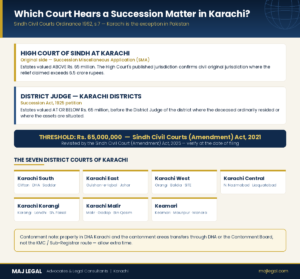
Figure 4 — Which court hears a succession matter in Karachi, and the seven district courts.
If your matter goes to court, the next question is which court. In Karachi the answer is unusual, and getting it wrong means a return of the petition and a fresh filing.
Karachi is the exception in Pakistan
Under Section 7 of the Sindh Civil Courts Ordinance, 1962, District Courts across Sindh — and indeed across Pakistan — exercise original civil jurisdiction without limit as to value. There is one carve-out: the Karachi districts. In Karachi, original civil jurisdiction in suits and proceedings above a stated value belongs to the High Court of Sindh on its original side, not to the District Judge.
That threshold has climbed steadily over the decades — from Rs. 25,000 when the District Court at Karachi was established under the Karachi Courts Order 1956, to Rs. 50,000 in 1970, Rs. 100,000 in 1981, Rs. 500,000 in 1991 and Rs. 3 million in 2002 — and stands, following the Sindh Civil Courts (Amendment) Act, 2021, at Rs. 65 million. The High Court of Sindh’s own published statement of its jurisdiction confirms civil original jurisdiction where the relief claimed exceeds 6.5 crore rupees, with a lower threshold of 5 crore in banking matters.
So, for a Karachi estate:
- Estate value at or below Rs. 65 million → the District Judge of the relevant Karachi district
- Estate value above Rs. 65 million → the High Court of Sindh at Karachi, by Succession Miscellaneous Application (SMA) on the original side
Given Karachi property values in DHA, Clifton, Bath Island, KDA Scheme 1 and PECHS, a single well-located house can carry an estate over the threshold on its own. This is a live calculation in real matters, not a theoretical one — and it is a distinction that simply does not exist for a family in Lahore, Faisalabad or Peshawar, where the District Judge has unlimited pecuniary jurisdiction.
A note of caution: the Sindh Civil Court (Amendment) Act, 2025 revisited this framework and was challenged before the High Court of Sindh, with petitioners arguing among other things that it repealed the Sindh Chief Court Rules (Original Side) framed under Article 202 of the Constitution. The Court dismissed the challenge at the Bill stage while leaving the petitioners at liberty to seek remedies once it became an Act. The position on pecuniary jurisdiction in Karachi should therefore be verified as at the date of filing. This is exactly the kind of moving target that makes local counsel worth engaging.
The seven districts
Within the District Court tier, the petition is filed before the District Judge of the district where the deceased ordinarily resided at the time of death, or where the assets are situated. Karachi’s seven districts are South, East, West, Central, Korangi, Malir and Keamari, and each has its own District & Sessions Court complex. Families in Clifton and DHA fall under Karachi South; Gulshan-e-Iqbal and Gulistan-e-Johar under Karachi East; North Nazimabad and Liaquatabad under Karachi Central; Orangi and Baldia under Karachi West depending on the exact locality; Korangi, Landhi and Shah Faisal under Karachi East and Malir, Gadap and Bin Qasim under Karachi Malir.
A cantonment wrinkle worth knowing
Properties in DHA Karachi and the cantonment areas — Clifton Cantonment, Karachi Cantonment, Faisal, Malir and Manora — sit under Cantonment Board or DHA transfer regimes rather than the ordinary KMC/Sub-Registrar route. The Letter of Administration is still the operative court document, but the downstream transfer procedure, the forms, the NOC requirements and the fee schedules are administered by a different body with its own rules. Budget additional time for a DHA or cantonment transfer, and confirm the current transfer requirements with the relevant board before assuming the KMC timeline applies.
Part 7: Succession certificates for overseas Pakistanis
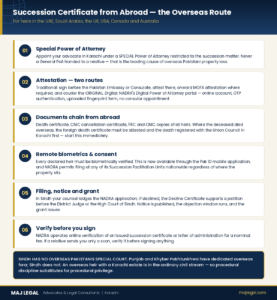
Figure 5 — The overseas route: Special Power of Attorney, attestation and remote biometrics.
A very large share of Karachi’s inherited property is claimed by heirs who no longer live in Pakistan. If you are in Dubai, Sharjah, Riyadh, Jeddah, London, Manchester, Birmingham, New York, Houston, Toronto, Mississauga, Sydney or Melbourne and your parent has passed away in Karachi, this section is for you.
You do not need to fly home
The route is a Special Power of Attorney (Mukhtarnama-e-Khas) appointing your counsel in Karachi to act in the succession matter. Three points determine whether it works:
- Scope. Use a Special PoA restricted to the succession matter, not a General PoA. A General PoA handed to a relative is the single most common source of overseas Pakistani property fraud. A Special PoA that authorises your advocate to file, appear, produce documents and receive the certificate — and nothing else — carries almost none of that risk. Draft the powers narrowly and expressly: the authority to apply for and obtain a certificate is not the same as the authority to sell.
- Execution and attestation. The traditional route is signature before the Pakistan Embassy or Consulate in your country of residence, with attestation there, onward attestation by the Ministry of Foreign Affairs in Pakistan where required, and courier of the original — never a photocopy — to your counsel. Pakistan missions charge a consular fee for succession-related services; the Consulate General of Pakistan in Houston, for example, publishes a USD 60 charge for the service, payable by card.
- The digital alternative. NADRA now operates a Digital Power of Attorney facility for overseas Pakistanis at its dedicated PoA portal. The executant creates an account, authenticates by OTP, applies online, uploads a fingerprint form, and the PoA is processed digitally rather than by physical consular appointment. The same NADRA platform also allows online verification of an issued succession certificate or letter of administration for a nominal fee — which is a genuinely useful safeguard if a relative in Pakistan sends you a scan of a certificate and asks you to sign something on the strength of it.
Verify the certificate before you sign anything. This is our standing advice to every overseas client.
Biometrics from abroad
The consent-and-biometrics stage no longer requires attendance in Pakistan. Biometric verification for succession applications is available through the Pak ID mobile application, and Pakistan missions abroad facilitate succession applications for overseas heirs. Between the digital PoA, the mobile biometric capture and cross-province filing, a Karachi estate can now be progressed by a family scattered across four countries.
Punjab and Khyber Pakhtunkhwa have established dedicated fora and facilitation mechanisms for overseas Pakistanis’ civil and property grievances. Sindh has not created an equivalent overseas Pakistanis special court. An overseas heir with a Karachi estate is therefore in the ordinary civil stream — the same District Court queue, the same SMA list at the High Court of Sindh — with no expedited track available on the basis of overseas status alone.
The practical implication is that procedural discipline substitutes for procedural privilege. What you can control is the quality of your filing: a complete asset schedule, a properly attested PoA, a clean FRC, heirs already biometrically verified, and a Decline Certificate in hand where the court route is being taken. Overseas clients who arrive with all of this move faster than local clients who arrive with none of it. That is the whole of the advantage available to you in Sindh, and it is worth having.
If the deceased died abroad
Where a Pakistani national dies overseas, expect a longer front end: the foreign death certificate must be attested (apostille or consular attestation, depending on country), the death must be registered with the relevant Union Council in Karachi, a Pakistani death certificate obtained, and the CNIC cancelled. Only then does the succession application become filable. Start this chain immediately — it frequently takes longer than the succession application itself.
Part 8: Who the legal heirs are
Neither NADRA nor the court invents the shares. They apply the personal law of the deceased.
For Muslim estates
Distribution follows Islamic law of inheritance (Faraid) as applied in Pakistan. The Class I heirs are the spouse, children and parents, with residuary and collateral heirs entering where these are absent. The general shape — subject always to the specific composition of the family, which changes the arithmetic — is:
- A widow takes one-eighth where there are children, one-quarter where there are none.
- A widower takes one-quarter where there are children, one-half where there are none.
- Sons and daughters share as residuaries, a son taking the share of two daughters.
- Parents each take one-sixth where the deceased left children.
Section 4 of the Muslim Family Laws Ordinance, 1961 is important and frequently overlooked in Karachi filings: where a son or daughter of the deceased predeceased the deceased, that child’s own children (the orphaned grandchildren) take, per stirpes, the share their parent would have taken had they survived. Families routinely omit orphaned grandchildren from the heir list, either innocently or otherwise. Where that happens, the certificate is vulnerable to revocation.
Shares must be worked out on the actual family composition, and Sunni and Shia rules diverge on several points. Do not rely on a generic table — including this one — for an actual distribution.
For non-Muslim estates
Christian, Hindu, Parsi and other non-Muslim estates in Karachi are governed by the Succession Act, 1925 itself (Parts V and VI) and, where applicable, the Hindu Marriage Act, 2017, the Sindh Hindu Marriage Act, 2016 and the personal law rules preserved for each community. The forum and procedure are the same; the distribution rules are not. Karachi has substantial Christian, Hindu and Parsi communities, and a succession lawyer in Karachi handling a non-Muslim estate needs to apply the right chapter of the Act rather than defaulting to Islamic shares.
Part 9: What it costs and how long it takes
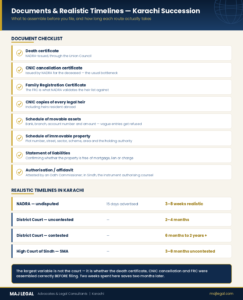
Figure 6 — Document checklist and realistic Karachi timelines.
NADRA route
NADRA charges a prescribed fee for the succession service, together with the cost of publishing the public notice. Fees are set administratively and revised from time to time; the correct figure is the one displayed on NADRA’s own succession page on the day you apply, not a figure quoted in a blog post. Note also the pending fee question in C.P. No. D-4497/2024 discussed above, which concerns fees charged where the application is declined.
Add to this the underlying document costs: death registration, CNIC cancellation, FRC, attestations, and — for overseas heirs — consular or digital PoA charges.
Court route
Court filings attract an ad valorem court fee under the Court Fees Act, 1870, as amended in its application to Sindh by successive Sindh Finance Acts, calculated on the value of the estate or of the debts and securities in respect of which the certificate is sought. Because the Sindh schedule has been amended more than once, the applicable rate and any cap should be confirmed against the current Sindh position at the time of filing rather than assumed. Add professional fees, publication costs, process fees and certified copy charges.
Realistic timelines in Karachi
| Route | Advertised | What we actually see |
| NADRA, undisputed | 15 days from complete application | 3–8 weeks, driven mostly by the death certificate / CNIC cancellation / FRC chain |
| District Court, uncontested | — | 2–4 months |
| District Court, contested | — | 6 months to 2 years+ |
| High Court of Sindh (SMA, high-value estate) | — | 3–8 months uncontested; longer if objections are filed |
The single largest variable is not the court. It is whether the preliminary documents were assembled correctly before filing. Families who spend two weeks getting the FRC and CNIC cancellation right save two months later.
Part 10: Where Karachi succession matters go wrong
Filing for the wrong instrument. Applying for a Succession Certificate when the estate is a house in Gulshan-e-Iqbal, or an LoA when the asset is a bank account. Mixed estates need both.
Omitting an heir. Deliberately or by oversight — a daughter, a widow from an unregistered second marriage, an orphaned grandchild under Section 4 MFLO. An omitted heir can move for revocation of the certificate under Section 383 of the Succession Act, and the High Court of Sindh entertains such applications. Everything built on a defective certificate — including a completed sale — is exposed.
The FRC does not match the family. NADRA validates against its own record. If a marriage was never registered, a child never added to the family tree, or a divorce never notified to the Union Council, the FRC will not show what the family knows to be true. This mismatch is the most common cause of a Decline Certificate in Karachi. It is also fixable — but the fix belongs before the succession application, not during it.
Vague asset schedules. A certificate that says “bank account” is useless. It must specify the bank, branch, account number and amount, or the bank will decline it and you will be applying for an amendment. The same is true of a property description: plot number, street, sector, scheme, area, and the society or authority holding the record.
Ignoring minors. Where an heir is a minor, the estate cannot simply be distributed to a parent. A guardianship certificate under the Guardians and Wards Act, 1890 may be required for dealing with the minor’s share, and courts in Karachi look closely at any proposed alienation of a minor’s property.
Trusting a General Power of Attorney. For overseas clients, this remains the leading cause of loss. Special PoA, narrow powers, and verify.
Assuming the Lahore procedure applies. It does not. The counsel-filing requirement, the surviving bar of jurisdiction, and the Rs. 65 million pecuniary split at the High Court of Sindh are all Karachi-specific.
Part 11: Using the certificate once you have it
The certificate is the beginning of the transfer, not the end.
Banks. Present the Succession Certificate with certified copies to the branch. Larger banks route succession claims through a central legal department, which adds time. Bank-held lockers require a separate inventory procedure.
Shares and securities. CDC and the company registrar require the certificate together with a transmission request; physical share certificates and unclaimed dividends often need separate follow-up, and older holdings may have been transferred to the SECP’s unclaimed asset framework.
Vehicles. The Excise, Taxation and Narcotics Control Department, Sindh transfers the vehicle file against the Succession Certificate, an heir NOC and the standard transfer set.
Immovable property. With the Letter of Administration: the Sub-Registrar and the concerned authority — KMC, KDA, the relevant cooperative housing society, DHA or the cantonment board — for mutation into the heirs’ names. Each has its own transfer form, NOC and fee.
Insurance, provident fund and gratuity. State Life and private insurers, and employers’ provident fund trustees, all require the certificate before releasing a deceased member’s benefit.
Once the property is mutated into the heirs’ joint names, a separate question arises: partition. Joint ownership among five siblings is not a settled position, and where one heir wants to sell and another does not, the remedy is a suit for partition — a different proceeding, on which we advise separately.
Frequently asked questions
- Do I need both a Succession Certificate and a Letter of Administration?
If the estate includes both movable assets and immovable property — which is true of most Karachi estates — yes. The Succession Certificate handles the bank accounts and shares; the Letter of Administration handles the house or plot.
- Can I get a succession certificate in Karachi without going to court?
Yes, where the estate is undisputed, through NADRA’s Succession Facilitation Unit under the Sindh Letters of Administration and Succession Certificates Act, 2021. In Sindh, the application is filed through legal counsel.
- Why do I need a lawyer for a NADRA application in Sindh when my cousin in Lahore did it himself?
Because the procedure differs by province. In Islamabad, Punjab and Khyber Pakhtunkhwa a legal heir applies in person. In Sindh and Balochistan the application is made through an attorney. Your cousin’s experience does not transfer.
- What is a Decline Certificate and why does it matter?
Where NADRA finds a factual controversy among the heirs it declines the application and issues a Decline Certificate. In Sindh this is the document that makes the subsequent court petition competent, because the Sindh Act bars the court from acting until NADRA has declined. Punjab removed its equivalent bar in 2025; Sindh has not.
- Which court in Karachi hears succession matters?
District Courts in the seven Karachi districts for estates within the pecuniary limit, and the High Court of Sindh at Karachi on its original side above it. The current threshold under the Sindh Civil Courts Ordinance as amended in 2021 is Rs. 65 million, and the High Court’s published jurisdiction confirms civil original jurisdiction above 6.5 crore rupees. Confirm the position at the date of filing.
- I live in Dubai. Do I have to come to Karachi?
No. A Special Power of Attorney in favour of your counsel in Karachi, executed and attested at the Pakistan Consulate or through NADRA’s digital PoA facility, allows the matter to proceed without you. Biometric verification is available through the Pak ID mobile application.
- How long does a succession certificate take in Karachi?
NADRA’s advertised turnaround at launch was fifteen days from a complete application. In practice, allow three to eight weeks for an undisputed NADRA matter, two to four months for an uncontested District Court petition, and considerably longer if the matter is contested.
- My father died without a will. Does that make it harder?
No — intestate succession is the normal case in Pakistan. A Muslim may in any event bequeath no more than one-third of the estate, and not to an heir without the other heirs’ consent, so most Muslim estates are administered as intestate estates. What matters is the accuracy of the heir list, not the existence of a will.
- One of my siblings refuses to cooperate. What now?
NADRA will decline, and the matter goes to the appropriate court under the Succession Act, 1925. The refusing sibling is not able to block the estate indefinitely; they are able to make it slower and more expensive. Early legal advice usually narrows the dispute considerably.
- Can a succession certificate be cancelled after it is issued?
Yes. Section 383 of the Succession Act provides for revocation of a certificate — for example where it was obtained by concealing an heir or by a false representation. Revocation applications are entertained in Karachi and are one reason why omitting an heir is a poor strategy.
- What if an heir is a minor?
The minor’s share is protected. Dealing with a minor’s property, particularly its sale, generally requires the appointment of a guardian and the court’s permission under the Guardians and Wards Act, 1890.
- My property is in DHA Karachi. Is the process different?
The court or NADRA instrument is the same, but the downstream transfer is administered by DHA rather than the KMC or Sub-Registrar, with its own transfer forms, NOC requirements and fee schedule. The same applies to cantonment areas. Allow extra time.
- Is my father’s foreign bank account covered?
No. The NADRA scheme covers assets located within Pakistan. Foreign assets are governed by the law of the country where they are held, and generally require a separate grant or process there. Many jurisdictions will, however, accept a Pakistani grant as supporting evidence — advice in that jurisdiction is required.
- We are a Christian family in Karachi. Does this apply to us?
The forum and procedure apply equally, but the distribution rules are those of the Succession Act, 1925 for non-Muslim estates, not Islamic shares. It matters that your counsel applies the correct chapter.
- How can I check whether a succession certificate is genuine?
NADRA operates an online verification facility for succession certificates and letters of administration for a nominal fee. If you are overseas and a relative in Pakistan asks you to act on a certificate you have only seen as a scan, verify it before signing anything.
Why families choose MAJ Legal
MAJ Legal — Advocates & Legal Consultants, is a Karachi law firm based in DHA Phase 5, Karachi handling succession, inheritance and property matters for local families and for overseas Pakistanis across the Gulf, the UK, North America, Australia and all over the European countries.
What we bring to a succession matter:
- Route selection before filing. We assess whether your estate belongs in the NADRA channel or the court channel before you spend money on either. Filing in the wrong place is the most expensive mistake in this area.
- Sindh-specific procedure. The counsel-filing requirement, the Decline Certificate as jurisdictional gateway, and the Rs. 65 million pecuniary split between the District Courts and the High Court of Sindh at Karachi are not general Pakistani rules — they are Karachi rules, and we practise in them daily.
- Document engineering. We fix the FRC and heir record before submission rather than reacting to a Decline Certificate afterwards.
- A complete overseas capability. Special PoA drafting, consular and NADRA digital PoA routes, remote biometrics, and correspondence in your time zone. You do not need to fly to Karachi.
- Coverage across all seven districts — South, East, West, Central, Korangi, Malir and Keamari — as well as DHA, Clifton and the cantonment boards, and before the High Court of Sindh.
- Downstream execution. Bank release, CDC transmission, Excise transfer, society and DHA mutation, and where necessary a partition suit.
If you are looking for the best succession lawyer in Karachi, an inheritance law firm in Karachi, or simply the top lawyers in Karachi for an estate that has been stuck for months, contact MAJ Legal for an assessment of your matter.
MAJ Legal Barristers |Advocates & Corporate Legal Consultants, Karachi
Website: majlegal.com
Mobile No: +92-3003444617
Address: MAJ Legal, office No. G4, Building No. 8-C, Stadium Lane No. 1, Khayaban-e-Shamsheer, DHA Phase 5, Karachi
Legal disclaimer
This article is general legal information about succession law in Karachi and Sindh. It is not legal advice, it does not create an advocate–client relationship, and it should not be relied on for any particular estate. Statutory provisions, NADRA administrative procedures, fee schedules and pecuniary jurisdiction limits are amended from time to time, and several matters discussed here — including the Sindh Civil Court (Amendment) Act, 2025 and C.P. No. D-4497/2024 concerning NADRA’s fees — were unsettled at the time of writing. Obtain advice on your own facts from a qualified advocate before acting.