

Property Law, Property Transfers & Property Disputes in Pakistan: Comprehensive Legal Guidance for Protecting Your Property Rights, Ownership and Investments
Contents
▪ Why Karachi property law is different
▪ What a property lawyer in Karachi actually does
▪ Who controls your land: the Karachi ownership map
▪ The statutory framework
▪ Buying property in Karachi: the eight-step legal route
▪ Due diligence: the documents that must be verified
▪ Taxes and transaction costs after the Finance Act 2026
▪ Registration and e-registration in Sindh
▪ Property disputes: choosing the right forum
▪ Qabza and illegal dispossession
▪ Overseas Pakistanis and Karachi property
▪ Inheritance, succession and property
▪ Benami transactions and hidden ownership
▪ Limitation: the deadlines that end cases
▪ Karachi red flags and common frauds
▪ How to choose the best property lawyer in Karachi
▪ Why clients instruct MAJ Legal
▪ Frequently asked questions
Karachi is the largest property market in Pakistan and, by some distance, the most legally complicated. A single plot in this city can sit under a KDA lease, a KMC sub-lease, a cooperative society allotment, a cantonment board record or a DHA transfer file ,and each of those routes carries a different set of documents, a different transferring authority and a different failure mode. Add an unregistered agreement to sell, a general power of attorney executed abroad in 2011, a co-owner nobody mentioned, and a caretaker who has quietly started calling himself the owner, and you have the ordinary Karachi property file.
This is why the choice of property lawyer in Karachi is not a formality. It is the difference between a transaction that closes cleanly and a decade in the Sindh High Court.
MAJ Legal is a Karachi-based property law practice acting for resident buyers and sellers, builders, landlords, heirs and ,a very large part of our work ,overseas Pakistanis whose Karachi assets are being managed, or mismanaged, from thousands of miles away. This guide sets out how property law actually works in this city in 2026: the statutes that govern it, the transfer process step by step, the taxes now payable after the Finance Act 2026, the remedies available when a dispute starts, and the specific traps that catch Karachi property owners most often.
Why Karachi property law is different
Property law in Pakistan is largely federal in its foundations ,the Transfer of Property Act, 1882, the Registration Act, 1908, the Specific Relief Act, 1877 and the Limitation Act, 1908 apply across the country. But the moment a Karachi file is opened, three local factors take over.
First, fragmented land control. Karachi’s land is not administered by one authority. Depending on where the property sits, the controlling body may be the Karachi Development Authority, Lyari or Malir Development Authority, the Karachi Metropolitan Corporation, a cantonment board, the Defence Housing Authority, a cooperative housing society, or the Board of Revenue in the case of city survey and revenue land. Each maintains its own records, and those records do not always agree with each other.
Second, leasehold dominance. A great deal of Karachi residential and commercial property is held on 99-year or 30-year leases rather than absolute ownership. What the seller calls “my property” is frequently a leasehold interest with covenants, ground rent, renewal conditions and restrictions on use or sub-division. A buyer who does not understand which interest is actually being sold is buying an assumption.
Third, a mature and organised dispossession problem. Karachi has a long-standing land-grabbing economy. The courts have recognised this directly: the Illegal Dispossession Act, 2005 was passed as a special and overriding law, aimed at protecting lawful owners and occupants from land-grabbers and organised encroachers and at providing a fast mechanism for restoring possession, alongside criminal liability for anyone who unlawfully or forcibly dispossesses a person from immovable property.
A property lawyer in Karachi who does not work with all three of these realities in view will draft a technically correct document that fails in practice.
What a property lawyer in Karachi actually does
Clients often think of a property advocate as someone who appears in court after a dispute has already started. That is the smallest and most expensive part of the work. The valuable part happens before signature.
Transactional work
- Full title and chain-of-title investigation, including Sub-Registrar searches and City Survey / Property Register extracts
- Encumbrance, litigation and attachment searches
- Drafting and vetting of sale agreements, sale deeds, lease and sub-lease deeds, gift deeds, mortgage deeds, partition deeds, development agreements and joint-venture documents
- Stamp duty assessment, e-challan and registration handling before the Sub-Registrar
- Mutation, transfer-letter and society or authority transfer follow-through
- Structuring transfers for tax efficiency within the law, including filer-status planning
Advisory work
- Advising on leasehold versus freehold status and what can lawfully be built, sub-divided or commercialised
- Building-control and land-use compliance under the Sindh Building Control Authority regime and Karachi building regulations
- Landlord and tenant strategy under the Sindh Rented Premises Ordinance, 1979
- Estate planning: gifts, wills, family settlements and inheritance distribution
Contentious work
- Suits for declaration, cancellation of instruments, specific performance, partition, permanent injunction and possession
- Complaints under the Illegal Dispossession Act, 2005 and defence of the same
- Ejectment proceedings before the Rent Controller
- Revenue appeals, revisions and record-correction proceedings
- Constitutional petitions before the Sindh High Court where a public authority has acted without lawful authority
The best property lawyers in Karachi are the ones who spend most of their energy on the first two categories so that the third never becomes necessary.
Who controls your land: the Karachi ownership map
Before any advice can be given, one question must be answered: which authority actually controls this land? The answer determines the transfer route, the documents, the fees and the forum for any dispute.
| Property type | Controlling authority | Transfer route | Notes |
| City survey / registered urban property | Board of Revenue, Sindh; Sub-Registrar | Registered sale deed + mutation | Property Register and City Survey record are the key evidence |
| KDA / LDA / MDA scheme plots | Relevant development authority | Lease or sub-lease + registration | Often leasehold with covenants |
| KMC leasehold property | Karachi Metropolitan Corporation | Sub-lease transfer + registration | Ground rent and renewal conditions apply |
| DHA Karachi | Defence Housing Authority | DHA transfer office; NDC and transfer letter | Runs on its own transfer regime, not the ordinary registry |
| Clifton and Karachi Cantonment areas | Cantonment Board | Cantonment record mutation | Governed by the Cantonments Act, 1924 |
| Cooperative housing societies | Society management committee | Allotment / share transfer, then registration | Registered under the Sindh Cooperative Societies Act, 1925 |
| Agricultural and revenue land | Board of Revenue, Sindh | Mutation in record of rights | Sindh Land Revenue Act, 1967 applies |
| Builder projects / apartments | Builder + SBCA + registry | Allotment, then sub-lease and registration | Completion plan and NOC status are critical |
The DHA and cantonment distinction is the single most under-explained point in Karachi property practice. Properties inside DHA Karachi and inside the Clifton or Karachi cantonment limits are not handled the way an ordinary registered plot in, say, Gulshan-e-Iqbal is handled. The transferring body is different, the record of ownership is different, and ,critically for landlords and tenants ,the rent statute is different. Rent disputes in cantonment areas fall under the cantonment rent regime rather than the Sindh Rented Premises Ordinance, 1979, and a tenant or landlord who files in the wrong forum can lose months before the objection is even taken. Any property law firm in Karachi advising on a Clifton or DHA file should raise this at the first meeting.
The statutory framework
| Statute | What it governs in a Karachi file |
| Transfer of Property Act, 1882 | Sale (s.54), part performance (s.53A), mortgage (s.58), lease (s.105), gift (s.122), conditions and covenants |
| Registration Act, 1908 | Compulsory registration of deeds, effect of non-registration, Sub-Registrar procedure |
| Stamp Act, 1899 (as applied in Sindh) | Stamp duty on instruments, adjudication, consequences of under-stamping |
| Specific Relief Act, 1877 | Specific performance (s.12), possession (ss.8–9), declaration (s.42), cancellation of instruments (s.39), injunctions |
| Illegal Dispossession Act, 2005 | Criminal liability and restoration of possession against land-grabbers |
| Limitation Act, 1908 | Time limits for every category of property suit |
| Code of Civil Procedure, 1908 | Suits, temporary injunctions (O.39 rr.1–2), execution (O.21) |
| Sindh Rented Premises Ordinance, 1979 | Landlord–tenant relations and ejectment in Sindh |
| Sindh Land Revenue Act, 1967 | Record of rights, mutation, revenue hierarchy |
| Sindh Building Control Ordinance, 1979 | Building plans, approvals, illegal construction |
| Cantonments Act, 1924 | Property within cantonment limits |
| Sindh Cooperative Societies Act, 1925 | Cooperative housing societies and share transfers |
| Benami Transactions (Prohibition) Act, 2017 | Property held in another person’s name |
| Income Tax Ordinance, 2001 | Advance tax on transfer (ss.236C, 236K), capital gains |
| Letters of Administration and Succession Certificates Act, 2021 | NADRA-issued succession documents |
Buying property in Karachi: the eight-step legal route
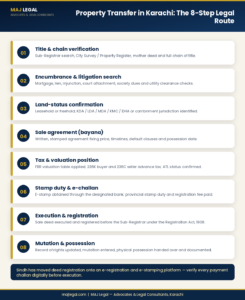
Property transfer in Karachi ,the 8-step legal route explained by MAJ Legal property lawyers
Step 1 ,Title and chain-of-title verification
The starting point is never the seller’s file. It is the official record. Your lawyer should obtain a Sub-Registrar search for the property, pull the City Survey or Property Register entry where applicable, and then trace the chain of title backwards through every transfer to the mother deed. A break anywhere in that chain ,a missing link, a transfer by someone who was never the recorded owner, a deed that was executed but never registered ,is a defect that will surface later, usually at the worst possible moment.
Step 2 ,Encumbrance and litigation search
Verify whether the property is mortgaged, subject to a lien, attached in execution of a decree, or the subject of a pending suit or injunction. Check society and authority dues, property tax arrears, and utility clearances. A buyer takes the property with its encumbrances; a decree against your seller becomes your problem.
Step 3 ,Land-status confirmation
Establish whether the interest is leasehold or freehold, which authority controls it, whether the lease term has expired or is close to expiry, and whether the use is residential, commercial or amenity. Amenity plots deserve particular caution: land reserved for amenity use in an approved layout cannot lawfully be converted to residential or commercial use simply because a builder says it can.
Step 4 ,The sale agreement
The bayana or agreement to sell should be in writing, adequately stamped, and specific. It must fix the price, the payment schedule, the completion date, who bears which tax, what happens on default by either side, and the exact date and manner of handover of possession. A one-page receipt for a token payment is not an agreement ,it is an invitation to litigation.
Step 5 ,Tax and valuation position
Establish the FBR-notified value for the area, confirm the Active Taxpayer List status of both parties, and calculate the buyer’s and seller’s advance tax exposure before the price is finalised. Filer status is not a paperwork detail in 2026; it is a material term of the deal.
Step 6 ,Stamp duty and e-challan
Stamp duty and the registration fee are computed on the notified value of the instrument. Sindh has moved to an e-stamping system, with challans generated online and e-stamps issued through designated banks. Every payment instrument should be verified digitally before execution ,physical stamp papers of doubtful provenance remain a live risk in this city.
Step 7 ,Execution and registration
The sale deed is executed and presented for registration before the Sub-Registrar having jurisdiction, within the period allowed by the Registration Act, 1908. Both parties (or their lawfully constituted attorneys) attend, identity is verified, and the deed is registered. An unregistered sale deed of immovable property does not transfer title. No amount of possession, payment or family assurance cures that.
Step 8 ,Mutation and possession
Registration is not the end. The record of rights must be updated, mutation entered in the relevant authority’s record, and physical possession taken and documented ,ideally with a written handover, photographs, a change of utility connections into the buyer’s name, and immediate physical securing of the property. A property that is registered in your name but occupied by someone else is a lawsuit waiting to happen.
Due diligence: the documents that must be verified
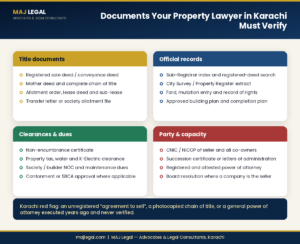
Property document verification checklist for Karachi buyers ,MAJ Legal
Photocopies prove nothing. Originals should be inspected, official records should be independently searched, and every signatory’s authority should be established. The four categories that matter are title documents, official records, clearances and dues, and party capacity.
The most common failure in Karachi is not a forged deed ,it is an unverified authority to sell. A property may be genuinely owned by the family it is said to belong to, and the deed may be genuine, while the person actually signing has no lawful power to sign: an heir who is one of six, an attorney whose power was revoked, a director without a board resolution, or a “caretaker” with nothing but a decade of occupation behind him. Verifying capacity is as important as verifying title.
Taxes and transaction costs after the Finance Act 2026
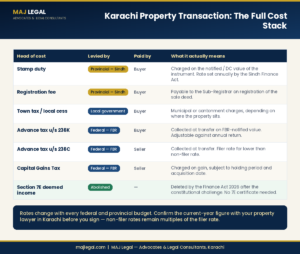
Karachi property transaction cost stack 2026-27 ,stamp duty, 236C, 236K, capital gains
Property transaction costs in Pakistan sit in two layers: provincial charges collected in Sindh, and federal taxes collected by the FBR.
Provincial (Sindh) ,stamp duty on the instrument, the registration fee payable to the Sub-Registrar, and town or cantonment charges depending on location. Stamp duty is calculated on the notified or DC value rather than a figure the parties choose, and the rate is set annually through the provincial Finance Act.
Federal (FBR) ,advance tax on the seller under section 236C, advance tax on the buyer under section 236K, and capital gains tax on any gain, subject to holding period and acquisition date. Both 236C and 236K are collected at the point of transfer on the FBR-notified value and are adjustable against the annual return.
The 2026 change most Karachi buyers have not caught up with
Two developments have materially altered the position for property owners.
Section 7E is gone. The deemed-income tax on immovable property under section 7E of the Income Tax Ordinance, 2001 has been deleted. The provision was held to be beyond legislative competence and then formally deleted by the Finance Act, so the deemed-income regime that applied to specified immovable properties no longer operates. The practical consequence is significant: both the tax on notional rental income and the 7E certificate requirement at transfer have disappeared. For years, obtaining a 7E certificate was a bottleneck that delayed Karachi transfers by weeks. That step has disappeared.
Transfer taxes were cut roughly in half for filers. Under the 2026-27 budget measures, advance tax on property sales was halved. Sellers on the Active Taxpayers List now face a flat rate of 2.75% under section 236C, down from 5.5%, while filer buyers pay a reduced 1.25% on fair market value under section 236K, against 2.5% previously.
Two cautions. First, non-filer rates remain punitive ,a multiple of the filer rate, and in some brackets several times higher. Getting onto the Active Taxpayer List before a transaction is one of the highest-return pieces of pre-transaction planning available. Second, rates change with every federal and provincial budget. Any figure in any article, including this one, must be confirmed against the current position before you sign. That verification is part of what you instruct a property lawyer in Karachi to do.
Registration and e-registration in Sindh
Registration is the act that gives a property transaction legal force against the world. Under the Registration Act, 1908, a sale of immovable property above the statutory threshold must be by registered instrument, and an unregistered document cannot be received as evidence of the transaction it purports to effect.
Sindh has been moving this process onto a digital footing. Deed registration now runs through an e-registration platform with online applications and e-stamping, and the Board of Revenue has been rolling out digitised land records, GIS-mapped deh and district maps and computerised property registers for Karachi city. The stated purpose is to compress a registration process that once ran for months into a matter of days, and to make objections visible to the parties immediately rather than months later.
For buyers, the practical benefit is verification. Digitised registers and online property records make it far easier ,though not yet infallible ,to check what the state’s record actually says before money moves. For sellers and overseas owners, the benefit is traceability: a digital footprint is much harder to quietly overwrite than a paper register.
None of this removes the need for a lawyer’s search. Digitisation has been progressive rather than complete, older records still require manual verification, and the record of rights is evidence of title, not proof of it.
Property disputes: choosing the right forum
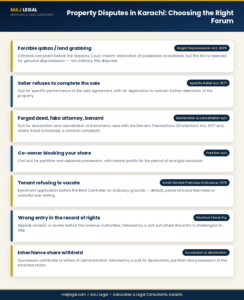
Property dispute remedies in Karachi ,choosing the right legal forum, MAJ Legal
Most property cases are lost not on the merits but on the choice of forum and the framing of the relief. Filing the wrong proceeding wastes years, and in some cases destroys the remedy altogether through limitation.
Suit for declaration and cancellation ,where a deed, mutation, transfer letter or power of attorney is forged, fraudulent or void, the remedy is a suit for declaration under section 42 of the Specific Relief Act, 1877, generally coupled with cancellation of the instrument under section 39 and a permanent injunction. Where fraud or forgery is involved, a parallel criminal complaint may be warranted.
Suit for specific performance ,where a seller has signed an agreement to sell and then refuses to complete, section 12 of the Specific Relief Act allows the court to compel performance. The suit should be accompanied by an application under Order XXXIX rules 1 and 2 CPC restraining further alienation, and the buyer must show continuous readiness and willingness to perform.
Suit for possession ,a title-holder out of possession sues for possession under section 8 of the Specific Relief Act. Separately, section 9 provides a summary remedy: a person dispossessed of immovable property without their consent and otherwise than in due course of law may sue for possession within six months of dispossession, without even having to prove title. That six-month window is short, powerful and routinely missed.
Partition suit ,where co-owners cannot agree, a suit for partition and separate possession is filed, with a claim for mesne profits covering the period of wrongful exclusion.
Ejectment before the Rent Controller ,a tenant who will not vacate is removed through an ejectment application under the Sindh Rented Premises Ordinance, 1979 on statutory grounds such as default in rent, personal bona fide requirement or unlawful sub-letting. Note again the cantonment exception discussed above.
Revenue proceedings ,where the complaint is a wrong entry in the record of rights, the first route is the revenue hierarchy of appeal, revision and review, followed by a civil suit where the dispute is genuinely one of title rather than of record.
Constitutional petition ,where a public authority, development authority or cantonment board has acted without lawful authority, a petition under Article 199 of the Constitution before the Sindh High Court may be the fastest route.
Qabza and illegal dispossession
The Illegal Dispossession Act, 2005 is the sharpest instrument available to a dispossessed Karachi owner, and also the most frequently misused. Understanding both halves of that sentence is what separates a competent qabza lawyer in Karachi from an expensive one.
What the Act gives you. A complaint under section 3 is filed before the Court of Sessions. The court can order interim restoration of possession during proceedings, can direct restoration on conviction, and can award compensation. Because it is a criminal proceeding, it moves faster than an ordinary civil suit and carries a consequence that concentrates minds.
Where the Act does not reach. The courts have repeatedly restricted the Act to genuine cases of land-grabbing. Its purpose is to curb property grabbers and protect lawful owners and occupiers from illegal or forcible dispossession ,and the courts have made clear this does not extend to every property quarrel. The jurisdiction is exceptional and penal in character, and can be invoked only where the foundational ingredients of illegal and forcible dispossession are clearly established. The Supreme Court has emphasised repeatedly that the Act must not be pressed into service for ordinary civil disputes, boundary disagreements or contractual claims unless the strict statutory requirements are met.
The practical filter courts apply is criminal intent. A court taking cognizance under the Act is expected to filter out complaints that disclose no criminal intent ,which is why a complaint drafted as though it were a civil plaint tends to be dismissed at the threshold.
Who can complain. The Act protects occupiers as well as owners. The Sindh High Court has held that an occupier falls within the definition in section 2(c) and may seek a remedy under the Act. A lawful tenant or lawful occupant forced out is therefore not without recourse.
Running civil and criminal proceedings together. Where title is genuinely disputed, courts are cautious about deciding possession under the Act before the civil issue is resolved. But the two tracks are not mutually exclusive: proceedings under the Act can proceed independently of related civil litigation over the same property. The correct strategy in a serious Karachi qabza matter is usually parallel ,a criminal complaint under the Act to address the dispossession, and a civil suit to settle title conclusively.
What decides these cases. Evidence of lawful possession before the dispossession, and speed. Photographs, utility bills, tax receipts, tenancy records, caretaker agreements, a police roznamcha entry made immediately, and a complaint filed within weeks rather than years. Owners who wait a year and then arrive with a photocopied file are the ones who lose.
Overseas Pakistanis and Karachi property
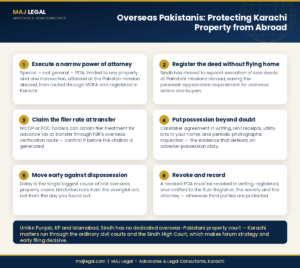
Overseas Pakistanis protecting Karachi property from abroad ,MAJ Legal guide
Overseas Pakistanis are the single most targeted category of property owner in Karachi. The reasons are structural: the owner is absent, the record is old, communication runs through family, and litigation requires physical presence that the owner cannot easily provide. MAJ Legal acts for a substantial number of clients in the Gulf, the United Kingdom, North America and Europe, and the pattern is consistent.
Power of attorney: the instrument that protects you and the one that destroys you
Almost every overseas property loss begins with a power of attorney. The safeguards are straightforward but rarely applied:
- Use a special power of attorney, never a general one. Limit it to one specific property, one specific transaction and, where possible, a fixed expiry date.
- Attest properly. Execute before the Pakistan Embassy or Consulate, then route through the Ministry of Foreign Affairs in Pakistan, and register it where the intended use requires registration.
- Do not give a power of sale where a power to manage will do. Collecting rent does not require the authority to convey title.
- Revoke formally. A revocation must be in writing, registered, and notified to the attorney, the Sub-Registrar, the society and the relevant authority. An informal revocation over the phone leaves third parties protected and you exposed.
Registering a deed without flying to Karachi
The Sindh government has moved to expand execution of sale deeds at Pakistani missions abroad and to ease the requirement that overseas Pakistanis appear in person at registration offices in Sindh, through an amendment to the registration framework as it applies in the province. The reform expands online completion of sale deeds at Pakistani diplomatic missions and embassies abroad, and amends section 38 of the Registration Act as applied in Sindh so that overseas Pakistanis need not appear in person at registration offices in the province. Because implementation of measures like this is progressive, the position at your consulate should be confirmed before you plan a transaction around it.
Advance tax at the filer rate
Non-resident Pakistanis holding NICOP or POC can obtain filer treatment for advance tax on property transfers through the FBR’s dedicated overseas verification route, rather than being taxed at non-filer rates simply because they do not appear on the Active Taxpayer List. The FBR procedure requires the authority, registrar or housing society handling the transfer to use the dedicated overseas link on the FBR portal to generate the payment slip, at which point POC or NICOP details are declared and the filer rate applied. This must be arranged before the challan is generated. Once tax has been collected at the non-filer rate, recovering it is a far longer road.
The forum problem nobody tells overseas clients about
Punjab, Khyber Pakhtunkhwa and Islamabad have each legislated for dedicated special courts to hear overseas Pakistanis’ property disputes on fast-track timelines, with e-filing and video-link hearings. In Punjab, the High Court has since read that jurisdiction broadly ,holding that the special courts’ jurisdiction reaches beyond ownership and possession to cover contracts, inheritance, partition, the validity of transactions and related ancillary issues.
Sindh has no equivalent special court for overseas property disputes. A Karachi matter therefore runs through the ordinary civil courts and the Sindh High Court, without the statutory 90-day or 120-day timelines available across the provincial border. This is not a reason for despair, but it is a reason for strategy: in Karachi, the advantage has to be manufactured through early filing, correctly framed interim relief, properly executed powers of attorney that survive challenge, and evidence assembled before the dispute rather than after it. Very few competitor guides mention this at all, and overseas clients frequently arrive at our office expecting a fast-track forum that does not exist in this province.
Practical protection while you are abroad
- Put a written caretaker or tenancy agreement in place ,never an informal family arrangement
- Keep utility connections and tax records in your own name
- Obtain rent receipts and periodic dated photographs
- Have an independent lawyer, not the family member in possession, hold a verified copy of the title documents
- Instruct a property lawyer to conduct an annual record check at the Sub-Registrar and the relevant authority
Inheritance, succession and property
A very large share of Karachi property litigation is family litigation wearing a property suit’s clothing.
On the death of a Muslim owner, the estate devolves immediately on the heirs in their Sharia shares. No heir needs anyone’s permission to own their share ,but to deal with it, the estate must be documented. That is done through a succession certificate for movable assets and letters of administration for immovable property, obtainable either through the court or, under the Letters of Administration and Succession Certificates Act, 2021, through NADRA’s succession facilitation route where the case is undisputed.
Where an heir has been excluded ,a common scenario being a daughter or sister whose share was never mutated, or a property transferred by one heir purporting to act for all ,the remedy is a suit for declaration, partition and possession, often coupled with cancellation of the instrument through which the exclusion was effected. Courts in Pakistan have treated the deprivation of female heirs with particular seriousness, and delay is less readily held against an heir who was kept in ignorance. But “less readily” is not “never”: limitation still applies, and the safest course is to act as soon as the exclusion is discovered.
A related trap: a gift (hiba) during the owner’s lifetime requires three elements ,declaration by the donor, acceptance by the donee, and delivery of possession. A “gift deed” executed to defeat other heirs, with the donor remaining in full possession and control until death, is vulnerable to challenge on precisely that ground.
Benami transactions and hidden ownership
Property held in one person’s name but paid for and controlled by another is a benami transaction. Under the Benami Transactions (Prohibition) Act, 2017, such transactions are prohibited, benami property is liable to confiscation, and ,critically ,the real owner cannot simply walk into court and claim the property back on the basis that they paid for it.
This matters in two very common Karachi situations. First, the family arrangement in which property is bought in a son’s or brother’s name “for convenience” and the arrangement is later denied. Second, the overseas client who remitted the entire purchase price but allowed the property to be registered in a relative’s name. Both are far harder to unwind under the 2017 Act than they were before it. The answer is prevention: buy in your own name, remit through banking channels traceable to you, and if a nominee arrangement is genuinely unavoidable, take proper advice on how to document it lawfully.
Limitation: the deadlines that end cases
More Karachi property claims die of delay than of weak merits. The Limitation Act, 1908 sets the outer boundaries.
| Type of claim | Limitation period | Runs from |
| Summary possession after dispossession (s.9, Specific Relief Act) | 6 months | Date of dispossession |
| Specific performance of a contract | 3 years | Date fixed for performance, or refusal |
| Cancellation or setting aside of an instrument | 3 years | When the facts entitling the plaintiff to relief become known |
| Suit for declaration (residuary) | 6 years | When the right to sue accrues |
| Possession based on title | 12 years | Dispossession or discontinuance of possession |
| Pre-emption | 1 year | Sale or registration, as applicable |
| Adverse possession maturing against an owner | 12 years | Commencement of adverse possession |
Two points are worth emphasising for overseas owners. Limitation generally runs from the wrongful act, not from the day you happened to find out about it ,with limited statutory exceptions where fraud has been concealed. And twelve years of undisturbed hostile possession by an occupant can mature into a title that defeats the paper owner. Distance is not a defence. Silence is not a strategy.
Karachi red flags and common frauds
Patterns we see repeatedly:
- Sale on an unregistered agreement. The buyer pays, takes possession, and holds a stamped agreement that does not transfer title. Years later the seller ,or the seller’s heirs ,sell again to a third party who registers first.
- The multi-sale. The same plot sold to three or four buyers on the strength of photocopies, with only one registration and a great deal of litigation.
- The stale power of attorney. A power executed years earlier, revoked or expired or granted by someone since deceased, used to convey property. A power of attorney dies with the principal.
- The silent co-owner. One heir signs on behalf of the whole family without authority. The transaction is voidable as to the shares of everyone who did not sign.
- Amenity or leasehold misuse. A plot reserved for amenity use, or held on a lease that prohibits commercial use, sold as commercial land with a promise that “conversion is a formality”.
- Fabricated society allotment files. Allotment letters for societies whose land status, layout approval or NOC does not exist in the form represented.
- The caretaker who becomes an owner. A trusted occupant left in place for a decade, quietly building evidence of adverse possession while the owner is abroad.
- Under-declared value. Recording a price below the real one to reduce duty. It creates a documented sale price the buyer may later be held to, and exposes both parties to tax consequences.
The common thread is that every one of these is detectable in advance by a search that costs a fraction of the litigation that follows.
How to choose the best property lawyer in Karachi
Ask specific questions:
- Will you conduct an independent title search, or rely on the seller’s documents? There is only one acceptable answer.
- Which authority controls this property, and what does that change? If the lawyer cannot answer this at the first meeting for a DHA, cantonment or society property, keep looking.
- What is the limitation position on my claim? A competent property advocate identifies the deadline before discussing strategy.
- What is your written scope and fee structure? Court fee, stamp duty and registration charges are separate from professional fees and should be itemised.
- Who will actually handle my file? In an overseas matter especially, you need a named point of contact and a communication rhythm.
- What is the realistic timeline and the realistic downside? A lawyer who promises certainty in a contested property matter is telling you what you want to hear.
The top lawyers in Karachi for property work are distinguished by their preventive discipline, not their courtroom volume.
Why clients instruct MAJ Legal
MAJ Legal ,Barristers, Advocates & Corporate Legal Consultants is a Karachi law firm with a dedicated property practice serving individuals, families, landlords, developers and a significant overseas Pakistani client base.
- Karachi-specific expertise across city survey property, KDA, LDA, MDA and KMC leaseholds, DHA and cantonment files, and cooperative society transfers
- Full transactional service from title search through registration, mutation and possession
- Contentious capability before the civil courts, the Court of Sessions in dispossession matters, the Rent Controller, the revenue hierarchy and the Sindh High Court
- Overseas client systems built for distance: properly drafted and attested powers of attorney, video consultations across time zones, documented file updates, and annual record checks on your Karachi property
- Written scope and clear fees before work begins
Whether you are buying your first apartment in Karachi, recovering a plot that has been taken over, defending a dispossession complaint, ejecting a tenant, or protecting an inherited family property from abroad, our property team can advise you on the position and the realistic options.
Contact MAJ Legal to book a property consultation
Frequently asked questions
- Why do I need a property lawyer in Karachi if the seller’s papers look complete?
Because “looking complete” and “being verified” are different things. Forged deeds, revoked powers of attorney, undisclosed co-owners, mortgages and pending litigation are not visible on the face of a document. Only an independent search of the official record reveals them, and by then it is too late to renegotiate.
- How much does a property lawyer in Karachi cost?
Fees vary with the work. A title verification and transaction package is normally quoted as a fixed fee. Litigation is quoted by stage. Government charges ,stamp duty, registration fee, court fee, taxes ,are separate and should always be itemised. Ask for the scope in writing before you instruct.
- Is an unregistered sale agreement enough to prove I own a property?
No. A sale of immovable property must be effected by a registered instrument. An unregistered agreement may support a claim for specific performance against the seller, but it does not by itself transfer title, and the claim carries a three-year limitation period.
- Someone has occupied my plot by force. What do I do first?
Act immediately. Report the incident and ensure it is recorded. Preserve every document proving lawful possession ,bills, tax receipts, photographs, tenancy or caretaker records. Then instruct a lawyer to assess whether a complaint under the Illegal Dispossession Act, 2005 is available, whether a summary suit for possession within six months applies, and what interim relief should be sought. Delay is the single most damaging thing you can do.
- Can I file an Illegal Dispossession Act case for any property dispute?
No. The Act is confined to genuine forcible dispossession by land-grabbers. Courts filter out complaints that are really ordinary civil, contractual or boundary disputes dressed up as criminal complaints. A wrongly framed complaint is dismissed and wastes the months you needed.
- I am an overseas Pakistani. Can I sell my Karachi property without travelling?
In most cases, yes ,through a properly drafted special power of attorney, executed and attested at the Pakistan mission in your country, routed through the Ministry of Foreign Affairs, and registered in Pakistan. Sindh has also been extending arrangements for execution of deeds at missions abroad. Confirm the current position for your consulate before planning around it.
- What is the safest form of power of attorney for property?
A special power of attorney limited to one property and one transaction, with a defined expiry date, executed and attested through the proper channel, and registered. Avoid open-ended general powers of attorney granting an unrestricted power of sale.
- Do I still need a section 7E certificate to transfer property?
No. Section 7E has been deleted from the Income Tax Ordinance, 2001 following the constitutional ruling and the Finance Act 2026, and the certificate requirement that went with it no longer applies. Because this is a recent change, confirm the position with your lawyer at the time of your transaction.
- What taxes will I pay when buying property in Karachi?
Provincially: stamp duty and the registration fee, plus town or cantonment charges. Federally: advance tax under section 236K as buyer, calculated on FBR-notified value. The seller pays advance tax under section 236C and may face capital gains tax. Non-filer rates are substantially higher than filer rates, so confirm your Active Taxpayer List status before the transaction.
- How long does property registration take in Karachi?
With complete and verified documents, registration itself can be quick under the e-registration system. The realistic timeline is driven by the preparatory stage ,title search, encumbrance checks, tax clearances and authority NOCs ,which typically takes a few weeks. Files with defects take considerably longer.
- My property is in DHA Karachi. Is the process different?
Yes. DHA operates its own transfer regime through its transfer office, with its own NOC and transfer documentation, rather than the ordinary Sub-Registrar route that applies to city survey property. Cantonment properties in Clifton and Karachi Cantonment are similarly governed by the cantonment framework. The applicable rent law also differs. This must be identified at the outset.
- My co-owners will not agree to sell. What can I do?
You can file a suit for partition and separate possession. Where physical division is not feasible, the court can direct sale and division of proceeds. You may also claim mesne profits for any period you were wrongfully excluded from the property.
- A tenant is refusing to vacate my Karachi property. What is the remedy?
An ejectment application before the Rent Controller under the Sindh Rented Premises Ordinance, 1979, on a statutory ground such as default in rent, personal bona fide requirement or unlawful sub-letting. Self-help eviction is unlawful and can expose you to criminal liability. Cantonment-area tenancies fall under the cantonment rent framework instead.
- How long do I have to file a property case in Pakistan?
It depends on the claim: six months for summary possession after dispossession, three years for specific performance, three years to cancel an instrument, six years for a declaration, and twelve years for possession based on title. Because the periods differ and start on different dates, have the limitation position assessed as soon as a dispute arises.
- Can I recover property that a relative registered in their own name using my money?
It is difficult. The Benami Transactions (Prohibition) Act, 2017 prohibits benami arrangements and bars the real owner from simply reclaiming the property on the basis of having paid for it. Take advice before assuming a claim exists, and never structure a purchase this way.
This article is general legal information about property law in Karachi, Pakistan and does not constitute legal advice on any specific matter. Statutory rates, tax rules and procedural requirements change frequently. For advice on your property, please consult a qualified property lawyer in Karachi.
MAJ Legal, Barristers | Advocates & Corporate Legal Consultants, Karachi
Property law · Family law · Landlord and tenant · Overseas Pakistani legal services