
Family Cases for Overseas Pakistanis in Karachi: The Complete Legal Guide
By MAJ Legal Barristers | Advocates & Legal Consultants, Karachi
Living in Dubai, London, Toronto, Jeddah or New York does not put your family matters beyond the reach of Pakistani law — and it does not put Pakistani remedies beyond your reach either. Every year, thousands of overseas Pakistanis need a khula decreed, maintenance enforced, custody of a child settled, a guardian certificate issued or a dowry recovered — and almost all of them assume they must book a flight to Karachi to make it happen.
They don’t.
A properly drafted power of attorney, an experienced advocate and a correctly framed plaint will carry your case from filing to decree while you continue working abroad. As a family law firm in Karachi that acts for overseas clients across the Gulf, Europe, North America and Australia, MAJ Legal has built its practice around exactly this problem: how to obtain a real, enforceable, NADRA-registered outcome in a Pakistani family court for a client who is eight time zones away.
This guide covers the whole of the family law field as it applies to non-resident Pakistanis — jurisdiction, khula, talaq, maintenance, dower, dowry, custody, guardianship, visitation, child-removal risk, recognition of foreign decrees and the practical mechanics of running a case by proxy. It is written for the person actually living the problem, not for a law library.
Why Karachi Family Courts Matter to Overseas Pakistanis
Karachi is the country’s largest city and, for a very large share of the diaspora, the place where the nikah was registered, where the wife’s family lives, where the disputed property sits, or where the children are currently residing. That is why the Family Courts of Karachi — sitting in the City Courts complex and in the district courts of Karachi East, West, South, Central, Korangi, Malir and Keamari — hear a disproportionate volume of overseas matters.
There are four recurring situations:
- The husband works abroad; the wife and children remain in Karachi. The wife sues for maintenance, dissolution or custody, and the husband must defend from overseas.
- The wife has moved abroad after marriage and wants to dissolve a marriage that was solemnised in Karachi and remains registered there.
- Both spouses live abroad, but the marriage was contracted in Pakistan, the dower is unpaid, and one party wants a Pakistani decree recognised by NADRA.
- A child has been brought to Karachi by one parent, and the parent overseas needs custody, visitation or a restraint on further removal.
Each of these raises a different jurisdictional question, and getting that question wrong at the filing stage is the single most common reason an overseas case collapses months later. Engaging the best family lawyers in Karachi at the outset is not an indulgence; it is what prevents a decree from being set aside on appeal for want of jurisdiction.
The Legal Framework: Which Laws Actually Govern Your Case

Figure 1 — Family matters overseas Pakistanis can pursue in the Family Courts of Karachi.
Pakistani family law is not a single code. An overseas family matter in Karachi will usually engage several instruments at once:
| Instrument | What it governs |
| Muslim Family Laws Ordinance, 1961 | Talaq procedure (s.7), khula and dissolution registration, polygamy permission (s.6), maintenance references to the Arbitration Council (s.9), succession of orphaned grandchildren (s.4) |
| Family Courts Act, 1964 (as applied in Sindh) | Constitution and jurisdiction of Family Courts, procedure, interim maintenance (s.17-A), six-month disposal requirement (s.12-A), appeals (s.14) |
| West Pakistan Family Courts Rules, 1965 | Territorial jurisdiction (Rule 6), form of the plaint, service of summons |
| Dissolution of Muslim Marriages Act, 1939 | The statutory grounds on which a wife may seek dissolution (s.2), including cruelty, non-maintenance for two years, imprisonment, impotence and failure to perform marital obligations for three years |
| Guardians and Wards Act, 1890 | Appointment of guardians of the person and property of a minor; guardian certificates |
| Dowry and Bridal Gifts (Restriction) Act, 1976 | Limits on dowry and the basis for recovery of listed articles |
| Sindh Child Marriages Restraint Act, 2013 | Minimum marriage age of 18 in Sindh for both parties — stricter than the federal position |
| Code of Civil Procedure, 1908 | Applied selectively — including s.133 exemption from personal appearance, relevant to overseas litigants |
| Sindh Protection Against Harassment / Domestic Violence legislation | Protection orders, residence orders and restraint of harassment where family violence is alleged |
A firm that describes itself among the top law firms in Karachi should be able to tell you within a first consultation which of these apply to your facts and which do not. Half of the anxiety overseas clients carry is caused by advice that mixes up, for example, the Union Council’s role under section 7 with the Family Court’s role under the 1964 Act. They are separate processes with separate timelines.
Jurisdiction: Can a Karachi Family Court Hear Your Case at All?
This is the threshold question, and it deserves care.
Under Rule 6 of the West Pakistan Family Courts Rules, 1965, a Family Court has jurisdiction where:
- the cause of action wholly or in part arose within its local limits; or
- the parties reside or last resided together within those limits; and
- the proviso: in suits for dissolution of marriage or dower, the court within whose local limits the wife ordinarily resides also has jurisdiction.
That proviso is the gateway most overseas cases pass through. It is also the one most frequently abused — and superior courts have noticed.
The “ordinarily resides” trap
Courts have consistently held that “ordinarily resides” describes a genuine, settled pattern of residence — not a fleeting stay. Where a wife living permanently in the United Kingdom entered Pakistan for a matter of weeks and instituted a dissolution suit on the basis of that visit, the decree was held to be without jurisdiction: temporary presence does not vest a Pakistani Family Court with authority. At the same time, the concept is read sympathetically for the estranged wife who has genuinely left the matrimonial home and settled at a place of her own choosing — that new place answers to “ordinarily resides”, even if it is not where her husband or parents live.
The practical consequence for overseas Pakistanis is straightforward:
- Do not manufacture residence. A two-week visit to Karachi with a hastily obtained address is a defect the opposing party’s counsel will find.
- Do document genuine connection. CNIC/NICOP address, ancestral home, property records, utility bills, the place where the nikahnama was registered, the location of the children, and where the parties last resided together all matter.
- Where the cause of action arose in Karachi — for instance, the nikah was solemnised and registered there, or the dowry articles are held there, or the husband abandoned the wife there — jurisdiction can rest on that limb without relying on the proviso at all.
For guardianship and custody, the Supreme Court has confirmed that territorial jurisdiction of the Family Court is governed by Rule 6 rather than section 9 of the Guardians and Wards Act, which is why custody applications concerning children physically present in Karachi are properly filed there.
Getting this analysis right at the outset is the clearest single marker of the best family law firm in Karachi versus a general practitioner taking on an overseas file for the first time.
Appointing a Lawyer Without Flying to Pakistan: The Power of Attorney

Figure 2 — Executing and attesting a Special Power of Attorney from abroad.
You do not need to be physically present in Karachi to sue or be sued. What you need is a Special Power of Attorney (SPA) — a case-specific instrument authorising a named person (often a trusted relative) and your advocate to act for you.
Why “special”, not “general”
A General Power of Attorney is too blunt an instrument for family litigation and is routinely challenged. A Special Power of Attorney should name:
- the exact parties and the marriage in question;
- the specific reliefs authorised (dissolution, khula, maintenance, custody, recovery of dowry, and so on);
- the court or forum in which proceedings are to be conducted;
- express authority to engage counsel, sign and verify pleadings, file applications, receive documents and — where you intend it — to compromise or settle;
- your CNIC/NICOP and passport particulars.
Vague or over-broad wording is the most common defect. If the SPA does not authorise settlement and your attorney signs a compromise, that compromise is open to challenge. Conversely, an SPA that authorises everything can create risk for you.
The attestation chain
How your SPA is validated depends on where you live:
Route A — Hague Apostille Convention countries. Pakistan acceded to the Hague Convention Abolishing the Requirement of Legalisation for Foreign Public Documents, and the Convention entered into force for Pakistan on 9 March 2023. Documents from contracting states bearing an Apostille from that state’s designated authority are accepted in Pakistan without further attestation by the Ministry of Foreign Affairs or a Pakistan Mission. This covers most of the diaspora — the UK, the USA, Canada, Australia, most of Europe, and the GCC states.
Route B — the consular route. Where an Apostille is unavailable or a Pakistani institution insists on it, the traditional chain applies: execute and sign the SPA before the authorised officer at the Pakistan Embassy, High Commission or Consulate in your country of residence, then have it counter-attested by the Ministry of Foreign Affairs in Islamabad or at a MOFA camp office.
In practice, we still recommend Pakistan Mission attestation for family SPAs even from Apostille states in some circumstances, because Union Councils and some district-level offices remain more familiar with the consular stamp than with the Apostille. Your advocate should make that call based on which office the document will ultimately be placed before.
Supporting requirements
- Two witnesses must sign, with CNIC copies attached.
- Attach NICOP or passport copy and recent photographs.
- Some courts require the SPA to be registered or to bear adhesive stamps; your counsel will advise on Sindh requirements.
- If the SPA is in English and the court requires Urdu, a certified translation may be needed.
Once the SPA is in place, your advocate files the plaint, appears on every date, argues the case and communicates with you by email or video call. For most overseas clients, the entire matter proceeds without a single flight.
Khula: Dissolution at the Wife’s Instance
Khula is the most frequently sought remedy by overseas Pakistani women, and it is the one most surrounded by misinformation.
The essential points
- The husband’s consent is not required. A Family Court can and regularly does decree khula over the husband’s objection where it is satisfied that the spouses cannot live together within the limits prescribed by Allah.
- The test is subjective aversion. Courts have held that evidence on oath of genuine hatred, disliking or serious disharmony is sufficient; the wife is not required to prove fault by the husband.
- The price of khula is usually the dower. In decreeing khula, the court ordinarily requires the wife to relinquish her haq mehr — the prompt dower already received or the deferred dower claimed. This is a quid pro quo, not a penalty. Whether other benefits must be returned depends on the facts and is frequently litigated.
- Khula does not extinguish maintenance for children. Confusion on this point causes real harm. A wife who obtains khula gives up her own dower and her post-khula maintenance claim, but the children’s maintenance and the arrears of past maintenance stand on entirely separate footing.
Where the wife lives abroad
If the wife resides overseas, jurisdiction must be established on a limb other than her current residence — usually because the marriage was solemnised and registered in Karachi, the parties last resided together there, or the husband resides there. Where the wife retains a genuine ordinary residence in Karachi despite periods abroad, the Rule 6 proviso can be relied upon, but the evidence must be real.
After the decree
A khula decree is not the end of the process. The decree is transmitted to the Union Council having jurisdiction, which then runs the statutory reconciliation period. The dissolution takes effect on the expiry of ninety days from receipt of the notice unless reconciliation succeeds within that time. Only after the Union Council issues its effectiveness certificate can a NADRA divorce certificate be obtained — and it is that NADRA certificate, not the court decree alone, that foreign authorities, embassies and second-marriage registrars usually demand.
Overseas clients who stop at the decree and skip the Union Council step discover the gap years later, often when applying for a spousal visa. Instructing the best khula lawyers in Karachi means instructing someone who will carry the file all the way through to NADRA registration.
Talaq and Section 7: For Overseas Pakistani Husbands
An overseas Pakistani husband who pronounces talaq — whether in Dubai, Manchester or Riyadh — has not completed a divorce recognised in Pakistan simply by pronouncing it.
Section 7 of the Muslim Family Laws Ordinance, 1961 requires that:
- The husband, as soon as may be after pronouncing talaq in any form whatsoever, gives written notice to the Chairman of the relevant Union Council;
- He supplies a copy of that notice to the wife;
- The Chairman constitutes an Arbitration Council to attempt reconciliation;
- The talaq takes effect ninety days after the Chairman receives the notice, unless revoked earlier;
- Where the wife is pregnant, the talaq does not take effect until ninety days have elapsed or the pregnancy ends, whichever is later.
Failure to give the section 7 notice has serious consequences. The divorce may be treated as ineffective in Pakistan, exposing the husband to continuing maintenance liability and — if he remarries — to allegations under section 6 regarding a subsequent marriage without permission.
For an overseas husband, the notice can be sent by an attorney under an SPA, by courier, or by registered post to the correct Union Council. Identifying the correct Union Council — determined by the wife’s residence — is where errors occur. A notice served on the wrong Union Council is, in practical terms, no notice at all.
Maintenance (Nafqah): Wife and Children
Maintenance is the most commonly litigated overseas family matter in Karachi, because remittances stop long before marriages formally end.
For the wife
A wife is entitled to maintenance during the subsistence of the marriage and during her iddat, provided she is not in wilful disobedience without cause. A decree can cover past maintenance (arrears) as well as future maintenance, and courts routinely grant both.
For the children
A father’s obligation to maintain his children is independent of the state of the marriage, of who has custody, and of whether the mother obtained khula. It continues:
- for sons, until they attain majority and are capable of earning;
- for daughters, until marriage;
- indefinitely for a child with a disability preventing self-support.
Interim maintenance under section 17-A
This provision is decisive for overseas cases. At the pre-trial stage, the Family Court fixes interim monthly maintenance, payable by the fourteenth of each month. If the defendant fails to pay, the court may strike out his defence and decree the suit. An overseas father who ignores summons on the assumption that distance protects him frequently finds an ex parte decree entered and his defence struck out.
How the quantum is assessed
Courts look at the father’s actual earning capacity, not merely his declared income. For overseas defendants, the following are routinely produced in evidence: foreign salary certificates, employment contracts, bank statements, remittance records, property holdings in Pakistan, standard of living maintained abroad, and school fee records. Karachi courts have become considerably more willing to draw adverse inferences where an overseas earner declines to disclose foreign income.
Enforcement against someone living abroad
This is the honest limitation. A Pakistani maintenance decree is enforced against assets and persons within Pakistan. Practical routes include:
- attachment and sale of the defendant’s property in Pakistan;
- attachment of bank accounts and rental income in Pakistan;
- recovery of arrears as arrears of land revenue through the Collector;
- warrants and coercive process if the defendant returns to Pakistan;
- in appropriate cases, applications concerning travel documents and exit control, though these are exceptional and subject to strict scrutiny.
A candid maintenance lawyer in Karachi will tell you at the outset which of these is realistic on your facts rather than promising enforcement that cannot be delivered.
Dower (Haq Mehr) and Dowry (Jahez)
Dower
Haq Mehr is a contractual obligation recorded in the nikahnama, not a gift. It may be:
- *Prompt (mu’ajjal)* — payable on demand, at any time during the marriage;
- *Deferred (mu’ajjal/ghair mu’ajjal)* — payable on dissolution or death.
Columns 13 to 16 of the nikahnama are decisive. Where a property has been stipulated as dower, the Family Court can decree transfer of that property. Where the husband claims dower was already paid, the burden of proving payment lies on him.
In khula proceedings, dower is ordinarily surrendered. In dissolution on other grounds, or in talaq, it is not.
Dowry and bridal gifts
Recovery of jahez is expressly within the Family Court’s jurisdiction. Practical guidance for overseas clients:
- The list of articles annexed to the nikahnama is the strongest evidence available. Where no list exists, courts rely on photographs, purchase receipts, video of the rukhsati and witness testimony.
- Courts commonly decree return of the articles or, in the alternative, their market value.
- Articles given to the bride are her property; articles given to the husband’s family are treated differently. This distinction is worth pleading carefully.
- Claims brought many years after separation face questions on limitation and on the natural depreciation or consumption of household goods.
Child Custody and Guardianship for Parents Living Abroad
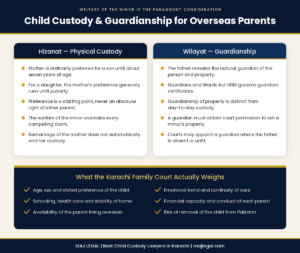
Figure 3 — Hizanat, guardianship and the welfare factors weighed by Karachi Family Courts.
This is the most emotionally charged and legally nuanced area, and the one where overseas parents are most often given wrong information.
Hizanat is not the same as guardianship
Pakistani law separates two concepts:
- Hizanat — the right of physical custody and day-to-day care, ordinarily vested first in the mother;
- Wilayat — legal guardianship of the person and property, ordinarily vested in the father as natural guardian.
A mother can hold custody while the father remains guardian. The two do not cancel each other out.
The presumptions — and their limits
Under Hanafi principles applied in Pakistan, the mother is ordinarily preferred for a son until about seven years and for a daughter until puberty. But this is a starting presumption, not a rule of entitlement. It yields to the welfare of the minor, which is the paramount and overriding consideration under both the Guardians and Wards Act, 1890 and settled case law.
Courts weigh: the age and sex of the child; the child’s own intelligent preference where old enough to form one; continuity of schooling and health care; the emotional bond and history of actual caregiving; stability of the proposed home; the character and conduct of each parent; the availability of the overseas parent to actually parent rather than merely to fund; and the risk of the child being removed from Pakistan.
The overseas parent’s real difficulty
An overseas parent seeking custody faces one recurring judicial concern: if custody is granted, the child leaves the jurisdiction and the Pakistani court loses all control. Courts are cautious for this reason. Overseas applicants improve their position substantially by offering:
- undertakings not to remove the child from Pakistan without leave of court;
- security or a bond;
- a mirror order or undertaking in the country of residence;
- concrete, funded arrangements for the other parent’s contact;
- evidence of settled accommodation, schooling and immigration status abroad.
Visitation for a parent who lives overseas
Where custody is not realistic, the more achievable and often more valuable relief is a structured visitation and contact order. Family Courts in Karachi routinely grant:
- fixed monthly or fortnightly meetings at a designated court or a neutral venue;
- extended blocks of contact during the overseas parent’s visits to Pakistan and during school holidays;
- regular video and telephone contact on a defined schedule — increasingly ordered as a matter of course for overseas parents;
- overnight and travel contact within Pakistan, where the court is satisfied there is no flight risk.
Consistent, documented contact is also the single best foundation for any future custody application.
Where a child has been removed to Karachi
If a child has been brought to Karachi without consent, several routes exist in parallel:
- a guardianship/custody application under the Guardians and Wards Act, 1890 before the Family Court;
- a habeas corpus petition under section 491 of the Code of Criminal Procedure, 1898 before the High Court or the Sessions Court, where the detention of the minor is illegal or improper — this is a summary remedy and is appropriate where speed is critical;
- an application to restrain removal of the child from Pakistan, including a request that the passport be deposited with the court and, in appropriate cases, placement on the Exit Control List.
A critical point: Pakistan is not a party to the Hague Convention on the Civil Aspects of International Child Abduction. A return order made in London, Toronto or Sydney is not automatically enforceable in Karachi. Pakistan and the United Kingdom operate a judicial protocol on child abduction under which the courts of each country give serious consideration to the other’s orders, but it is a protocol of comity — not a mechanism of automatic enforcement. Any parent in this situation needs Pakistani proceedings commenced on the ground, promptly, in parallel with anything happening abroad.
Guardian certificates
Where a minor in Karachi has inherited property — a common situation when an overseas father dies — a guardian certificate under the Guardians and Wards Act, 1890 is required before that property can be dealt with. The guardian must obtain the court’s permission before selling, mortgaging or otherwise transferring a minor’s immovable property; a transaction made without leave is voidable. For diaspora families holding inherited property in Karachi, this is one of the most common and most avoidable sources of later title disputes.
Recognition of Foreign Divorces and Decrees in Pakistan
A recurring question: “I divorced in Dubai / Toronto / Birmingham. Is it valid in Pakistan?”
The answer is nuanced.
- A talaq pronounced abroad by a Pakistani Muslim husband remains subject to section 7 of the 1961 Ordinance. Pronouncement abroad, without notice to the Union Council, does not produce a divorce fully effective for Pakistani purposes — including for NADRA registration and for the wife’s ability to remarry under Pakistani law without dispute.
- A foreign court’s civil divorce decree may be recognised as a matter of private international law and comity, but recognition is not automatic. Section 13 of the Code of Civil Procedure, 1908 sets out when a foreign judgment is conclusive and when it is not — for example, where it was not pronounced by a court of competent jurisdiction, was not on the merits, or was obtained by fraud.
- The practical solution in nearly all cases is to regularise the position in Pakistan: give the section 7 notice, obtain the Union Council effectiveness certificate, and secure the NADRA divorce certificate. This is far cheaper and faster than litigating recognition later.
The same logic applies to foreign maintenance and custody orders. There is no reciprocal enforcement treaty covering most of these. A foreign order is powerful evidence before a Karachi Family Court, and courts give it real weight, but the enforceable order must be a Pakistani one.
The Court Process and Realistic Timelines
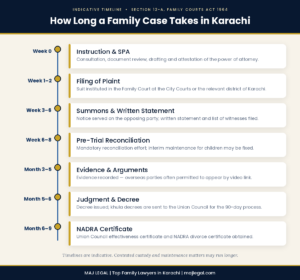
Figure 4 — Indicative timeline for an overseas Pakistani family case in Karachi.
Section 12-A of the Family Courts Act, 1964 requires a Family Court to dispose of a case within six months of institution. In practice, straightforward khula and maintenance suits in Karachi often do conclude within four to eight months. Contested custody, guardianship and dowry matters take longer.
The sequence is:
- Institution of the plaint in the Family Court having jurisdiction, with the SPA and supporting documents.
- Summons and notice on the defendant. Where the defendant is abroad, service may be effected through registered post, courier, publication in a newspaper, or by other modes the court directs. Proper service on an overseas defendant is a technical exercise and defective service is a standard ground of appeal.
- Written statement with a list of witnesses and a précis of their evidence.
- Pre-trial reconciliation — mandatory. Interim maintenance under section 17-A is commonly fixed at this stage.
- Framing of issues, evidence and cross-examination.
- Arguments and judgment, followed by the decree.
- Union Council process and NADRA registration in dissolution matters.
- Execution proceedings where the decree is not satisfied voluntarily.
An appeal lies under section 14 of the Act, generally within thirty days, to the District Court or — depending on the nature and value of the matter — to the High Court of Sindh. Note that decrees for dissolution of marriage other than khula are, in defined circumstances, made final and non-appealable, which is a point of genuine tactical significance.
Appearing without travelling
Overseas parties are not necessarily required to attend in person:
- Section 15 of the Family Courts Act, 1964 read with section 133 of the Code of Civil Procedure, 1908 exempts certain persons from personal appearance, and gives the court a discretion to excuse attendance where it cannot be procured without unreasonable delay, expense or inconvenience — a description that fits most overseas litigants precisely.
- Section 21 permits appearance through a duly authorised agent.
- Commission for recording evidence may be issued so that evidence is recorded at a convenient location.
- Video-link evidence has become an established feature of Sindh’s district judiciary since 2020, and Karachi Family Courts now routinely permit overseas parties and witnesses to depose by video link on application. This should be applied for early, not on the date of evidence.
There remain moments where the court may wish to see a party — particularly in khula, where the judge may want to satisfy himself directly on reconciliation, and in custody, where the child’s interaction with a parent may need observation. A realistic advocate will tell you in advance if your matter is likely to be one of them.
What Overseas Clients Get Wrong — and What It Costs
- Ignoring summons. Distance is not a defence. An ex parte decree passed in Karachi is fully valid and can be executed against your Pakistani assets. Setting it aside is far harder than defending in the first place.
- Using an unregistered “agent” rather than an advocate. Only an advocate can conduct proceedings. Relatives acting under an SPA are attorneys, not counsel.
- A defective or over-broad power of attorney. The commonest single cause of procedural failure in overseas files.
- Stopping at the decree. Without the Union Council effectiveness certificate and the NADRA divorce certificate, the divorce will not be accepted by foreign immigration authorities or by a nikah registrar.
- Manufacturing jurisdiction. A short visit does not create ordinary residence. The decree can be set aside years later.
- Serving the section 7 notice on the wrong Union Council. No notice, no effective talaq.
- Assuming a foreign order enforces itself. It does not. Parallel Pakistani proceedings are almost always necessary.
- Delay in child cases. Every month a child spends settled with one parent strengthens that parent’s position on the welfare test. In child matters, speed is substantive, not merely procedural.
Why Overseas Pakistanis Instruct MAJ Legal
MAJ Legal is a family and property law firm based in Karachi with a dedicated overseas Pakistani practice. We act for clients across the United Arab Emirates, Saudi Arabia, Qatar, Oman, Bahrain, the United Kingdom, the United States, Canada, Australia, Malaysia and across the European Union.
What that means in practice:
- You do not need to travel. We draft the SPA, guide the attestation or Apostille route step by step, and conduct the case end-to-end from Karachi.
- Communication across time zones. Scheduled video consultations at hours that work in your country, and written updates after every hearing rather than only when something goes wrong.
- Complete file handling. Not just the decree — the Union Council process, the effectiveness certificate, the NADRA certificate, certified copies and, where required, attestation for use abroad.
- Candid advice on enforcement. We tell clients at the outset what a Pakistani decree can and cannot achieve against assets or persons outside Pakistan.
- Both sides of the case. We appear for wives seeking khula, maintenance and custody, and for husbands defending exaggerated claims or seeking contact with children they are being kept from.
If you are searching for the best family law firm in Karachi for overseas Pakistanis, the criteria that actually matter are: does the firm handle the jurisdictional analysis properly, does it carry the file through to NADRA, and does it tell you the truth about enforcement? Those are fair questions to ask us, and fair questions to ask anyone else you are considering.
Contact MAJ Legal for a confidential consultation on your family matter in Karachi — wherever in the world you are reading this from.
Frequently Asked Questions
- Can I get a khula in Karachi without travelling to Pakistan?
In most cases, yes. A properly drafted and attested Special Power of Attorney allows your advocate and appointed attorney to file and conduct the suit. Karachi Family Courts also permit video-link appearance for overseas parties in appropriate cases. Occasionally a judge will wish to see the wife personally on the reconciliation question, and your lawyer should flag that possibility at the outset.
- How long does a family case take in Karachi for an overseas Pakistani?
Section 12-A of the Family Courts Act, 1964 sets a six-month target. Uncontested khula and maintenance suits commonly conclude in four to eight months. Contested custody, guardianship and dowry recovery matters generally take longer, and the Union Council’s ninety-day process runs after the decree in dissolution cases.
- Does my husband’s consent matter for khula?
No. A Family Court may decree khula without the husband’s consent where it is satisfied the parties cannot live together within the limits prescribed by Allah. The wife will ordinarily be required to relinquish her dower as consideration.
- I pronounced talaq in Dubai. Is my divorce valid in Pakistan?
Not by itself. Section 7 of the Muslim Family Laws Ordinance, 1961 requires written notice to the Chairman of the relevant Union Council and a copy to the wife. The talaq becomes effective ninety days after the Chairman receives that notice. Without this step, the divorce is not fully effective for Pakistani purposes, including NADRA registration.
- Is a Special Power of Attorney executed in the UK, USA or Canada valid in Pakistan?
Yes, if correctly executed and authenticated. Since 9 March 2023, Pakistan accepts Apostille certificates from Hague Convention contracting states without further attestation. Alternatively, the document may be executed before a Pakistan Embassy, High Commission or Consulate and counter-attested by the Ministry of Foreign Affairs.
- Can a Karachi Family Court order maintenance against a father living abroad?
Yes. The court has jurisdiction to pass the decree, and interim maintenance under section 17-A is commonly fixed early. Enforcement, however, operates against assets and persons within Pakistan — typically through attachment of property, bank accounts or rental income, or recovery as arrears of land revenue.
- My child was taken to Karachi without my consent. What can I do?
Move quickly and on two tracks: a custody or guardianship application before the Family Court under the Guardians and Wards Act, 1890, and, where the detention is illegal or improper, a habeas corpus petition under section 491 of the Code of Criminal Procedure, 1898. You should also apply to restrain further removal of the child from Pakistan. Pakistan is not a party to the Hague Abduction Convention, so a foreign return order is persuasive evidence but is not automatically enforceable.
- Do Karachi courts allow evidence by video link?
Yes, increasingly. Video-link evidence has become established in Sindh’s district judiciary and Karachi Family Courts routinely permit overseas parties and witnesses to depose remotely on a properly made application. The application should be filed early rather than on the date fixed for evidence.
- Will my khula decree be accepted by the UAE, UK or Canadian authorities?
Foreign authorities almost always ask for the NADRA divorce certificate rather than the court decree alone. That means completing the Union Council process, obtaining the effectiveness certificate, then applying to NADRA — and, for use abroad, having the certificate attested or apostilled.
- Which Family Court in Karachi will hear my case?
It depends on Rule 6 of the West Pakistan Family Courts Rules, 1965 — where the cause of action arose, where the parties last resided together, and, in dissolution and dower suits, where the wife ordinarily resides. Matters are filed in the Family Courts at the City Courts complex or in the relevant district court of Karachi East, West, South, Central, Korangi, Malir or Keamari.
- What documents do I need to send from abroad?
Typically: the nikahnama, CNIC/NICOP and passport copies, children’s birth certificates or B-Forms, the dowry list if any, evidence of the marriage’s registration, correspondence and remittance records relevant to maintenance, and the executed and attested Special Power of Attorney. Scanned copies suffice to begin; originals or attested copies follow.
- Can I file for restitution of conjugal rights or jactitation of marriage from overseas?
Yes. Both fall within the Family Court’s jurisdiction under the schedule to the Family Courts Act, 1964, and both may be conducted through an attorney under a Special Power of Attorney. Restitution suits are frequently filed defensively in response to a maintenance claim, and courts scrutinise the bona fides of such suits closely.
This article is provided for general information about the law in Pakistan and does not constitute legal advice on any specific matter. Family law outcomes turn closely on individual facts. For advice on your situation, please contact a qualified advocate. MAJ Legal — Advocates & Legal Consultants, Karachi.